South-South Ideas Papers Launch: “Institutionalization and impact assessment of South-South and Triangular Cooperation (SSTC): Key findings and recommendations from Southern think-tanks”
When: 13 September 2021, 9:00 – 10:30 AM (EST)
How to Join: to join this event, please click here.
Introduction
Over the last 40 years, South-South and Triangular Cooperation (SSTC) has increased in relevance as a key modality of international cooperation for sustainable development. There has been a shift in the way of implementing SSTC, moving from ad-hoc or one-time activities to a growing interest to formalize it and incorporate it into national and regional programmes, development strategies and frameworks.
The BAPA +40 Outcome Document acknowledges the increasing institutionalization in SSTC and its incorporation into policymaking by some countries and regions and recognizes the importance of building the “institutional capacity needed to formulate and implement national development policies, strategies and programmes for South-South and triangular cooperation” to implement Agenda 2030. The importance of SSTC institutionalization has been further recognized by the 20th Session of the High-Level Committee on South-South Cooperation (HLC SSC), concluded successfully on June 4, 2021. HLC SSC has reaffirmed the need to strengthen the national and international institutional arrangements for resourcing and implementing SSTC, and better integrate SSTC into a global development eco-system.
The evolution of SSTC – which has become more inclusive, multi-directional, with much wider actors, instruments and modalities, has significant implications to the institutional capacity for managing SSTC. Developing countries are facing a dichotomy between the increasing importance of SSTC in their national economies and the lack of long-term vision and medium and short-term policies to coordinate and guide SSTC at the national level. Only a handful of countries have national strategies on SSTC, while elements of the SSTC institutional framework can be traced in national development plans, trade and investment agreements, regional agreements, etc. However, since such elements are in most cases scattered across different institutional arrangements without an explicit, elaborate and holistic manner, it is difficult to take them as a comprehensive guide for action-oriented follow-up and to harness the full potential of SSTC. Southern countries encounter the challenge of coordinating, managing, monitoring and evaluating development assistance programmes, often in complex multi-stakeholder arrangements across several jurisdictions.
Strengthening institutional arrangements can provide a measure of stability and reliability to efforts that have otherwise relied on ad hoc mechanisms and approaches. To this end, the Global South has recognized the need to reinforce institutional arrangements of SSTC and to collaborate with different multi-stakeholders to accelerate SSTC institutionalization. For example, some emerging economies are strengthening their institutional schemes through developing legal regulations and strategies and establishing a results framework for the SSC programme. Others are looking to streamline their institutional arrangements and capacity to better coordinate and benefit from the diversified options and modalities of cooperation offered by SSTC partners. In relatively short periods, countries that have successfully included SSTC in their national cooperation strategies have evolved their level of engagement to go from activities to projects and from projects to medium and long-term programs.
Additionally, the issue of impact assessments, monitoring and evaluation of SSTC initiatives has gained growing importance as can be seen from the inclusion of this issue in policies guidance on SSC, including more recently the BAPA+40 outcome document, and the resolution of the 20th HLC on SSC.
The BAPA+40 outcome document references the need to better understand the role and impact of SSTC to successfully implement the 2030 Agenda for Sustainable Development and regional development frameworks. It also encourages developing countries to develop country-led systems to evaluate and assess the quality and impact of SSTC programmes and improve data collection at the national level to promote cooperation in the development of methodologies.
The demand for reliable data and comprehensive evaluation frameworks to facilitate evidence-based decision making and policy planning in the context of SSTC have come from a wide range of stakeholders including the Member States and non-state actors, including during the 20th Session of the High-Level Committee on South-South Cooperation. In particular, Southern countries have stressed the need to focus on the development, testing and application of monitoring and evaluation frameworks that are specifically tailored and in alignment with the principles of SSTC. This, however, remains a major gap.
This does not suggest problems intrinsic to this modality of cooperation but, rather, possible shortfalls in design, delivery, management and M&E. Thus, the developmental value of SSTC – including their ability to secure and help sustain a flow of benefits overtime to Southern countries especially to excluded and marginalized populations – will require greater attention to these issues.
Conceptual gaps still exist in the assessment and reporting practices of the impact of SSTC for sustainable development. Moreover, national reporting mechanisms use different approaches and methodologies, making it difficult to draw cross-country comparisons.
To better understand and address the above-mentioned gaps, it is important that research and analysis are done. Think tanks, research institutes and academia globally, and especially from the Global South, are well-positioned to address these needs and gaps. They can provide thought leadership on SSTC for sustainable development and inform policies and practices to support the implementation of the SDGs. The BAPA+40 Conference and the 20th HLC on SSC recognized the contribution of think tanks and research institutions in the improvement of SSTC practices and called on the United Nations entities to continue their engagement and support to these organizations to further strengthen the impact of SSC and TrC.
Background and Objectives
Against the above-mentioned backdrop, the United Nations Office for South-South Cooperation (UNOSSC) and the United Nations Development Programme (UNDP) have jointly been supporting Southern think tanks, as well as northern-based think tanks, in the production of frontier research on SSTC through the South-South Global Thinkers initiative – A Global Coalition of Think Tank Networks for South-South Cooperation (SSC). The objective of the initiative is to contribute to the growing body of evidence and knowledge on issues pertinent to SSTC, to inform policy dialogues and advance thought leadership.
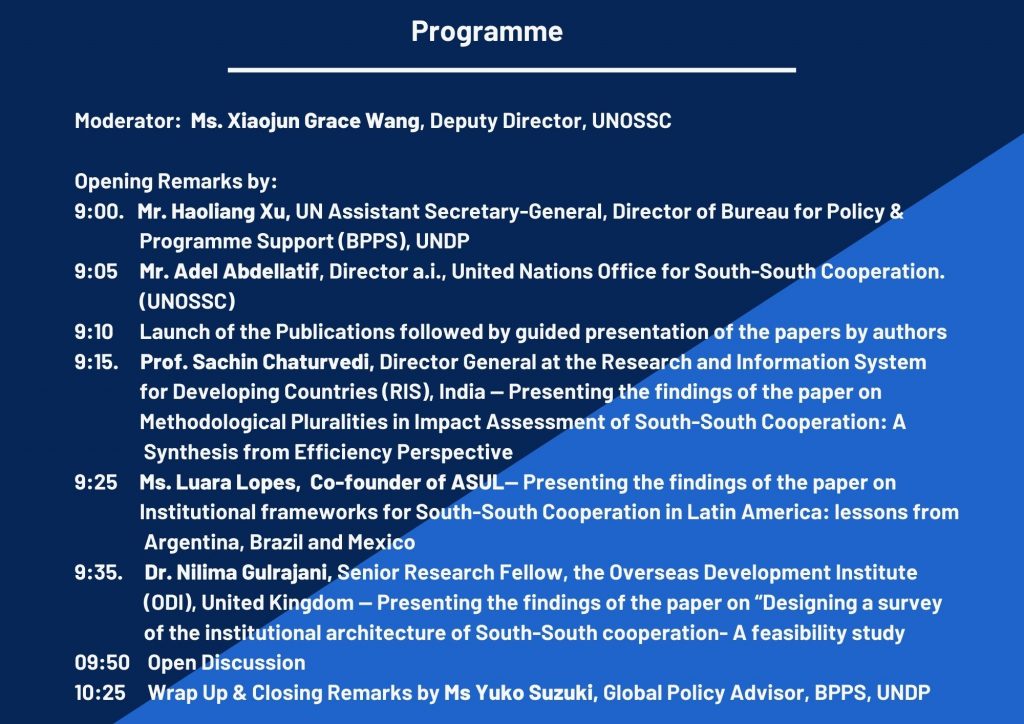
In 2020, the supporting research papers gave particular consideration to topics related to SSTC’s institutionalization, and impact assessment of SSTC. This event will launch and present the findings of three commissioned research papers “South-South Ideas” developed by members of the South-South Global Thinkers titled:
Methodological Pluralities in Impact Assessment of South-South Cooperation: A Synthesis from Efficiency Perspective”
“Institutional frameworks for South-South Cooperation in Latin America: lessons from Argentina, Brazil and Mexico”
Designing a survey of the institutional architecture of South-South cooperation- A feasibility study.
Taking the opportunity, two additional relevant research papers will be introduced for launching via social media following the event.
“Advancing Alternative Development Paradigms: A case study of the Indian Technical and Economic Cooperation Programme”
The role of institutional arrangements for South-South Cooperation: Experiences from Ecuador and Sri Lanka”.
The objective of this event is to learn from the key findings and recommendations from the Southern think tanks on the institutionalization of SSTC and the impact assessment of SSC. The event will also be an opportunity to exchange views and perspectives on the challenges, experiences and opportunities of the two topics to advance sustainable development.
The research publications will also be available on the South-South Global Thinkers Platform- an online platform to facilitates the sharing of knowledge, expertise, and perspectives from the Global South to inform policy dialogues, as well as in the South-South Galaxy.
Audience:
The publications presented at the side event are expected to inspire SSTC practitioners and policymakers from governments, regional or international institutions, UN entities, academia, think tanks, private sector and entrepreneurs, civil society and non-governmental organizations, etc. to learn about existing institutional arrangements in the Global South to better manage, implement and assess SSTC.
Programme:
Concept Note:
Click here to download the concept note.