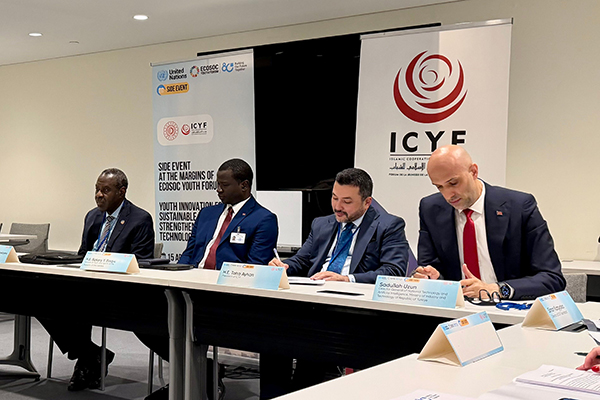
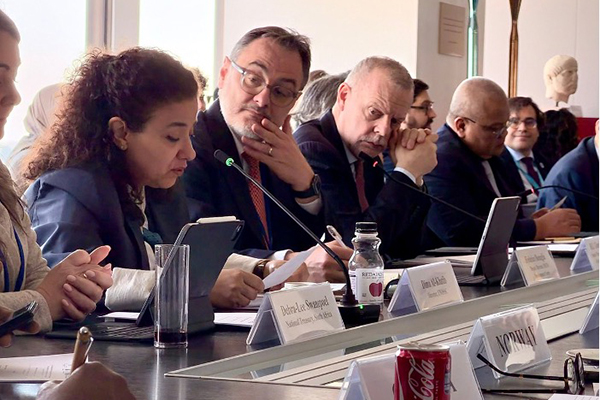
New York, 21 May 2018 – The United Nations Office for South-South Cooperation hosted the event “South-South Climate Cooperation in Support of the SDGs” at the 6th Biennial High-Level Meeting of the Development Cooperation Forum 2018. Held in New York, this event convened member states, international organizations, specialized agencies and inter-governmental agencies to strengthen partnership, promote cooperation and coordination on South-South cooperation on sustainable development and climate change and facilitate exchanges among the member states.
The event introduced the stakeholders’ efforts in promoting South-South climate cooperation for the Sustainable Development Goals and in advancing interchange of experiences and lessons learned among the member states and international organizations.
Mr. Jorge Chediek, Envoy of the Secretary-General on South-South Cooperation, Director, UNOSSC, emphasized further commitments, beyond the Paris Agreement, are needed to keep planetary boundaries within acceptable limits. And in this context, SSC could be a critical tool. In fact, 15 Nationally Determined Contributions (NDCs) acknowledge SSC as an important tool in providing and in receiving climate cooperation, including among countries that confront similar or equivalent challenges. Mr. Chediek briefly mentioned the recently adopted United Nations Action Plan on South-South Climate Cooperation (2017-2021). He also mentioned the recently launched QIAO Plan on climate cooperation under the aforementioned Action Plan, with the support of a philanthropic organization in China, to provide seed resources to SSC projects on climate change. He further emphasized that the volume of resources of SSC is secondary to the wisdom, knowledge of capacity that is transferred/exchanged among parties. He then welcomed the prominent participants of the event to deliver their statements and to kindly provide recommendations and to contribute to the High-Level Conference on SSC, to be held in March 2019, to discuss how SSC can help implement 2030 Agenda, to which the UNOSSC is a secretariat for the preparatory process.
Dr. Shamshad Akhtar, Under-Secretary-General and Executive Secretary of UN ESCAP, emphasizing the role of regional commissions, with its distinct intergovernmental mandates, in promoting an inclusive regional South-South cooperation regime, noted that the future of SSC depends on how effectively the SSC platforms are structured in future, in addition to SSC finance and transfer of knowledge. Dr. Akhtar pointed out that China, India and Japan have progressively institutionalized SSC platforms offering support to enhance climate actions and it’s financing. In 2016, China established a training and knowledge platform based on successful stories, in terms of real investment and legal and regulatory changes that are being enforced at the provincial, state and urban level. China also hosted sustainable center for agriculture mechanization to enhance the region’s agricultural system and food security against intensifying impacts of climate change. India has hosted longstanding Asia-Pacific center for technology transfer. This center has been working to transfer green technologies through SSC. Given that Asia-Pacific region has large proportions of front-line states, bearing the impact of climate change, the region has developed action plans for disaster risk resilience, and climate adaptation, drawing lessons from decades of experiences, strategies, tools and instruments. However, delivery platforms for SSC on climate change are built on ad hoc basis and much more needs to be done, including financing needs to transfer technology and knowledge. Emphasizing how Clean Development Mechanism (CMD) Under Kyoto Protocol has been instrumental, she further pointed out that Asia-Pacific has 6400 registered CDM projects, 85 percent of which are hosted in China and India and others countries such as like Indonesia, Thailand, Malaysia and Vietnam. The evolving know-how on mitigation, technologies and methodologies has supported measurement on Green House Gas (GHG) emissions production across different sectors. Noting that SSC can undoubtedly complement other endeavors, enhance mutual learning, experience sharing and effective resource mobilization, Dr. Akhtar pointed that SSC should not replace multilateral efforts to tackle climate change for three reasons— to ensure that the actions on the ground add up to collective ambition of the global community to limit the global temperature rise to safe levels; to seek equitable solutions for finance and technology based on the norm of common but differentiated responsibility; and to harmonize measurement, reporting and verification in order to increase transparency, build trust, and lay the ground for carbon trade to offer countries a cost-effective solution to lowering their emissions.
Echoing the vital role of finance in promoting sustainable development, H.E. Ambassador Dr. Ali Naseer Mohamed, Chair of AOSIS, the Maldives, highlighted that the global South is increasingly becoming a source of knowledge, expertise and resources. He noted the contributions of Southern countries, including China, India and Thailand in supporting the Maldives reduce the impacts climatic disasters and enhance its ability to adapt to climate change. Given that the Maldives consists of 1200 Islands and is susceptible to sea-level rises, the government prioritizes building infrastructure to connect the Islands in order to reduce population pressure and to enhance service delivery system to its peoples. In this context, Mohamed highlighted two megaprojects of worth USD2 Billion— one related to the construction of a bridge that would connect the Island’s airport to the capital of Maldives, Malé, funded by China and the other related to the expansion of the airport, funded by a consortium of financiers from the Middle-East. Underlining the challenges to achieving economies of scale, as per unit of investment is expensive in a small country, he concluded that South-South cooperation could play a vital role in achieving economies of scale by harmonizing the sustainable development efforts.
In efforts to address climate change, H.E. Ambassador Agustín García López, Executive Director of the Mexican Agency for International Cooperation, Mexico pointed out that Mexico is leading the carbon pricing cooperation platform in the Americas to exchange information on market-based instruments and to develop knowledge product on climate mitigation and adaptation strategies. Considering high level of risk and vulnerabilities brought about by extreme weather events to small island developing states and particularly to the Pacific and the Caribbean, Mexico is developing and implementing a comprehensive strategy that includes the Multi-Stakeholder Adaptation and Resilience Caribbean Initiative (MARCI) to strengthen the capabilities of Caribbean countries; comprehensive disaster risk management in preparedness, prevention and early warning emergency resources, reconstruction and climate resilient transformation for structural and climate resilient construction regulations and agriculture and agroforestry systems and ecosystem services; Mexico and FAO collaboration for resilience and adaptation to climate change of the rural systems of the Caribbean. Through these initiatives, López stressed how technical cooperation could play a vital role in promoting climate adaptation and mitigation actions and in accessing funds.
Stressing on the impacts of climate change and its hindrance in the achievement of the Sustainable Development Goals in the least developed countries (LDCs) and small island developing states (SIDS), H.E. Ambassador Masud Bin Momen, Bangladesh pointed out the urgent need to implement climate mitigation and adaptation plans by sharing best practices and low-cost solutions among the countries in the global south. Momen specified the initiatives led by the government of Bangladesh in efforts to combat climate change that includes- Bangladesh climate change trust fund (USD 400 million allocated from the domestic resources); inclusion of NDCs in the National Development Plans; state-of-the-art warning system for floods, cyclones and storms and community-based disaster preparedness; and a strong legal regime for the enforcement of and compliance with environmental standards.
H.E. Ambassador Mahmadamin Mahmadaminov, Tajikistan portrayed how climate change is affecting Tajikistan and underscored the importance of climate partnerships. The government of Tajikistan is working with international partners such as the World Bank, ADB, and Aga Khan Development Network to strengthen resilient infrastructure in efforts to combat climate change. Some of the country initiatives Mahmadaminov mentioned include modernization of hydropower stations and enhanced integration of international practice in the field of foresting, assessment and risk management. Calling the international community for enhanced climate partnership, Mahmadaminov announced that the High-level Conference for Implementation on International Decade for Action: Water for Sustainable Development will be held in June 2018 to discuss the importance of specific means of implementation including monetary, financial and capacity development, access to technology and partnership with the private sector and civil society.
Director General of Information and Public Diplomacy, Ministry of Foreign Affairs of the Republic of Indonesia highlighted that Indonesia has adopted a comprehensive plan and an ocean-based climate change strategies to enhance climate resilience. Indonesia launched a national registry system to advance mitigation and adaptation efforts and established a wetland restoration programme in order to restore two million hectares of wetland in five years. Emphasizing the increased role of Indonesia as SSC provider, it was highlighted that countries should continue increasing SSC activities aimed at capacity-building, knowledge sharing and transfer of technology.
Professor Francisco Sagasti, Senior Researcher Emeritus and Former Executive Director of FORO Nacional/Internacional, Graduate School of the Universidad del Pacifico accentuated the existing science and technological inequality and encouraged the international community to build a dedicated facility to support science and technological collaboration among Southern countries.
Highlighting the development challenges related to climate change like dependence on traditional means of energy and agriculture, limited water for production, and increasing demand for energy and resources as a result of increasing refugees from the neighboring countries, Mr. Rauben Byereta, Counsellor, Uganda called for more South-South climate cooperation activities to convert existing solutions of climate change into practical climate actions.
Ms. Ama Brandford-Arthur, Senior Technical Specialist, Global Engagement, Knowledge and Strategy Division, IFAD stressed the importance of South-South technology coordination for the achievement of the SDGs. Brandford-Arthur outlined two of the IFAD’s strategic partnerships— first is the bilateral funding facility with China targeted at mobilizing knowledge, expertise and resources, particularly for agriculture and rural development to support smallholders and rural people, and the second is outlined in the Brazilian Declaration Action Agenda targeted to mobilize expertise particularly from Brazil towards African countries to support the various initiatives to support knowledge sharing and management.
Ms. Yuxin Ai, Programme Management Officer, UN-OHRLLS highlighted the efforts led by UN-OHRLLS to promote sustainable energy in the least developed countries (LDCs). In addition, Ms. Sameera Savarala, Climate Change Analyst, Climate Change and Disaster Risk Reduction Unit, BPPS, UNDP underscored the work of UNDP in supporting countries align their NDCs with the SDGs and in leveraging public and private financing to realize these goals.
Furthermore, Mr. Manuel Montes, Senior Advisor, Finance and Development, South Centre emphasized the vital role of South-South cooperation in the areas of technical cooperation for knowledge creation and knowledge sharing, institution building, infrastructure development, and financing. Also, China iterated its commitment to South-South cooperation, as a complement to North-South cooperation. And finally, Thailand encouraged the international community to expand the South-south climate cooperation in other areas of sustainable development that are closely linked to climate change such as energy, water, agriculture, health, nutrition and biodiversity.
The event was widely attended by member states, international and intergovernmental organizations, civil society groups, and researchers as well.
***
Media contact
Ms. Ajita Singh (ajita.singh@undp.org), Analyst, Climate and Sustainability Programme, UNOSSC
Mr. Mithre Sandrasagra (mithre.sandrasagra@undp.org), Strategic Communications Advisor, UNOSSC