• Home
  • /
  • News
  • /
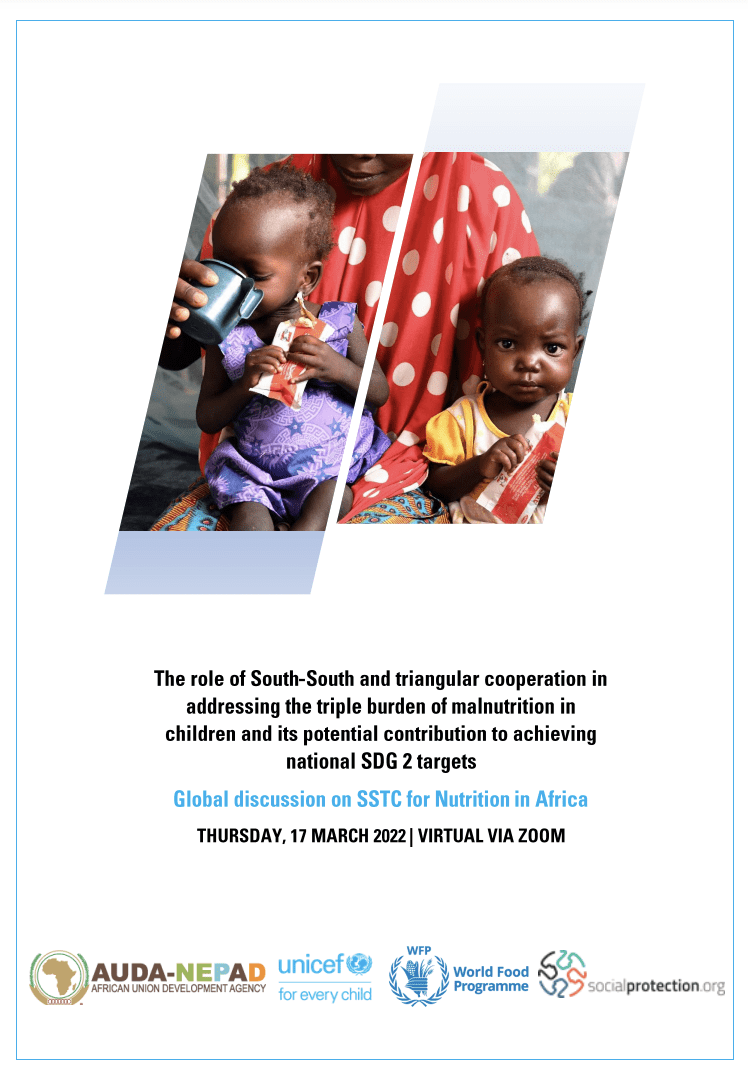
  • Webinar Report: The Role of South-South and Triangular Cooperation in Addressing the Triple Burden of Malnutrition in Children and its Potential Contribution to Achieving National SDG 2 Targets

Webinar Report: The Role of South-South and Triangular Cooperation in Addressing the Triple Burden of Malnutrition in Children and its Potential Contribution to Achieving National SDG 2 Targets


According to the global nutrition report 2020 published by UNICEF, almost a quarter of all children under 5 years of age are stunted. At the same time, overweight and obesity are increasing rapidly in nearly every country in the world. Glaring inequalities are reported as amongst the root causes. Underweight is a persisting issue for the poorest countries and can be ten times higher than in wealthier countries while overweight and obesity prevail in wealthier countries at rates of up to five times higher than in poorer countries.

There are approximately 516.5 million malnourished individuals living in the Asia and Pacific region and about 239 million malnourished living in Sub-Saharan Africa. Malnourished children risk losing 10 percent of their earning potential over the life course while estimates also suggest that, due to child undernutrition, African countries are losing the equivalent of between 1.9 and 16.5 percent of their GDP1. Globally, there are 821.6 million people that are considered undernourished or starving.2 Around 45 percent of deaths among children under 5 years of age are linked to undernutrition.
Download PDF

Covid-19 exacerbated the already fragile situation of global nutrition especially for poor and vulnerable families, exposing the vulnerability and weaknesses of already fragile food systems. Accessibility and affordability of healthy, sustainably produced food become even more challenging. Access to staple food distribution and local food markets becomes at risk and millions of households in formerly food-secure regions of the world have fallen into severe food insecurity. In battling the pandemic, governments are driven to reduce social services such as family allowances and school nutrition programmes that are a lifeline for vulnerable populations. The virus’ impact on the economy caused food and nutrition shortages, again unevenly impacting different groups of the population.

In building back better, governments take measures to ensure that there is enough nutritious food, distributed fairly, to cover basic nutrition needs – especially for the most vulnerable. This is reflected in the African Union’s declaration of 2022 as the year of nutrition with the theme of “Building resilience in nutrition on the African continent: Accelerate the human capital and social-economic development”. Moreover, the African Union and AUDA-NEPAD have in place the African Regional Nutrition Strategy (ARNS) which was initially developed to guide member states on nutrition policies and programs over a period of 10 years from 1993 – 2004; 2005- 2015 and 2015-2025. The ARNS 2015-2025 calls on all AU Member States to put together multi-sectoral nutrition action plans, budgets and expenditure tracking systems for effective implementation and monitoring of nutrition interventions.

UNICEF and WFP call for better food systems for nutritious diets, better integration of nutrition services in health care systems, better financing, and better data. The world needs a more equitable, sustainable nutritious, efficient and inclusive food systems everywhere, as the UN Food Systems Summit strongly advocated for launching a global coalition to support national food system transformation pathways. Similarly, Africa Common Position4 which was led by AUDA-NEPAD on UN Food Systems provides a synthesis of member states’ expressed views, perspectives and priorities as well as ambitions on key issues shaping Africa’s and the global food systems.

Click here to access the report on the AUDA-NEPAD website.
Connect with UNOSSC

Stay updated with the latest trends in South-South cooperation and access our vast repository of knowledge.

Copyright © UNOSSC/UNDP

Alliance Application Form

Submit an Expression of Interest and/or Demand Signal. UNOSSC reviews submissions on a rolling basis.

1. Official name of organization / institution / government entity (exclusions to apply) *
Organization logo
Maximum file size: 20 MB
2. Country *
3. Region *
4. SDG *
5. Partner category *
6. Website *
7. Brief description of your institution (max. 150 words) *
Name for the Lead *
Title for the Lead *
Email address for the Lead *
Name for the co-lead
Title for the co-lead
Email address for the co-lead
Section 3. Expression of Interest in the Alliance *
Additional information on proposed areas of engagement may be requested through the platform following initial review by the Alliance Secretariat.
Section 4. Due Diligence and Integrity Declaration *

Submission Note:

  • Submission of this Expression of Interest form does not automatically confer participation in the Alliance.
  • All submissions will be reviewed by the Alliance Secretariat, including basic eligibility screening and proportionate due diligence, as appropriate.
  • Participation in Alliance activities is determined based on relevance to articulated cooperation needs, alignment with Alliance principles, and integrity considerations.
  • Engagement under the Alliance is voluntary, non-binding, and facilitative in nature, and does not constitute funding approval, contractual commitment, or institutional membership.
  • The Alliance Secretariat may contact submitting entities for additional information or clarification during the review process.

Submission of Demand Form

Description of Demand

Indicate the type of support or cooperation requested through the Alliance.
Please briefly describe the challenge, gap, or priority. (Max. 300 words)

Thematic and Geographic Focus

Please indicate the main focus areas of your demand:

A. Thematic Areas (select up to three)
B. Geographic Focus (select all that apply)

Proposed Engagement Modalities

Please indicate how you would like to engage through the Alliance (select all that apply):

Expected Outcomes

Please indicate the main results you seek to achieve through this engagement. (Max. 200 words)
Examples:
• Capacity strengthened
• Partnerships established
• Sectoral or regional strategies co-developed
• Solutions piloted
• Knowledge generated
• Policies informed

Timeline and Readiness (if applicable)

1. Expected timeframe for engagement:
2. Current stage:

Additional Information

Please provide any additional information, documents, or links relevant to this submission.
(Max. 200 words or upload link)

Submission of Offer Form

Description of Contribution

Indicate the type of contribution your institution can provide and describe the expertise, resources, or solutions you may offer.
Please briefly describe your proposed contribution. (Max. 300 words)

Thematic and Geographic Focus

Please indicate the main focus areas of your interest:

A. Thematic Areas (select up to three)
B. Geographic Focus (select all that apply)

Proposed Engagement Modalities

Please indicate how you would like to engage through the Alliance (select all that apply):

Expected Outcomes

Please indicate the main results you aim to achieve through this engagement. (Max. 200 words)
Examples:
• Capacity strengthened
• Partnerships established
• Sectoral or regional strategies co-developed
• Solutions piloted
• Knowledge generated
• Policies informed

Timeline and Readiness (if applicable)

1. Expected timeframe for engagement:
2. Current stage:

Additional Information

Please provide any additional information, documents, or links relevant to this submission.
(Max. 200 words or upload link)

Organization Registration

Authentication & Due Diligence This prototype simulates identity verification, due diligence confirmation, and an authentication step before submission. *

First Name *
Last Name *
Email address *
Password *
Confirm Password *
Name of institution / organization *
Country / Region *
Organization Type *
Organization other *
Function / role *
Organization logo *
Maximum file size: 1 GB

Login

Login / email *
Password *
Remember me

Forgot password?

Connect form

Your name *
Email *
Organization / institution *
Job title / role *
Reason for connecting:
Short message

Scroll to Top