
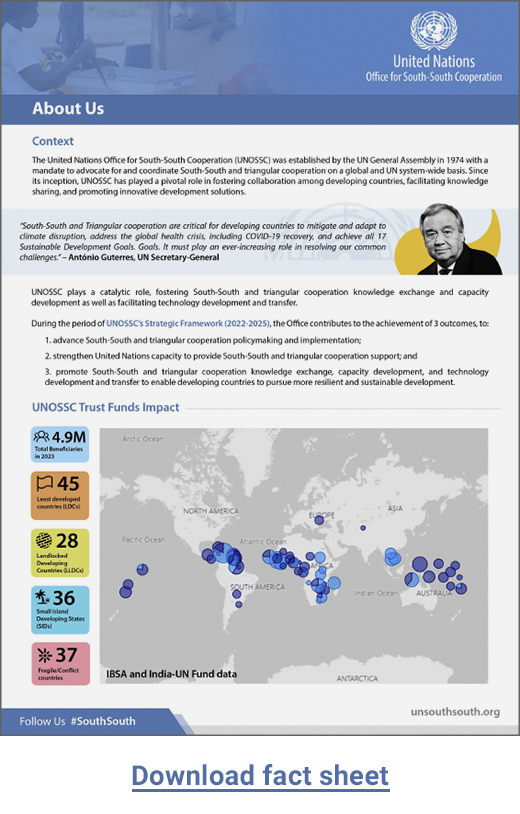
 The United Nations Office for South-South Cooperation (UNOSSC) was established to promote, coordinate and support South-South and triangular cooperation globally and within the United Nations system.
UNOSSC, hosted by UNDP since 1974, was established by the UN General Assembly with a mandate to advocate for and coordinate South-South and triangular cooperation on a global and UN system-wide basis. UNOSSC receives policy directives and guidance from the General Assembly and through its subsidiary body, the High-level Committee on South-South Cooperation. The UNOSSC Strategic Framework is presented every four years to the Executive Board of UNDP/UNFPA/UNOPS.
What We Do
The United Nations Office for South-South Cooperation strategic framework, 2026–2029 aims to strengthen the role of South-South and triangular cooperation as catalytic drivers to accelerate progress on the Sustainable Development Goals. To this end, the Office will focus on three outcomes: (a) a transformed UNOSSC that facilitates enhanced strategic leadership; (b) a functional alliance that catalyses country-owned solutions; and, ultimately, (c) Member States that are better equipped to address critical Sustainable Development Goal gaps by leveraging relevant solutions and innovative finance.
These outcomes will be delivered through UNOSSC’s core catalytic roles, aligned with its global and UN system-wide mandate and comparative advantage: (a) global focal point and impartial convener – providing multilateral platforms that integrate South-South and triangular cooperation into UN system strategies, intergovernmental processes and Sustainable Development Goal frameworks; (b) alliance hub and strategic manager – establishing a voluntary, multi-stakeholder Alliance for South-South and Triangular Cooperation to co-create, adapt and scale country-owned solutions; (c) thought leader, innovation catalyst and knowledge broker – evolving into the leading global knowledge hub and repository for South-South and triangular cooperation, leveraging digital tools and artificial intelligence to transform data into actionable insight; and (d) catalytic finance and resource innovator – mobilizing and facilitating innovative financing mechanisms, including blended finance, triangular cooperation modalities, debt-related solutions and domestic resource mobilization approaches; while ensuring sound management of the United Nations Fund for South-South Cooperation; Pérez-Guerrero Trust Fund for South-South Cooperation (PGTF); India, Brazil and South Africa Facility for Poverty and Hunger Alleviation (IBSA Fund); and India-United Nations Development Partnership Fund to maximize catalytic impact.
Background
In 1974, the United Nations General Assembly, in its resolution 3251 (XXIX), endorsed “the establishment of a special unit within the United Nations Development Programme to promote technical co-operation among developing countries”. With the endorsement of the Buenos Aires Plan of Action (BAPA) for Promoting and Implementing Technical Cooperation among Developing Countries by the General Assembly in 1978 (resolution 33/134), the Special Unit was strengthened in order to fulfil its primary mandate, set forth in BAPA. Its name was then changed to the United Nations Office for South-South Cooperation (UNOSSC) by High-level Committee decision 17/1 of 2 April 2012 and endorsed by the General Assembly in its resolution 67/39.
South-South Cooperation: The Making of a History
- 1949 – The UN Economic and Social Council establishes the first UN technical aid programme.
- 1955 – Newly independent African and Asian States meet in Bandung, Indonesia, and decide to work together at the UN as the Afro-Asian Group.
- 1964 – The idea of economic cooperation among developing countries results in the establishment of the United Nations Conference on Trade and Development (UNCTAD). At the first UNCTAD, Latin American countries join with African and Asian countries to create the Group of 77.
- 1965 – The United Nations Development Programme (UNDP) is created.
- 1972 – The UN General Assembly creates a Working Group on technical cooperation among developing countries (TCDC) that recommends the creation of a special unit for TCDC.
- 1974 – The General Assembly, in its resolution A/3251 (XXIX), endorses “the establishment of a special unit within the United Nations Development Programme to promote technical cooperation among developing countries…with the objective of integrating this activitiy of technical co-operation among developing countries fully within the Programme”.
- 1978 – A conference of the Global South on TCDC is held in Buenos Aires, resulting in the adoption of the Buenos Aires Plan of Action (BAPA) for Promoting and Implementing TCDC. It identifies 15 focal areas for TCDC and stipulates that special attention be paid to the least developed countries, the landlocked developing countries, and the small island developing States.
- 2000 – The Millennium Development Goals (MDGs), based on priorities set out in the UN Millennium Declaration, are adopted by the UN General Assembly (resolution 55/2).
- 2003 – The UN General Assembly, in its resolution 58/220, decides to declare 19 December, the date on which it had endorsed BAPA, as the United Nations Day for South-South Cooperation. The first UN Day for SSC is to be celebrated in 2004.
- 2004 – The Special Unit for TCDC has a new name: the Special Unit for South-South Cooperation (SU/SSC). The new name reflects the increased importance and expanded focus of cooperation among developing countries. The decision to change the name was adopted by the High-level Committee at its thirteenth session in May 2003 (decision 13/2) and endorsed by the General Assembly in its resolution 58/220 of 19 February 2004.
- 2005 – The 2005 Group of Eight (G-8) meeting at Gleneagles, Scotland, underscores the new geography of trade, investment and intellectual relations that involved such fast-track performers as Brazil, China, India, Malaysia, the Republic of Korea, South Africa and Thailand. Flanking the G-8 Heads of Government are the leaders of Brazil, China, India, Mexico and South Africa, a tacit acknowledgement that even with increased Northern commitments of official development assistance (ODA) and enhanced debt cancellation, the Millennium Development Goals cannot be met without increased South-South interactions and assistance.
- 2009 – The High-level UN Conference on South-South Cooperation is held in Nairobi, Kenya. At this conference, participants produce the Nairobi outcome document highlighting the roles that national governments, regional entities and UN agencies are to play in supporting and implementing South-South and triangular cooperation.
- 2013 – The General Assembly in its resolution 67/227 endorses the decision of the 17th session of the High-level Committee, which reaffirmes the mandate of the Special Unit for South-South Cooperation, hosted by UNDP, as a separate entity and coordinator for promoting and facilitating South-South and triangular cooperation on a global and United Nations system-wide basis, and decides to rename the Special Unit for South-South Cooperation the “United Nations Office for South-South Cooperation”.
- 2015 – The 2030 Agenda for Sustainable Development is adopted by the UN General Assembly (resolution 70/1).
- 2016 – The General Assembly, in its resolution A/RES/71/244, decided to convene a high-level United Nations conference on South-South cooperation on the occasion of the fortieth anniversary of the adoption of the Buenos Aires Plan of Action.
- 2019 – The Second High-level United Nations Conference on South-South Cooperation, or BAPA+40, convened in Buenos Aires, Argentina, 20-22 March 2019. At this conference, world leaders adopt the Buenos Aires outcome document urging greater South-South cooperation to achieve sustainable development. Significant changes in international politics and economic relations were cited, which create conditions conducive to promoting South-South cooperation, pursuing sustained economic growth and building national and collective self-reliance.
