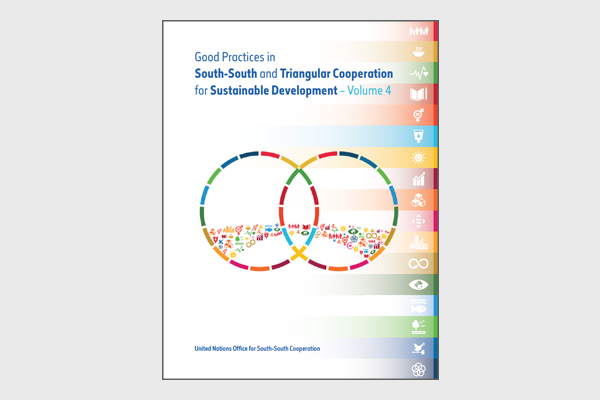
Good Practices in South-South and Triangular Cooperation for Sustainable Development – Vol. 4 (2022)


  Unprecedented challenges have arisen in the first years of the Decade of Action for the delivery of the Sustainable Development Goals (SDGs) by 2030: the Covid-19 pandemic, climate crises and war in the Ukraine are among other hardships threatening progress. In these crucial times, South-South and triangular cooperation can be fundamental for ensuring we continue to move ahead in recovering losses and furthering the global commitment of leaving no one behind. At the core of South-South and triangular cooperation is the understanding that exchanging knowledge, skills, experiences and lessons learned between and among countries of the global South serves as a powerful catalyst for development. These exchanges complement and may even improve traditional North-South cooperation and are a fundamental tool for inclusive global partnerships towards sustainable development. Fulfilling its mandate and the commitments expressed in the BAPA+40 Outcome Document, the United Nations Office for South-South Cooperation works to record, systematize and facilitate access to development knowledge from and for the global South. The Good Practices in South-South and Triangular Cooperation for Sustainable Development publication series is the culmination of that mission and documents the incredible work that is currently happening in the global South. Building on the successes of previous installments, the 4th volume of the Good Practices series further expands the body of knowledge on how development actors are utilizing South-South and triangular cooperation to accelerate progress towards the attainment of all 17 SDGs. This volume documents evidence-based good practices, showcasing over 130 development solutions that have demonstrated cross-boundary cooperation and knowledge transfer between countries of the global South and which are highly adaptable to local economic and social conditions. These cases come from over 50 partners, including Member States, intergovernmental organizations, United Nations entities and other development stakeholders. The good practices herein highlight the spirit of multilateralism and camaraderie that characterizes South-South and triangular cooperation. An amazing array of sectors and countries are represented in this volume. From a training centre in Indonesia partnering with a food authority in the United Kingdom to share food packaging and labelling skills with technicians in 15 African, Caribbean, Central American and South American countries; to a United Nations-sponsored project for Chinese private investment in Africa that transformed into a permanent South-South chamber of commerce; to the training of medical physicists in regional centres in Asia and the Pacific who in turn trained their peers in neighbouring countries, the projects are impressive, creative and necessary. While COVID-19, and other recent crises, have challenged our ambitious global agenda, it has also shown the importance of global solidarity. South-South and triangular cooperation can help us stay in the right track towards the achievement of the 2030 Agenda. We hope the sharing of this actionable knowledge will encourage development stakeholders to connect with the providers of the Good Practices in this volume to support their own efforts in adopting and scaling up innovative solutions and making strong collaborations that will advance the achievement of the SDGs.
ABOUT

Terms of Service

Privacy Policy

Disclosures

RESOURCES

Terms of Service

Privacy Policy

Disclosures

ENGAGE

Terms of Service

Privacy Policy

Disclosures

Copyright © UNOSSC/UNDP

wpChatIcon
wpChatIcon

Alliance Application Form

Submit an Expression of Interest and/or Demand Signal. UNOSSC reviews submissions on a rolling basis.

1. Official name of organization / institution / government entity (exclusions to apply) *
2. Country *
3. Region *
4. SDG *
Secondary SDG *
5. Partner category *
6. Website *
7. Brief description of your institution (max. 150 words) *
Name for the Lead *
Title for the Lead *
Email address for the Lead *
Name for the co-lead
Title for the co-lead
Email address for the co-lead
Section 3. Expression of Interest in the Alliance *
Additional information on proposed areas of engagement may be requested through the platform following initial review by the Alliance Secretariat.
Section 4. Due Diligence and Integrity Declaration *

Submission Note:

  • Submission of this Expression of Interest form does not automatically confer participation in the Alliance.
  • All submissions will be reviewed by the Alliance Secretariat, including basic eligibility screening and proportionate due diligence, as appropriate.
  • Participation in Alliance activities is determined based on relevance to articulated cooperation needs, alignment with Alliance principles, and integrity considerations.
  • Engagement under the Alliance is voluntary, non-binding, and facilitative in nature, and does not constitute funding approval, contractual commitment, or institutional membership.
  • The Alliance Secretariat may contact submitting entities for additional information or clarification during the review process.

Submission of Demand Form

Description of Demand

Indicate the type of support or cooperation requested through the Alliance.
Please briefly describe the challenge, gap, or priority. (Max. 300 words)

Thematic and Geographic Focus

Please indicate the main focus areas of your demand:

A. Thematic Areas (select up to three)
B. Geographic Focus (select all that apply)

Proposed Engagement Modalities

Please indicate how you would like to engage through the Alliance (select all that apply):

Expected Outcomes

Please indicate the main results you seek to achieve through this engagement. (Max. 200 words)
Examples:
• Capacity strengthened
• Partnerships established
• Sectoral or regional strategies co-developed
• Solutions piloted
• Knowledge generated
• Policies informed

Timeline and Readiness (if applicable)

1. Expected timeframe for engagement:
2. Current stage:

Additional Information

Please provide any additional information, documents, or links relevant to this submission.
(Max. 200 words or upload link)

Submission of Offer Form

Description of Contribution

Indicate the type of contribution your institution can provide and describe the expertise, resources, or solutions you may offer.
Please briefly describe your proposed contribution. (Max. 300 words)

Thematic and Geographic Focus

Please indicate the main focus areas of your interest:

A. Thematic Areas (select up to three)
B. Geographic Focus (select all that apply)

Proposed Engagement Modalities

Please indicate how you would like to engage through the Alliance (select all that apply):

Expected Outcomes

Please indicate the main results you aim to achieve through this engagement. (Max. 200 words)
Examples:
• Capacity strengthened
• Partnerships established
• Sectoral or regional strategies co-developed
• Solutions piloted
• Knowledge generated
• Policies informed

Timeline and Readiness (if applicable)

1. Expected timeframe for engagement:
2. Current stage:

Additional Information

Please provide any additional information, documents, or links relevant to this submission.
(Max. 200 words or upload link)

Organization Registration

Authentication & Due Diligence This prototype simulates identity verification, due diligence confirmation, and an authentication step before submission. *

First Name *
Last Name *
Email address *
Password *
Confirm Password *
Name of institution / organization *
Country / Region *
Organization Type *
Organization other *
Function / role *
Organization logo *
Maximum file size: 1 GB

Login

Login / email *
Password *
Remember me

Forgot password?

Connect form

Your name *
Email *
Organization / institution *
Job title / role *
Reason for connecting:
Short message

Scroll to Top