• Home
  • /
  • News
  • /
  • 10th Asia-Pacific Forum for Sustainable Development Highlights the Importance of South-South Cooperation

10th Asia-Pacific Forum for Sustainable Development Highlights the Importance of South-South Cooperation


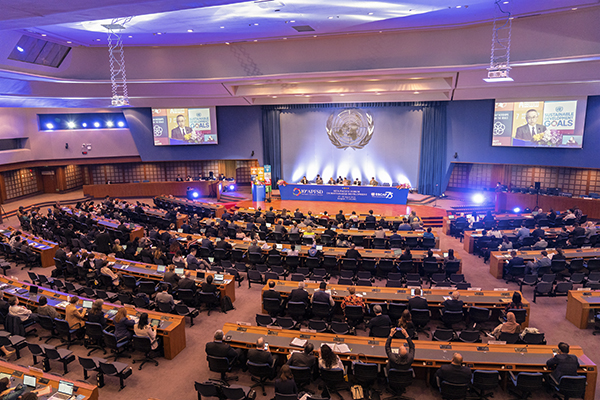
Bangkok, Thailand – “As we approach the mid-point of the 2030 Agenda for Sustainable Development, it has become clear that we will need urgent and additional efforts to accelerate progress,” said Dima Al-Khatib, Director of the United Nations Office for South-South Cooperation, in her remarks to the 10th Asia-Pacific Forum on Sustainable Development 2023. “South-South and triangular cooperation – among countries facing similar challenges – can be a valuable catalyst in galvanizing political will and enhancing know-how to implement much needed economic and social reforms needed to rescue the SDGs,” Ms. Al-Khatib said, opening a ministerial segment focusing on accelerating the implementation of the 2030 Agenda through voluntary national reviews (VNRs). Countries are increasingly integrating South-South and triangular cooperation during the preparation and presentation of their VNRs as part their follow-up and review of the 2030 Agenda for Sustainable Development. These VNRs aim to facilitate the sharing of experiences, including successes, challenges and lessons learned, with a view to accelerate development impacts. For instance, Pakistan and Sri Lanka carried out a successful ‘twinning initiative’ in 2022 facilitated by the United Nations Economic and Social Commission for Asia and the Pacific (UN-ESCAP). This involved online engagement and joint workshops, as well as sharing of institutional arrangements, policy directions and strategic multi-stakeholder partnerships which strengthened the countries’ implementation of the 2030 Agenda and accelerated their progress. Denis Nkala, UNOSSC Chief of Intergovernmental and UN Systems Affairs, moderated the SDG Round Table 17 final plenary and breakout discussion on the role of capacity building and partnerships. In the presentation on SDG 17, UNESCAP indicated that the Asia-Pacific region will no longer reach its SDG goals by 2030, and not only that, but will miss them by decades. The need to expand South-South cooperation and capacity building to all goals, not just Goal 17 was highlighted. Participants advocated for a people-centered approach to capacity building and South-South cooperation. The other breakout groups under Round Table 17 focused on leveraging trade for sustainable development, and financing for SDGs. The results of Round Table 17 were presented to the plenary by the Deputy Speaker of the Parliament of Maldives.   Integrating South-South cooperation into VNRs UNOSSC also co-organized a side event with the UN ESCAP titled ‘Bringing South-South and Triangular Cooperation into action through the Voluntary National Reviews’. “Solutions and innovative strategies originating in the South have and are delivering robust results around the world,” said Mr. Nkala, opening the side event. The joint side event explored the added value of South-South and triangular cooperation in the VNR process. Panelists from China and Indonesia shared their good practices and lessons on integrating South-South and triangular cooperation into preparation and presentation of the VNRs. The panelists from Mongolia, Tajikistan and Uzbekistan  discussed how the ‘twinning approach’ can benefit the VNR process and SDG acceleration efforts. The side event also encouraged discussion of what practical support the UN system can provide to facilitate and support further integration of South-South and triangular cooperation twinning in the VNR process. “VNRs are valuable catalysts in galvanizing political and civic will to redouble efforts at meeting the SDG targets,” said Mr. Nkala. Responding to the Member State’s requests in 2022 HLPF Ministerial Declaration and latest UNGA Resolution on South-South Cooperation – in collaboration with Member States and other stakeholders – UNOSSC is preparing a handbook which provides step-by-step guidance, drawing from good practices, and examples, on integrating South-South and triangular cooperation into the perpetration and presentation of VNRs. UNRCs Hanaa Singer-Hamdy (Nepal) and Tapan Mishra (Mongolia) reflected on the forthcoming UNOSSC VNR handbook, and emphasized the importance of not only sharing the process and guidance on VNR preparation, but also South-South good practices. Mr. Bhushan Shrestha, UNOSSC Result-Based Management Specialist presented key elements of the forthcoming handbook on ‘Integrating South-South and Triangular Cooperation into Voluntary National Reviews’ for discussion and feedback. The handbook considers integrating South-South and triangular cooperation in VNRs from two perspectives: Firstly, from a process perspective, which means applying South-South and triangular cooperation activities as a part of the VNR preparation process. Secondly, from a content perspective, which means reporting on South-South and triangular cooperation efforts and achievements in the VNR report itself. The handbook will be available for use in July 2023. Dr. Zhou Taidong, researcher at the China Center for International Knowledge on Development (CIKD), pointed out that south-south and triangular cooperation has been a key “element” in China’s VNR as well as China’s Progress Reports on the Implementation of the 2030 Agenda for Sustainable Development. This helps update progresses in south-south cooperation in different sectors, analyze corresponding challenges, and encourage mutual learning among different stakeholders.   Launch of South-South projects During the 10th Asia-Pacific Forum for Sustainable Development the government of Thailand launched three United Nations flagship initiatives to accelerate the shift to organic agriculture, as well as improve sexual and reproductive health services, including capacity development in midwifery and of health officials to engage at global health forums.  The initiatives were developed with initial support to the UNCT by UNOSSC which helped them to reduce number of un-coordinated South-South initiatives and narrowed them  down to initiatives prioritised by the Government. The initiatives are already receiving triangular financial support from the European Union. H.E. Ureerat Chareontoh, Director-General of the Thailand International Cooperation Agency, emphasized during the launch that, “South-South and triangular cooperation always lies at the heart of Thailand’s development policy.” Read more here.   For more information please contact: Bhushan Shrestha, Results-Based Management Specialist, bhushan.shrestha@unossc.org
Related Post


  • All Post
  • ATCT Featured Publications POM
  • BAPA+40
  • Blog
  • Capacity Development Initiatives
  • CICETE Featured Publications POM
  • CIKD
  • Cities Clusters - Agriculture
  • Cities Clusters - COVID-19
  • Cities Clusters - COVID-19 Knowledge Products
  • Cities Clusters - DRR
  • Cities Clusters - E-commerce
  • Cities Clusters - Tourism
  • Cities Clusters - Tourism Knowledge Products
  • Cities Clusters - Transport
  • Cities Clusters - Waste
  • Cities Project
  • Cities Project COVID-19 Newsletters
  • Cities Project COVID-19 Response
  • Cities Project Knowledge Products
  • Classic (untouched)
  • Climate Action
  • COMSATS Featured Publications POM
  • COMSATS Featured Solutions POM
  • Converted from Divi
  • Converted from Mixed
  • Converted from WPBakery
  • COVID-19
  • COVID-19 Page Featured Solutions
  • DRR Knowledge Products
  • DRR News
  • Empty Post
  • Events
  • Featured Event UN-Habitat POM
  • Financing for Development
  • Financing Mechanisms
  • g7+
  • Gender Events
  • Gender News
  • Good Practices in SSTrC Series
  • Good Practices Publications
  • Good Practices Thematic Series & Special Editions
  • Good Practices Vol. 2
  • Good Practices Vol. 3
  • GSSDC
  • Highlighted
  • Highlighted Publications
  • IAEA Featured Solutions POM
  • IBRAF Featured Publications POM
  • IBSA Fund
  • IBSA Fund Annual Reports
  • IBSA Fund News and Stories
  • IBSA Fund Publication
  • IBSA Fund Story
  • ICGEB Featured Events POM
  • ICGEB Featured Publications POM
  • ICGEB Featured Solutions POM
  • ILO Featured Events POM
  • ILO Featured Publications POM
  • ILO Featured Solutions POM
  • India-UN Development Partnership Fund
  • India-UN Fund Publication
  • India-UN Fund Story
  • IsDB
  • IsDB Featured Publications POM
  • IsDB SCC
  • News
  • Norec Featured Publications POM
  • Norec Featured Solutions POM
  • Peace and Development
  • PGTF Publications
  • PGTF Story
  • PICA Featured News POM
  • PICA Featured Publications POM
  • PICA Featured Solutions POM
  • PIDF Featured Publications POM
  • Publications
  • Regional Updates
  • Research
  • ROK-UNOSSC Facility
  • SGP Featured Publication POM
  • SGP Featured Solutions POM
  • Solution
  • South South in Action
  • South-South Global Thinkers
  • South-South Ideas
  • South-South Ideas Series
  • South-South in Action Series
  • Southern Response to COVID-19
  • SSN4PSI Featured Publications POM
  • SSN4PSI Featured Solutions POM
  • Training
  • UN Day for SSC 2020
  • UN Fund for SSC
  • UN SSC Day Publications
  • UN-Habitat Featured Publications POM
  • UN-HABITAT Featured Solutions POM
  • UNCCT
  • UNEP Featured Publications POM
  • UNFPA
  • UNFSSC Publication
  • UNFSSC Story
  • UNIDO Featured Publications POM
  • UNIDO Featured Solutions POM
  • UNIDO POM Events
  • UNOCT Featured Publications POM
  • UNV
  • UNV Featured Publications POM
  • WB Featured Publications POM
  • WB Featured Solutions POM
  • Webinars
  • WFP Featured Events POM
  • WFP Featured Publication POM
  • WFP Featured Solutions POM
  • WIPO
  • Workshops and Seminars
  • Youth4South
  • z Across the Globe 1
  • z Across the Globe 2
  • z Across the Globe 4
  • z Across the Globe 5
  • z Across the Globe 6
  • z Across the Globe 7
  • z Across the Globe 8
  • z ES BAPA+40
  • z ES Eventos
  • z ES Noticias
  • z ES Noticias Destacadas
  • z ES Publicaciones
  • z ES Publicaciones Destacadas
  • z ES Serie Buenas Prácticas en la CSSyT
  • z ES Serie El Sur-Sur en Acción
  • z FR Actualités
  • z FR BAPA+40
  • z FR Événements
  • z FR Publications
  • z FR Publications en vedette
  • z FR Série Bonnes pratiques en CSST
  • z FR Série Sud-Sud en action
  • z Highlighted News
  • z Photos
  • z Videos
  • z ZH BAPA+40
  • z ZH Events
  • z ZH News

ABOUT

Terms of Service

Privacy Policy

Disclosures

RESOURCES

Terms of Service

Privacy Policy

Disclosures

ENGAGE

Terms of Service

Privacy Policy

Disclosures

Copyright © UNOSSC/UNDP

wpChatIcon
wpChatIcon

Alliance Application Form

Submit an Expression of Interest and/or Demand Signal. UNOSSC reviews submissions on a rolling basis.

1. Official name of organization / institution / government entity (exclusions to apply) *
2. Country *
3. Region *
4. SDG *
Secondary SDG *
5. Partner category *
6. Website *
7. Brief description of your institution (max. 150 words) *
Name for the Lead *
Title for the Lead *
Email address for the Lead *
Name for the co-lead
Title for the co-lead
Email address for the co-lead
Section 3. Expression of Interest in the Alliance *
Additional information on proposed areas of engagement may be requested through the platform following initial review by the Alliance Secretariat.
Section 4. Due Diligence and Integrity Declaration *

Submission Note:

  • Submission of this Expression of Interest form does not automatically confer participation in the Alliance.
  • All submissions will be reviewed by the Alliance Secretariat, including basic eligibility screening and proportionate due diligence, as appropriate.
  • Participation in Alliance activities is determined based on relevance to articulated cooperation needs, alignment with Alliance principles, and integrity considerations.
  • Engagement under the Alliance is voluntary, non-binding, and facilitative in nature, and does not constitute funding approval, contractual commitment, or institutional membership.
  • The Alliance Secretariat may contact submitting entities for additional information or clarification during the review process.

Submission of Demand Form

Description of Demand

Indicate the type of support or cooperation requested through the Alliance.
Please briefly describe the challenge, gap, or priority. (Max. 300 words)

Thematic and Geographic Focus

Please indicate the main focus areas of your demand:

A. Thematic Areas (select up to three)
B. Geographic Focus (select all that apply)

Proposed Engagement Modalities

Please indicate how you would like to engage through the Alliance (select all that apply):

Expected Outcomes

Please indicate the main results you seek to achieve through this engagement. (Max. 200 words)
Examples:
• Capacity strengthened
• Partnerships established
• Sectoral or regional strategies co-developed
• Solutions piloted
• Knowledge generated
• Policies informed

Timeline and Readiness (if applicable)

1. Expected timeframe for engagement:
2. Current stage:

Additional Information

Please provide any additional information, documents, or links relevant to this submission.
(Max. 200 words or upload link)

Submission of Offer Form

Description of Contribution

Indicate the type of contribution your institution can provide and describe the expertise, resources, or solutions you may offer.
Please briefly describe your proposed contribution. (Max. 300 words)

Thematic and Geographic Focus

Please indicate the main focus areas of your interest:

A. Thematic Areas (select up to three)
B. Geographic Focus (select all that apply)

Proposed Engagement Modalities

Please indicate how you would like to engage through the Alliance (select all that apply):

Expected Outcomes

Please indicate the main results you aim to achieve through this engagement. (Max. 200 words)
Examples:
• Capacity strengthened
• Partnerships established
• Sectoral or regional strategies co-developed
• Solutions piloted
• Knowledge generated
• Policies informed

Timeline and Readiness (if applicable)

1. Expected timeframe for engagement:
2. Current stage:

Additional Information

Please provide any additional information, documents, or links relevant to this submission.
(Max. 200 words or upload link)

Organization Registration

Authentication & Due Diligence This prototype simulates identity verification, due diligence confirmation, and an authentication step before submission. *

First Name *
Last Name *
Email address *
Password *
Confirm Password *
Name of institution / organization *
Country / Region *
Organization Type *
Organization other *
Function / role *
Organization logo *
Maximum file size: 1 GB

Login

Login / email *
Password *
Remember me

Forgot password?

Connect form

Your name *
Email *
Organization / institution *
Job title / role *
Reason for connecting:
Short message

Scroll to Top