In Africa solar power is offering a unique opportunity to provide affordable, reliable, and sustainable electricity to a large share of humanity – improving economic opportunities and quality of life.
Given solar power’s potential, the UN, among other multilateral and international organizations are advocating for investments to drive development of the energy and renewables sectors in Africa’s developing economies.
In 2012, a study conducted in Cameroon highlighted the existence of the enormous potential for renewable energy, as well as concrete possibilities for the development and use of these forms of energy. Given this potential, the Cameroonian authorities decided to focus their actions in the energy sector on promoting the use of renewable energy, including solar, which was already in use, especially in urban areas. Penetration in rural areas was low. This, despite the fact that solar systems are relatively low cost, easy to maintain, and particularly well-suited to rural areas.
Further, low supply forces people in the country’s northern regions to seek their energy from the surrounding forests, where they extract fuelwood to meet more than 95 percent of their energy needs. The resulting deforestation, leads to its own set of problems, including global heating, soil erosion and reduced fertility, landslides, flash floods, and increased likelihood of pests and crop diseases owing to a lack of habitat for birds, bats, and insects that attack agricultural invaders.
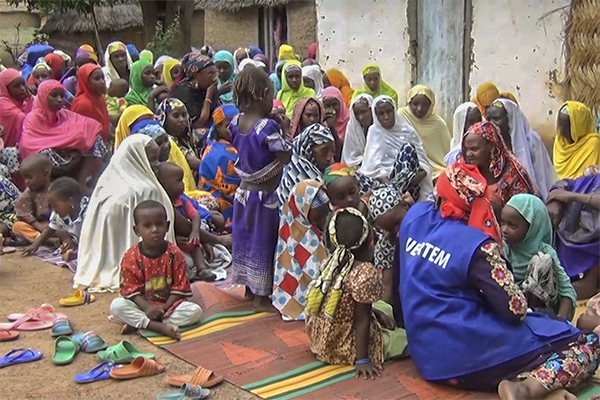
In 2020, Cameroon’s Ministry of Water and Energy and UNESCO launched a partnership aimed at improving access to energy in rural areas of the North and Far North regions by promoting renewable energy and energy efficient technologies. With support from the India-UN Development Partnership, the project distributed solar kits, cook stoves and related materials. The project also conducted trainings, and advocacy support to enable roughly 6,000 community members to take advantage of solar energy’s potential.
This project is an exceptional example of South-South cooperation, whereby developing countries share knowledge, skills, expertise, and resources to meet their development goals.
For example, a partnership with India’s Social Work and Research Centre, widely known as the Barefoot College, provided an opportunity for five illiterate women from three rural villages in northern Cameroon to undergo a four-month training at the Dakar, Senegal campus of the College. Known as ‘Solar Mamas’, the women learned about the technology of solar equipment, as well as how to pass this knowledge on to others.
The project team advised each partnering community to form a village solar committee, the members of which were then trained to manage the community’s solar energy project. In addition to selecting the ‘Solar Mamas’ that received training, the committee hosted a rural electronic workshop, oversaw budgeting, and ensured community engagement to care for, budget, and plan for management and upkeep of the systems.
The team also introduced photovoltaic solar equipment to be installed in public buildings, efficient cook stoves produced with local material, and biodigesters for biogas and biomass production. Through the introduction of these renewable energy systems, the project also benefited community members, leaders, and government officials, including women and youth.
The local University of Maroua, in cooperation with the communities, designed and constructed three demonstration sites that host the project activities. Each site has a biodigester, improved cooking stoves, and conducts ecological briquette production.
Completed in December 2022, the project surpassed all expectations, impacting more than 12,000 people, or 207.85% of the original goal. More than 1,300 people were trained in how to use and maintain the 1,000 solar kits distributed to the community. Working together, community members manufactured more than 3,500 cook stoves. The project also developed a training curricula based on the technologies learned and further developed, and planted more than 2,000 trees in the region. Moving forward the ‘Solar Mamas’ continue to install, assemble, maintain, and train their neighbours to ensuring benefits continue to grow and expand.
World Economic Forum, September, 2022.
As established in the project’s independent evaluation.