Electron Beam (EB) technology is an excellent example of peaceful application of nuclear energy for sustainable and resilient development.
The United Nations Office for South-South Cooperation (UNOSSC) and the Regional Cooperative Agreement Regional Office (RCARO) in Daejeon, Republic of Korea, implemented two phases of a project on “Electron Beam Applications for Value Addition to Food and Industrial Products and Degradation of Environmental Pollutants in the Asia Pacific region,” under the Republic of Korea (ROK)-UNOSSC Facility on Science, Technology and Innovation in 2011-2021.
The project successfully introduced and promoted the EB technology through advisory services, capacity building and technology exchanges through South-South and triangular cooperation.
“We are delighted to see that this strategic initiative, piloted in the framework of the RoK-UNOSSC Facility 2011-2021, was successful at establishing long-lasting networks and partnerships,” said Ms. Dima Al-Khatib, UNOSSC Director. “It has proved the case for the benefits of this type of technical cooperation, and through a new phase of collaboration will be scaled-up with a new set of partners.”
During the initial project, seven new EB facilities were established in India, Pakistan and Thailand with the support of IAEA and other stakeholders. Over 100 new employment opportunities were created in 14 participating countries, among many other tangible results. The project also facilitated South-South exchanges and learning among participating countries. For example, Sri Lankans used Malaysian facilities to demonstrate the efficacy of EB technology in industry. Indonesia demonstrated the usefulness of irradiated food delivered to disaster areas after the volcanic eruption of Mount Merapi.
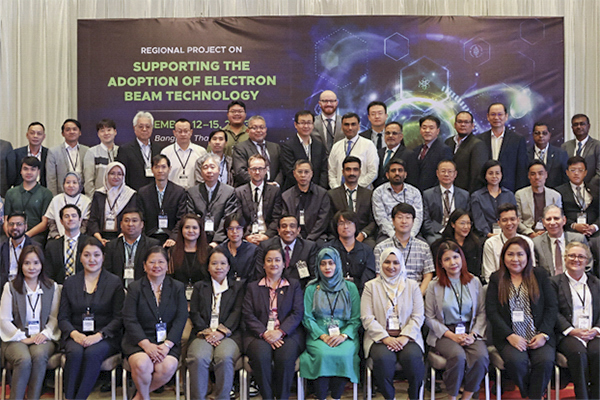
Building on the successful outcomes of the RoK-UNOSSC Facility and due to greater country demand, a new triangular cooperation project entitled, “Supporting the Adoption of Electron Beam Technology and its Applications in Areas of Food and Agriculture, Industry, Human Health and Environment Treatment” was launched on 12 December 2023.
The new 5-year project (2024-2028) is supported by the Office of Radiological Security (ORS) of the United States Department of Energy National Nuclear Security Administration (DOE/NNSA) in partnership with the RCA Regional Office (RCARO). It covers 22 Asian countries under the RCA, which is an intergovernmental agreement for the East Asia and Pacific region under the auspices of the International Atomic Energy Agency (IAEA).
The project aims to improve the quality of environment and living conditions of the Asia-Pacific region through supporting the building of EB infrastructure and facilitation of its application. Specifically, it focuses on:
- facilitation of the application of EB accelerators for processing food and agricultural commodities to improve food security; adding value to industrial products including sterilization of medical devices; and treating environmental pollutants;
- promotion of the adoption of EB equipment and facilities and supporting sustainable maintenance; and
- improvement of the quality and safety of the environment and enhancing the well-being of the region through adoption of technology.