As we pass the midpoint of the implementation of the 2030 Agenda, the world is falling short of meeting most of the Sustainable Development Goals. Nearly 40 per cent of all developing countries suffer from severe debt problems.
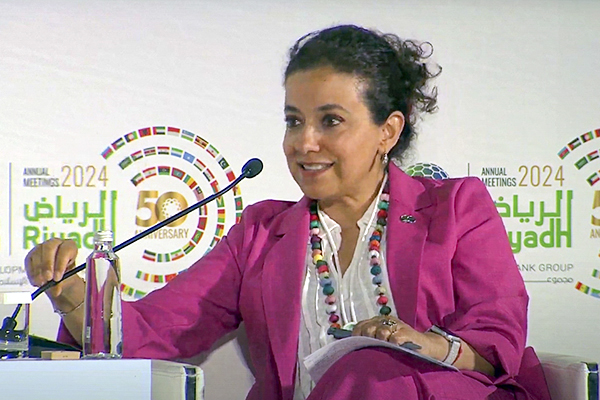
Responding to the priorities of the Global South since its establishment in 1974, the Islamic Development Bank (IsDB) has been providing innovative, sustainable and predictable development financing, said UNOSSC Director Ms. Dima Al-Khatib, during a discussion highlighting IsDB’s 50 years of championing South-South cooperation in its Member Countries and beyond. The discussion was held alongside the IsDB 2024 Annual Meetings and Golden Jubilee celebrations in Riyadh.
The importance of scaling up innovative development finance is reflected in various recent international foras and respective agreements, including the 21st Session of the High-Level Committee on South-South Cooperation; the Science, Technology, and Innovation (STI) Summit; and the Third South Summit, among others. Here it is important to note that Member States emphasize that Southern-led development finance provides essential support to developing countries in the implementation of their sustainable development agendas, adapted to their specific domestic conditions.
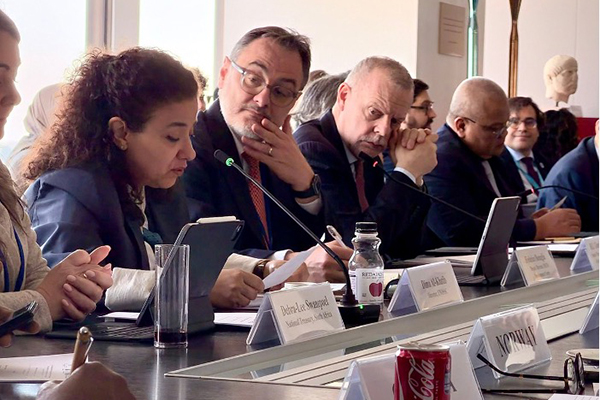
During the IsDB discussion, panelists exchanged views and ideas on the various ways and means to scale up South-South cooperation, emphasizing the huge potential of South-South cooperation to assist the countries from the Global South to achieve the sustainable development goals, among internationally agreed development goals.
“IsDB’s unique position as the premier multilateral development bank owned by the Global South, has empowered us to use innovative development approaches, approaches that are rooted in solidarity and South-South cooperation,” said Dr. Mansur Muhtar, Vice President, Operations, Islamic Development Bank, during his opening remarks. “Since its inception, the Islamic Development Bank has served multiple roles in South-South cooperation as a connector, as a facilitator, and as a financier.”
The IsDB’s unique South-South cooperation approach, known as reverse linkage, puts solidarity-based cooperation ahead of finance, and highlights the expertise, technologies and resources of its Member Countries. By the end of 2023, with funding exceeding $231 million, IsDB had helped more than 37 Member Countries collaborate in 76 projects using its reverse linkage mechanism.
“In Guinea, we don’t want to keep on sending our minerals outside, we want to transform them locally,” said H.E. Mr. Ismael N’falla Nabe, Minister of Planning and International Cooperation, Republic of Guinea. “So, in order to transform locally, we want to learn from the experiences of our friends from the South, we want to learn from the experience of Saudi Arabia, and other Southern countries.”
“At the Saudi Fund for Development (SFD), our commitment to South-South cooperation is unwavering,” said Dr. Abdullah Alsakran, Executive Director of the Strategy and Development Sector and Head of the Strategic Transformation Management Office, of the SFD. “In the last 49 years, the vast majority of our 740 development tools, valued at over $20 billion across 93 countries, has been dedicated to countries in the Global South.” He emphasized, the focus of SFD “has always been in mutual development, facilitating knowledge exchange and addressing shared challenges.”
“Indonesia has been actively engaged in South-South cooperation for more than 30 years,” said Mr. Tormarbulang Lumbantobing, Chief Executive Officer of the Indonesian Agency for International Development. “We are of the view that South-South cooperation should bring a focus on development solutions to facilitate the exchange of knowledge, resources, and expertise in order to produce mutual benefits.”
“South-South cooperation has to be further institutionalized, including networking between the existing institutions of the South,” said Mr. Mohamed Blidi, Director General, Tunisian Agency for Technical Cooperation. “We have to think about devising mechanisms for the funding of South-South cooperation, because this is instrumental in order to achieve development.”
“Dating back to the early 1980s, UNOSSC has been a proud partner of the IsDB, in its endeavor toward building prosperity across the Global South and beyond,” said UNOSSC Director Ms. Dima Al-Khatib. The Director invited all partners to explore the over 1,000 South-South and triangular experiences and solutions on UNOSSC’s South-South Galaxy platform. She also noted that UNOSSC had recently launched UN country team guidelines to mainstream and South-South cooperation within national development planning process, through the UN system.
Concluding the event, moderator Dr. Issa Faye, Director General, Global Practice and Partnerships of the Islamic Development Bank, reminded participants that through South-South cooperation partners are demonstrated really a high sense of solidarity, oftentimes in very difficult circumstances, to not just test ideas, but to share development solutions that already work.
Click here to watch the video of the event.
Click here to read the contribution of Dima Al-Khatib, UNOSSC Director, to the IsDB Special Edition SDGs Digest.
Click here to read the IsDB Special Edition SDGs Digest: Cherishing our Past Charting our Future.
More about the IsDB-UNOSSC Partnership for South-South Cooperation.