From ECOSOC Youth Forum 2024 to Actions at Higher Education Institutions
Following the launch of the pilot project “Greening Higher Education: Promoting the Role of Science, Technology, and Innovation in SDG Impacts through Meaningful Youth Engagement and Leadership among the South-South University Cooperation Network” by UNESCO International Institute for Higher Education (UNESCO IESALC) and the United Nations Office of South-South Cooperation (UNOSSC) at COP28 in Dubai in December 2023, the two UN offices have joined hands once again. During the United Nations Economic and Social Council (ECOSOC) Youth Forum UNESCO IESALC and UNOSSC organized a partnership discussion, bringing together youth leaders from various regions and stakeholders who have taken actions in the space of Greening Higher Education and committed to continue working with the UN in the realization of SDG4 on Education and SDG 13 on climate change through strong partnerships. While co-hosted by UNESCO IESALC and UNOSSC, UNESCO SDG4 Youth & Student Network, UNICEF, National Geographic Learning, University of Helsinki, Education Above All and Technological University Dublin supported the event as partners.
The event “Greening Higher Education Institutions: bridging SDG4 and SDG 13” provided education stakeholders and communities with the knowledge to drive a green transformation in higher education. Harnessing the resources of higher education institutions and cooperating with partners in different sectors is critical to achieving this objective successfully. Furthermore, the shift to a sustainable society requires the incorporation of green concepts into science, technology, and innovation (STI), including the value and promotion of youth led projects for green STI aimed at a sustainable future. It also stressed the essential role that higher education, especially through young people’s leadership and engagement, should play in fostering a sustainable and environmentally conscious society, building the basis for a better tomorrow for today’s and future generations.
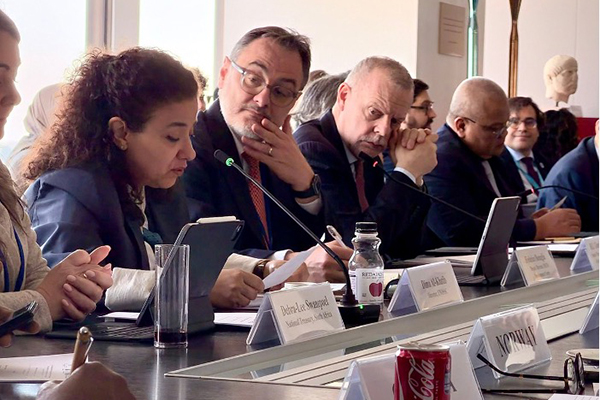
 Mr. Francesc Pedró (UNESCO IESLAC Director) and Ms. Dima Al-Khatib (UNOSSC Director) introduced the interagency pilot initiative on Greening Higher Education launched by the two offices to wider audiences of young people and stakeholders, advocating for multistakeholder partnership and reassuring the support that the two UN offices provide towards youth-led institutional efforts on SDG13 through encouraging South-South exchanges and cooperation.
UNOSSC Director, Ms. Dima Al-Khatib stated that in the context of the current climate crisis “the need for immediate action has never been more urgent”. She calls for a prompt, decisive and inclusive response to the current climate change threats for ecosystems and human well-being, addressing the importance of partnerships and strategic alliances.
Mr. Francesc Pedró, UNESCO IESLAC Director, emphasized the importance of this event, “not only for the UN system and Member States, but in particular in the context of the Global South”.
Mr. Francesc Pedró (UNESCO IESLAC Director) and Ms. Dima Al-Khatib (UNOSSC Director) introduced the interagency pilot initiative on Greening Higher Education launched by the two offices to wider audiences of young people and stakeholders, advocating for multistakeholder partnership and reassuring the support that the two UN offices provide towards youth-led institutional efforts on SDG13 through encouraging South-South exchanges and cooperation.
UNOSSC Director, Ms. Dima Al-Khatib stated that in the context of the current climate crisis “the need for immediate action has never been more urgent”. She calls for a prompt, decisive and inclusive response to the current climate change threats for ecosystems and human well-being, addressing the importance of partnerships and strategic alliances.
Mr. Francesc Pedró, UNESCO IESLAC Director, emphasized the importance of this event, “not only for the UN system and Member States, but in particular in the context of the Global South”.
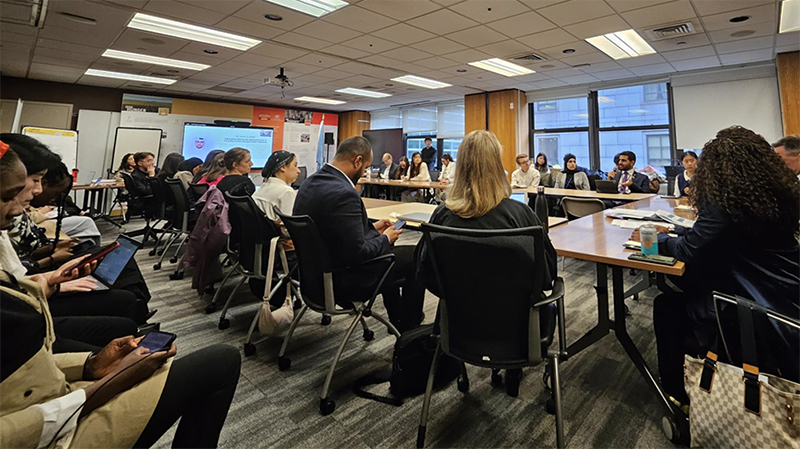 The four pillars of UNESCO’s Greening Higher Education work were shared by different partners and participants acting at communal, institutional, national, regional, and international levels namely: 1) Greening Teaching Training and Curriculum, 2) Greening Science, Technology, and Innovation, 3) Greening Skills and Jobs, and 4) Greening Universities.
Ms. Bosen Lily Liu, UNESCO IESALC Head of Partnership, noted the approaches that have been proposed during consultation dialogues with universities among the South-South University Cooperation Network (SUCN) since January 2024 as part of the pilot project: a) promoting the capacity of innovation, b) ensuring institutional policy and guidelines, c) increasing relevancy of content through real life scenarios, d) encouraging contextualization of solutions, e) upgrading knowledge on citizenship and knowledge integration on greening into official curriculum, and f) providing quality data in adaptation of evidence-based decision-making in greening higher education.
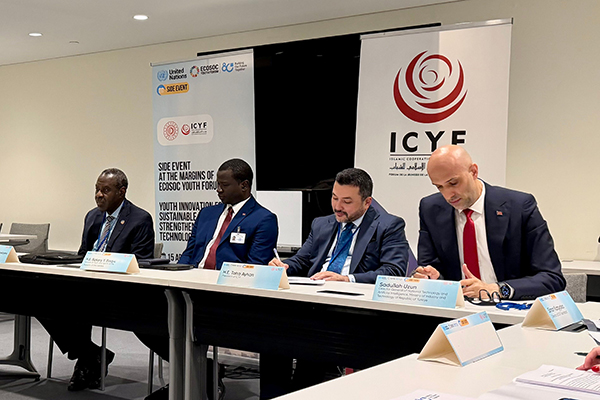
A significant engagement of the event was the signing ceremony of UNESCO IESALC and National Geographic Learning, marking the next stage of the strategic partnership between the two parties, contributing to all four pillars of Greening Higher Education including the pillar on Greening Science, Technology, and Innovation in collaboration with UNOSSC.
The four pillars of UNESCO’s Greening Higher Education work were shared by different partners and participants acting at communal, institutional, national, regional, and international levels namely: 1) Greening Teaching Training and Curriculum, 2) Greening Science, Technology, and Innovation, 3) Greening Skills and Jobs, and 4) Greening Universities.
Ms. Bosen Lily Liu, UNESCO IESALC Head of Partnership, noted the approaches that have been proposed during consultation dialogues with universities among the South-South University Cooperation Network (SUCN) since January 2024 as part of the pilot project: a) promoting the capacity of innovation, b) ensuring institutional policy and guidelines, c) increasing relevancy of content through real life scenarios, d) encouraging contextualization of solutions, e) upgrading knowledge on citizenship and knowledge integration on greening into official curriculum, and f) providing quality data in adaptation of evidence-based decision-making in greening higher education.
A significant engagement of the event was the signing ceremony of UNESCO IESALC and National Geographic Learning, marking the next stage of the strategic partnership between the two parties, contributing to all four pillars of Greening Higher Education including the pillar on Greening Science, Technology, and Innovation in collaboration with UNOSSC.
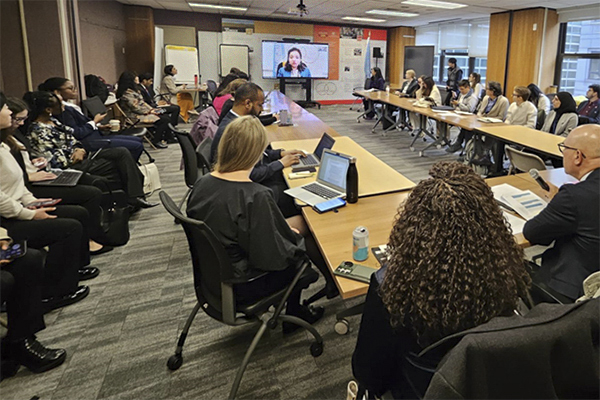
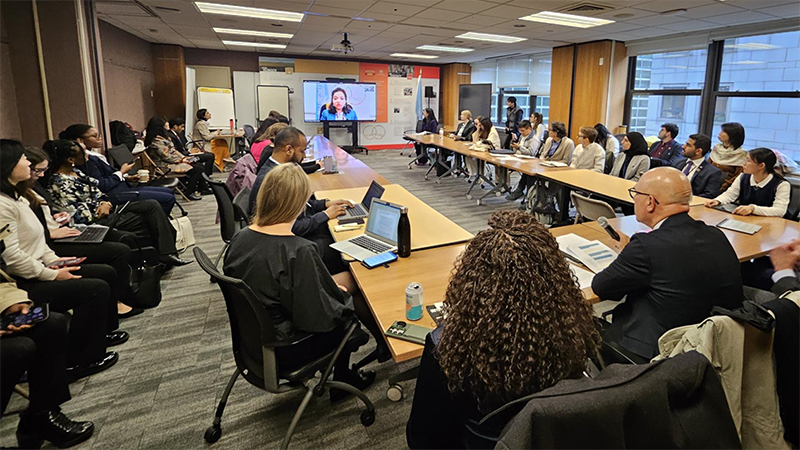
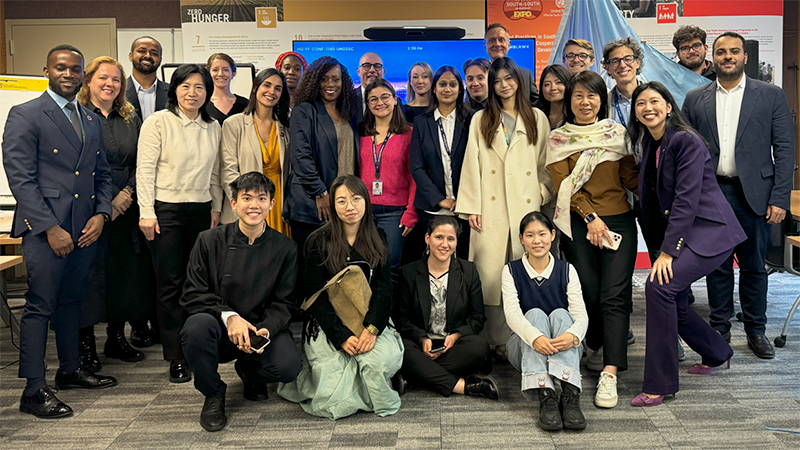 Following the 18 April meeting, on 30 April 2024, an Institutional Kickoff Meeting was organized with the 10 Lead Universities, namely, in alphabetic order, American University of Beirut, American University of Sharjah, Siam University, The University of the West Indies, Universidade de São Paulo, Universidad de los Andes, Universidad Nacional Autónoma de México, University of Cape Town, University of Doha for Science and Technology, and University of Nairobi as well as UNESCO IESALC and UNOSSC.
 All Lead Universities – representing Africa, Arab States, Asia and Pacific, and Latin America and the Caribbean – committed to the pilot project, and shared their capacity and willingness to drive greening science, technology, and innovation at institutional level in support of regional, sub-regional, and national challenges on SDG13.
While each university has strong research and engagement experience on SDG13, university representatives, including students, professors, researchers, and managers, also exchanged within SUCN their intersectional approaches to SDG13 through SDG 4 (Quality Education), SDG7 (Affordable and Clean Energy), SDG 9 (Industry, Innovation, and Infrastructure), SDG 11 (Sustainable Cities and Communities), SDG 12 (Responsible Consumption and Production), and SDG 17 (Partnerships for the Goals). They expressed that this is an exciting moment, marking the establishment of this SUCN community and the hope for concrete impacts and exchanges in the very near future.
During the Institutional Kickoff Meeting, Mr. Francesc Pedró expressed his appreciation of UNOSSC once again for its engagement in this meaningful partnership, and noted the action-oriented approach of the South-South University Cooperation Network in transferring solutions through institutional exchanges and cooperation in the Global South.
Ms. Xiaojun Grace Wang, Trust Fund Director of UNOSSC, shared concrete examples from UNOSSC trust funds and programmes, of the impactful outcomes of university participation, noting that institutional cooperation leads to mutual understanding and development.
One approach noted involves institutional exchanges through shared contexts, leading to shared solutions. The PGTF project on solar energy for vineyards in Argentina, Chile, and South Africa brought together researchers, institutions, and producers from the three countries to exchange knowledge and experiences on solar energy for vineyard irrigation. “International collaboration is important because at the end, despite the different characteristics, the problems are similar and it is important to be able to share them and address them in a general way,” said Pilar Gil Montenegro, of Catholic University of Chile. The project contributed toward a deeper understanding of local context and solar energy solutions through the South-South cooperation among the partner institutions from the three countries: the National Institute of Agricultural Technology and the Mendoza Agricultural Experimental Station in Argentina, the University of Chile and the Catholic University of Chile, the Agricultural Research Council, and the Stellenbosch University of South Africa.
Another approach highlighted the importance of institutional technical support. For example: Beijing Normal University (ICRG, BNU), through its Innovation Center for Risk Governance, has provided technical support to a UNOSSC pilot project on promoting sustainable and low-carbon transportation in the metropolitan region of Santiago, Chile. This pilot project promoted the development of sustainable low-carbon urban transport in the metropolitan region of Santiago through digital technology, capacity improvement, knowledge transfer, and city-to-city exchanges. Through sharing of the successful experience and digital and technological solutions of Hangzhou City’s digital transformation of public transportation, the partners supported the assessment and formulation of the development strategy of smart public transportation in Santiago based on local needs.
Universities were called upon to prioritize sustainability as a strategic focus area, uniting various stakeholders to drive innovation.
Next steps, shared by Ms. Bosen Lily Liu on behalf of UNESCO IESALC and UNOSSC, will involve carrying out an institutional mapping exercise with each university and launching of an intergenerational ‘Greening-with-STI Bootcamp among the Leader Universities’ where students will lead on designing, prototyping and demoing on greening initiatives. Dingding Sun, UNOSSC Programme Specialist, proposed a building of a shared virtual space on UNOSSC’s South-South Galaxy platform to facilitate regular exchanges among SUCN Leader Universities in support of this work.
All Lead Universities – representing Africa, Arab States, Asia and Pacific, and Latin America and the Caribbean – committed to the pilot project, and shared their capacity and willingness to drive greening science, technology, and innovation at institutional level in support of regional, sub-regional, and national challenges on SDG13.
While each university has strong research and engagement experience on SDG13, university representatives, including students, professors, researchers, and managers, also exchanged within SUCN their intersectional approaches to SDG13 through SDG 4 (Quality Education), SDG7 (Affordable and Clean Energy), SDG 9 (Industry, Innovation, and Infrastructure), SDG 11 (Sustainable Cities and Communities), SDG 12 (Responsible Consumption and Production), and SDG 17 (Partnerships for the Goals). They expressed that this is an exciting moment, marking the establishment of this SUCN community and the hope for concrete impacts and exchanges in the very near future.
During the Institutional Kickoff Meeting, Mr. Francesc Pedró expressed his appreciation of UNOSSC once again for its engagement in this meaningful partnership, and noted the action-oriented approach of the South-South University Cooperation Network in transferring solutions through institutional exchanges and cooperation in the Global South.
Ms. Xiaojun Grace Wang, Trust Fund Director of UNOSSC, shared concrete examples from UNOSSC trust funds and programmes, of the impactful outcomes of university participation, noting that institutional cooperation leads to mutual understanding and development.
One approach noted involves institutional exchanges through shared contexts, leading to shared solutions. The PGTF project on solar energy for vineyards in Argentina, Chile, and South Africa brought together researchers, institutions, and producers from the three countries to exchange knowledge and experiences on solar energy for vineyard irrigation. “International collaboration is important because at the end, despite the different characteristics, the problems are similar and it is important to be able to share them and address them in a general way,” said Pilar Gil Montenegro, of Catholic University of Chile. The project contributed toward a deeper understanding of local context and solar energy solutions through the South-South cooperation among the partner institutions from the three countries: the National Institute of Agricultural Technology and the Mendoza Agricultural Experimental Station in Argentina, the University of Chile and the Catholic University of Chile, the Agricultural Research Council, and the Stellenbosch University of South Africa.
Another approach highlighted the importance of institutional technical support. For example: Beijing Normal University (ICRG, BNU), through its Innovation Center for Risk Governance, has provided technical support to a UNOSSC pilot project on promoting sustainable and low-carbon transportation in the metropolitan region of Santiago, Chile. This pilot project promoted the development of sustainable low-carbon urban transport in the metropolitan region of Santiago through digital technology, capacity improvement, knowledge transfer, and city-to-city exchanges. Through sharing of the successful experience and digital and technological solutions of Hangzhou City’s digital transformation of public transportation, the partners supported the assessment and formulation of the development strategy of smart public transportation in Santiago based on local needs.
Universities were called upon to prioritize sustainability as a strategic focus area, uniting various stakeholders to drive innovation.
Next steps, shared by Ms. Bosen Lily Liu on behalf of UNESCO IESALC and UNOSSC, will involve carrying out an institutional mapping exercise with each university and launching of an intergenerational ‘Greening-with-STI Bootcamp among the Leader Universities’ where students will lead on designing, prototyping and demoing on greening initiatives. Dingding Sun, UNOSSC Programme Specialist, proposed a building of a shared virtual space on UNOSSC’s South-South Galaxy platform to facilitate regular exchanges among SUCN Leader Universities in support of this work.
Mr. Francesc Pedró (UNESCO IESLAC Director) and Ms. Dima Al-Khatib (UNOSSC Director) introduced the interagency pilot initiative on Greening Higher Education launched by the two offices to wider audiences of young people and stakeholders, advocating for multistakeholder partnership and reassuring the support that the two UN offices provide towards youth-led institutional efforts on SDG13 through encouraging South-South exchanges and cooperation.
UNOSSC Director, Ms. Dima Al-Khatib stated that in the context of the current climate crisis “the need for immediate action has never been more urgent”. She calls for a prompt, decisive and inclusive response to the current climate change threats for ecosystems and human well-being, addressing the importance of partnerships and strategic alliances.
Mr. Francesc Pedró, UNESCO IESLAC Director, emphasized the importance of this event, “not only for the UN system and Member States, but in particular in the context of the Global South”.
The four pillars of UNESCO’s Greening Higher Education work were shared by different partners and participants acting at communal, institutional, national, regional, and international levels namely: 1) Greening Teaching Training and Curriculum, 2) Greening Science, Technology, and Innovation, 3) Greening Skills and Jobs, and 4) Greening Universities.
Ms. Bosen Lily Liu, UNESCO IESALC Head of Partnership, noted the approaches that have been proposed during consultation dialogues with universities among the South-South University Cooperation Network (SUCN) since January 2024 as part of the pilot project: a) promoting the capacity of innovation, b) ensuring institutional policy and guidelines, c) increasing relevancy of content through real life scenarios, d) encouraging contextualization of solutions, e) upgrading knowledge on citizenship and knowledge integration on greening into official curriculum, and f) providing quality data in adaptation of evidence-based decision-making in greening higher education.
A significant engagement of the event was the signing ceremony of UNESCO IESALC and National Geographic Learning, marking the next stage of the strategic partnership between the two parties, contributing to all four pillars of Greening Higher Education including the pillar on Greening Science, Technology, and Innovation in collaboration with UNOSSC.
Following the 18 April meeting, on 30 April 2024, an Institutional Kickoff Meeting was organized with the 10 Lead Universities, namely, in alphabetic order, American University of Beirut, American University of Sharjah, Siam University, The University of the West Indies, Universidade de São Paulo, Universidad de los Andes, Universidad Nacional Autónoma de México, University of Cape Town, University of Doha for Science and Technology, and University of Nairobi as well as UNESCO IESALC and UNOSSC.
All Lead Universities – representing Africa, Arab States, Asia and Pacific, and Latin America and the Caribbean – committed to the pilot project, and shared their capacity and willingness to drive greening science, technology, and innovation at institutional level in support of regional, sub-regional, and national challenges on SDG13.
While each university has strong research and engagement experience on SDG13, university representatives, including students, professors, researchers, and managers, also exchanged within SUCN their intersectional approaches to SDG13 through SDG 4 (Quality Education), SDG7 (Affordable and Clean Energy), SDG 9 (Industry, Innovation, and Infrastructure), SDG 11 (Sustainable Cities and Communities), SDG 12 (Responsible Consumption and Production), and SDG 17 (Partnerships for the Goals). They expressed that this is an exciting moment, marking the establishment of this SUCN community and the hope for concrete impacts and exchanges in the very near future.
During the Institutional Kickoff Meeting, Mr. Francesc Pedró expressed his appreciation of UNOSSC once again for its engagement in this meaningful partnership, and noted the action-oriented approach of the South-South University Cooperation Network in transferring solutions through institutional exchanges and cooperation in the Global South.
Ms. Xiaojun Grace Wang, Trust Fund Director of UNOSSC, shared concrete examples from UNOSSC trust funds and programmes, of the impactful outcomes of university participation, noting that institutional cooperation leads to mutual understanding and development.
One approach noted involves institutional exchanges through shared contexts, leading to shared solutions. The PGTF project on solar energy for vineyards in Argentina, Chile, and South Africa brought together researchers, institutions, and producers from the three countries to exchange knowledge and experiences on solar energy for vineyard irrigation. “International collaboration is important because at the end, despite the different characteristics, the problems are similar and it is important to be able to share them and address them in a general way,” said Pilar Gil Montenegro, of Catholic University of Chile. The project contributed toward a deeper understanding of local context and solar energy solutions through the South-South cooperation among the partner institutions from the three countries: the National Institute of Agricultural Technology and the Mendoza Agricultural Experimental Station in Argentina, the University of Chile and the Catholic University of Chile, the Agricultural Research Council, and the Stellenbosch University of South Africa.
Another approach highlighted the importance of institutional technical support. For example: Beijing Normal University (ICRG, BNU), through its Innovation Center for Risk Governance, has provided technical support to a UNOSSC pilot project on promoting sustainable and low-carbon transportation in the metropolitan region of Santiago, Chile. This pilot project promoted the development of sustainable low-carbon urban transport in the metropolitan region of Santiago through digital technology, capacity improvement, knowledge transfer, and city-to-city exchanges. Through sharing of the successful experience and digital and technological solutions of Hangzhou City’s digital transformation of public transportation, the partners supported the assessment and formulation of the development strategy of smart public transportation in Santiago based on local needs.
Universities were called upon to prioritize sustainability as a strategic focus area, uniting various stakeholders to drive innovation.
Next steps, shared by Ms. Bosen Lily Liu on behalf of UNESCO IESALC and UNOSSC, will involve carrying out an institutional mapping exercise with each university and launching of an intergenerational ‘Greening-with-STI Bootcamp among the Leader Universities’ where students will lead on designing, prototyping and demoing on greening initiatives. Dingding Sun, UNOSSC Programme Specialist, proposed a building of a shared virtual space on UNOSSC’s South-South Galaxy platform to facilitate regular exchanges among SUCN Leader Universities in support of this work.