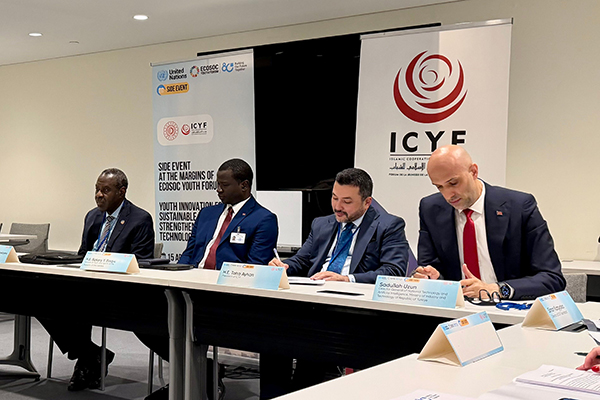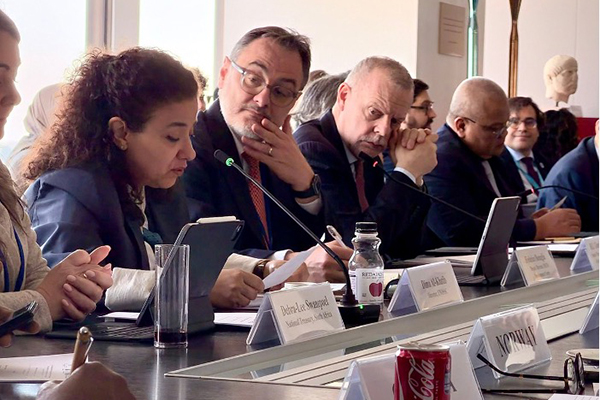
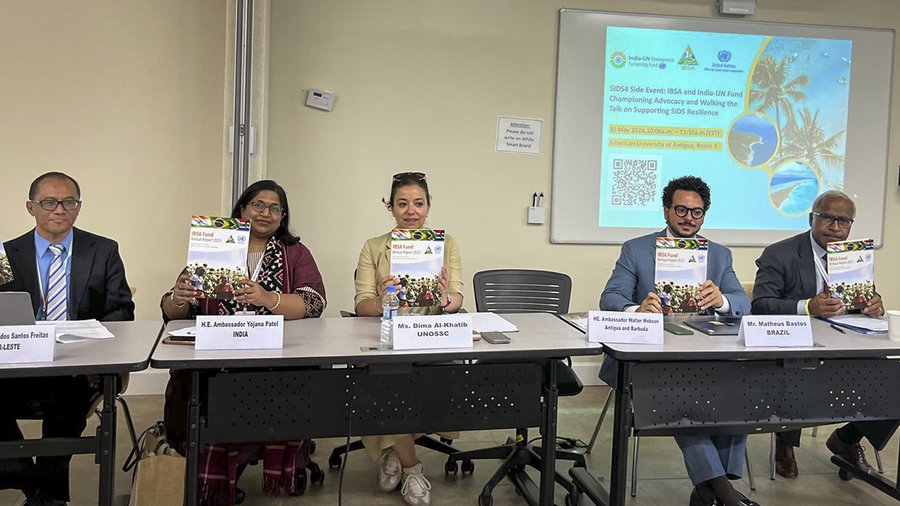
The Governments of India, Brazil, and South Africa, in collaboration with the United Nations Office for South-South Cooperation (UNOSSC), showcased the commitment of South-South cooperation Trust Funds to supporting resilience in Small Island Developing States (SIDS) during a side-event at the 4th International Conference on Small Island Developing States (SIDS4).
“The goal is to benefit most those countries which are not getting access to development finance, driven by the demand of those countries, and with projects tailor-made to their needs and that have direct impact in communities,” said H.E. Ambassador Yojana Patel, Deputy Permanent Representative of India to the United Nations.
“Participation by the SIDS in UNOSSC-managed South-South Funds is very vibrant and results in a wealth of diversity of knowledge and approaches in the projects they implement,” said Ms. Dima Al-Khatib, UNOSSC Director. “At UNOSSC we look forward to further advancing a reinvigorated agenda for SIDS resilience and prosperity.”
In the presence of Ministers and Ambassadors from partnering countries, the event featured results from completed and ongoing projects, as well as invited deliberations on catalytic approaches in support of the implementation of ‘The Antigua and Barbuda Agenda for SIDS (ABAS) – a Renewed Declaration for Resilient Prosperity’ in the years to come.
 “A successful UNCDF project is expanding access to parametric insurance among vulnerable and remote populations,” said H.E. Filipo Tarakinikini, Permanent Representative of Fiji to the United Nations. “Development partners can scale this solution to facilitate climate change adaptation through parametric insurance.”
“An information technology in education project was implemented as a response to the Samoa Pathway to increase connectivity and access to technology in partnership with UNDP,” noted H.E. Dionisio Babo Soares, Permanent Representative of Timor-Leste to the United Nations.
“Through robust South-South cooperation, we seek to address structural vulnerabilities, according to the needs and priorities of developing countries, which drive the projects,” said Mr. Matheus Bastos, Second Secretary at the Permanent Representative of Brazil to the United Nations.
The IBSA Fund 2023 Annual Report was also launched on this occasion, along with a video spotlighting and advocating for increased South-South support to SIDS.
SIDS benefit from a high level of participation in South-South trust funds managed by UNOSSC. As a grouping, SIDS are the single largest beneficiary of the India, Brazil and South Africa Facility for Poverty and Hunger Alleviation (IBSA Fund) and the India-UN Development Partnership Fund (India-UN Fund).
In total, over 30 SIDS have been supported through 63 country-level projects and 3 multi-country projects. 64% of the portfolio of the India-UN Fund, and 37% of the portfolio of the IBSA Fund, representing a total of $55.5 million ($38.2 million and $17.2 million, respectively), have been allocated to SIDS.
These projects range from supporting climate resilience, through early warning systems and refurbishment of extreme weather resistant infrastructure; to enabling better health, notably thanks to COVID-19 response or reproductive health projects; to facilitating the adoption of solar energy and its applications; and to expanding the use of information technology, both in education and through digitalization.
Support to SIDS has been provided across all geographical regions. Overall, 14 SIDS in the Caribbean, 12 SIDS in the Pacific and 4 SIDS in Africa have accessed these two South-South trust funds.
Noting the Funds’ demand-driven and non-prescriptive approach, discussions during the side-event were instrumental in highlighting a shared-vision for the coming years.
“A successful UNCDF project is expanding access to parametric insurance among vulnerable and remote populations,” said H.E. Filipo Tarakinikini, Permanent Representative of Fiji to the United Nations. “Development partners can scale this solution to facilitate climate change adaptation through parametric insurance.”
“An information technology in education project was implemented as a response to the Samoa Pathway to increase connectivity and access to technology in partnership with UNDP,” noted H.E. Dionisio Babo Soares, Permanent Representative of Timor-Leste to the United Nations.
“Through robust South-South cooperation, we seek to address structural vulnerabilities, according to the needs and priorities of developing countries, which drive the projects,” said Mr. Matheus Bastos, Second Secretary at the Permanent Representative of Brazil to the United Nations.
The IBSA Fund 2023 Annual Report was also launched on this occasion, along with a video spotlighting and advocating for increased South-South support to SIDS.
SIDS benefit from a high level of participation in South-South trust funds managed by UNOSSC. As a grouping, SIDS are the single largest beneficiary of the India, Brazil and South Africa Facility for Poverty and Hunger Alleviation (IBSA Fund) and the India-UN Development Partnership Fund (India-UN Fund).
In total, over 30 SIDS have been supported through 63 country-level projects and 3 multi-country projects. 64% of the portfolio of the India-UN Fund, and 37% of the portfolio of the IBSA Fund, representing a total of $55.5 million ($38.2 million and $17.2 million, respectively), have been allocated to SIDS.
These projects range from supporting climate resilience, through early warning systems and refurbishment of extreme weather resistant infrastructure; to enabling better health, notably thanks to COVID-19 response or reproductive health projects; to facilitating the adoption of solar energy and its applications; and to expanding the use of information technology, both in education and through digitalization.
Support to SIDS has been provided across all geographical regions. Overall, 14 SIDS in the Caribbean, 12 SIDS in the Pacific and 4 SIDS in Africa have accessed these two South-South trust funds.
Noting the Funds’ demand-driven and non-prescriptive approach, discussions during the side-event were instrumental in highlighting a shared-vision for the coming years.
“A successful UNCDF project is expanding access to parametric insurance among vulnerable and remote populations,” said H.E. Filipo Tarakinikini, Permanent Representative of Fiji to the United Nations. “Development partners can scale this solution to facilitate climate change adaptation through parametric insurance.”
“An information technology in education project was implemented as a response to the Samoa Pathway to increase connectivity and access to technology in partnership with UNDP,” noted H.E. Dionisio Babo Soares, Permanent Representative of Timor-Leste to the United Nations.
“Through robust South-South cooperation, we seek to address structural vulnerabilities, according to the needs and priorities of developing countries, which drive the projects,” said Mr. Matheus Bastos, Second Secretary at the Permanent Representative of Brazil to the United Nations.
The IBSA Fund 2023 Annual Report was also launched on this occasion, along with a video spotlighting and advocating for increased South-South support to SIDS.
SIDS benefit from a high level of participation in South-South trust funds managed by UNOSSC. As a grouping, SIDS are the single largest beneficiary of the India, Brazil and South Africa Facility for Poverty and Hunger Alleviation (IBSA Fund) and the India-UN Development Partnership Fund (India-UN Fund).
In total, over 30 SIDS have been supported through 63 country-level projects and 3 multi-country projects. 64% of the portfolio of the India-UN Fund, and 37% of the portfolio of the IBSA Fund, representing a total of $55.5 million ($38.2 million and $17.2 million, respectively), have been allocated to SIDS.
These projects range from supporting climate resilience, through early warning systems and refurbishment of extreme weather resistant infrastructure; to enabling better health, notably thanks to COVID-19 response or reproductive health projects; to facilitating the adoption of solar energy and its applications; and to expanding the use of information technology, both in education and through digitalization.
Support to SIDS has been provided across all geographical regions. Overall, 14 SIDS in the Caribbean, 12 SIDS in the Pacific and 4 SIDS in Africa have accessed these two South-South trust funds.
Noting the Funds’ demand-driven and non-prescriptive approach, discussions during the side-event were instrumental in highlighting a shared-vision for the coming years.