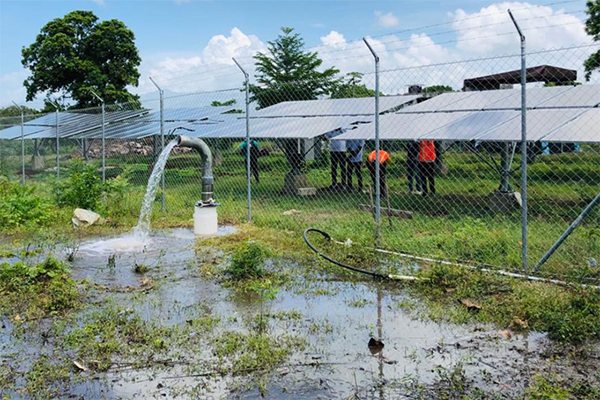
On this United Nations World Environment Day we recognize that all over the world, ecosystems are threatened. From forests and drylands to farmlands and lakes, natural spaces on which humanity’s existence depends are reaching a tipping point.
South-South and triangular cooperation is a powerful mechanism to support countries’ efforts to protect and restore the planet. It promotes collaboration on climate change mitigation and adaptation, helping countries develop, learn and adopt innovative approaches, knowledge and nature-based solutions.
This year, UNOSSC is highlighting the contributions of the United Nations Fund for South-South Cooperation, the India, Brazil and South Africa Facility for Poverty and Hunger Alleviation (IBSA Fund), the India-UN Development Partnership Fund and the Perez-Guerrero Trust Fund to support countries of the Global South in their efforts to mitigate and adapt to climate change, while advancing environmental sustainability.
“One urgent area in which the power of South-South cooperation must be harnessed is the quest for climate justice. Developing countries bear the brunt of climate change impacts. Through cooperative efforts, we can pool our resources and expertise to better adapt to the consequences of climate change and pursue sustainable energy alternatives.” — Dima Al-Khatib, Director of the United Nations Office for South-South Cooperation (UNOSSC)
In Cameroon, access to energy is a significant challenge, particularly in the northern regions where only 10-22 percent of households are connected to the grid. Many communities rely heavily on fuelwood, leading to severe deforestation and associated environmental issues, such as soil erosion and flash floods.
With the support of India-UN Development Partnership Fund, renewable energy solutions have been introduced in north Cameroon through the project Scaling-Up Rural Households’ Use of Renewable Energy and Energy-Efficient Technologies.
“This project enables us to harness our natural energy potential, which is the sun,” said Mohamadou Alidou of the National Advanced School of Engineering of Maroua, Cameroon. “Renewable energy is at the heart of most development projects, which justifies the education sector’s support to this project.”
Watch a video report on the project achievements:
Partnering with India’s Barefoot College, the project trained five women from rural villages in Cameroon to become ‘Solar Mamas’, equipping them with skills to maintain photovoltaic solar systems and train others, benefiting over 6,000 women and youth since 2021, and showcasing the transformative impact of renewable energy on rural livelihoods and environmental sustainability. The UN Fund for South-South Cooperation (UNFSSC) has been instrumental in fostering collaboration among developing countries to share knowledge, skills, and successful climate-action practices. Under the UNFSSC framework, UNOSSC initiated the South-South and Triangular Cooperation among Maritime-Continental Silk Road Cities for Sustainable Development Project (Cities Project) with funding support from the Government of China. This project promotes South-South and triangular cooperation at the city level to advance the Sustainable Development Goals (SDGs). Since its launch, the South-South Cities Project has captured and replicated innovative solutions in the context of city-to-city environmental cooperation and climate actions, particularly in the areas of renewable energy, urban planning and resilience, waste and water management and green sustainable transport. In partnership with UN-Habitat, the Cities Project developed the report Innovative experiences of Cities: Environmental Sustainability and Climate Action through South-South and Triangular Cooperation, offering 12 case studies of innovative approaches to environmental sustainability and climate action in small and large cities in Africa, Asia, and Latin America. The Cities Project has also funded a pilot initiative to improve green public transportation in the Metropolitan Region of Santiago (Chile) through cooperation with the city of Hangzhou (China). This initiative builds on the knowledge and technical expertise of Hangzhou on standardization of road foundations and aims to support the Metropolitan Region of Santiago in building a system to effectively monitor and mobilize transport resources and contribute to low-carbon development. Another important joint initiative of UNOSSC and the Government of China, with UNFSSC support, that has notably contributed to climate action in the Global South, is the Global South-South Development Center Project. This is a global network of centres of excellence for South-South cooperation in advancing SDGs. The project has supported institutional building of the International Center on Small Hydro Power (ICSHP) which has grown into a leading specialized intergovernmental organization with over 80 member states globally and has piloted initiatives on small hydropower and renewable energy research and development and training in Nepal and other Asian countries. Climate change and global warming have significant but often overlooked impacts on animal health and diseases, which are now global issues rather than confined to individual countries. Many scientific institutions of the Global South need to build capacity and disseminate knowledge related to these challenges. The spread of Bluetongue virus (BTV) in Europe and the Middle East, exacerbated by the effects of climate change, underscores the need for better understanding and control strategies. A project supported by the Perez-Guerrero Trust Fund, organized a consultation research workshop with experts from Algeria, Egypt, the Palestinian Authority, and Jordan to discuss the impact of climate change on animal diseases, develop control strategies, and investigate clinical cases of BTV in livestock in the region. This collaboration highlights the value and opportunities of knowledge-sharing and international cooperation in addressing climate-related health challenges. By working together, sharing knowledge and resources and standing in solidarity, we can all turn the challenge of climate change into an opportunity to build a more resilient, equitable and sustainable world.