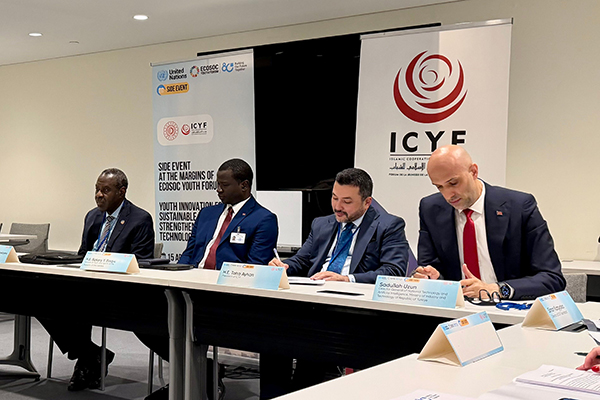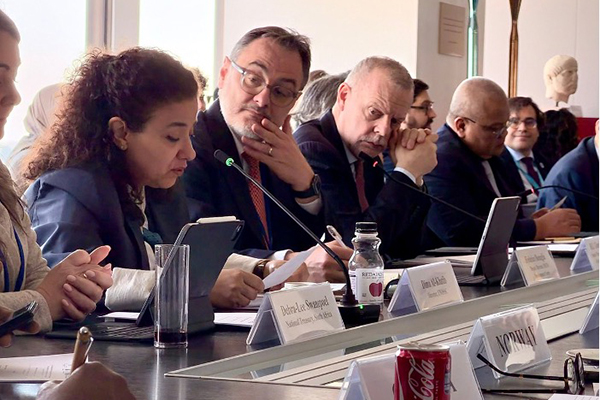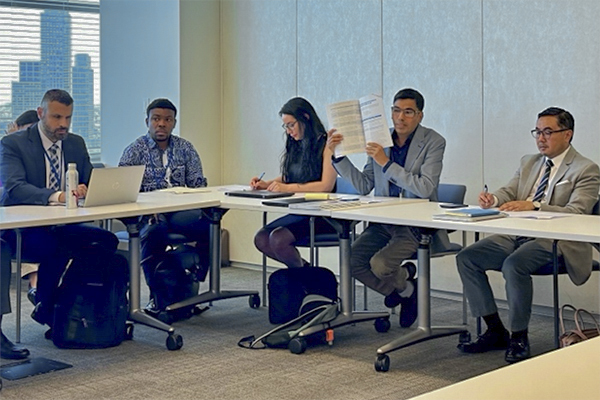
The Co-Chairs of the Group of Friends (GoF) of the Voluntary National Reviews (VNRs) – H.E. Omar Hilale, Permanent Representative of Morocco to the United Nations, and H.E. Antonio M. Lagdameo, Permanent Representative of the Philippines to the United Nations – convened an Expert-level meeting of the Group on 28 June, ahead of the July 2024 High-Level Political Forum on Sustainable Development. The Co-chairs were represented in the meeting by the H.E. Ms. Leila C. Lora-Santos, Deputy Permanent Representative of the Philippines to the United Nations, and Ms. Meriem El Hilali, Counselor, Permanent Mission of Morocco to the United Nations.
The meeting focused on leveraging multi-stakeholder engagement among countries presenting their VNRs of SDG progress in 2024 (Armenia, Austria, Azerbaijan, Belize, Brazil, Chad, Colombia, Congo (Republic of the), Costa Rica, Ecuador, Equatorial Guinea, Eritrea, Georgia, Guinea, Honduras, Kenya, Lao People’s Democratic Republic, Libya, Mauritania, Mauritius, Mexico, Namibia, Nepal, Oman, Palau, Peru, Samoa, Sierra Leone, Solomon Islands, South Africa, South Sudan, Spain, Syrian Arab Republic, Uganda, Vanuatu, Yemen, Zimbabwe).
Country-presenters discussed the role and participation of relevant stakeholders and major groups, the integration of regional/sub-regional engagements in the VNRs through South-South and triangular cooperation, as well as gender perspectives in the VNRs.
Mr. Oli Henman, Co-Chair, Major Groups & Other Stakeholders (MGOS), highlighted the important role of major groups to bring expertise and strategic solutions in the pursuit of sustainable development and in the VNRs. It was noted that MGOS run their own survey toward broad sharing of ideas of those active in each VNR presenting country. With regard to follow up, toolkits are available for national coalitions and local community groups; and multi-stakeholder mechanisms are available, including for example, for regular monitoring in between the VNRs.
Ms. Sara Faivre, Intergovernmental Specialist, UN Women, presented on interlinkages of SDGs and the role of gender equality in the VNR process, highlighting the perspective of women as a major group. She noted that addressing gender equality is the most efficient way to address the gap in SDG achievement. A best practice noted was the regular gathering and analysis of national and local data from women’s organizations; another involved the strengthening of women’s caucuses affecting parliamentary processes.
Mr. Bhushan Shrestha, United Nations Office for South-South Cooperation (UNOSSC) Results-Based Management Specialist, highlighted the growing importance of regional engagement and integrating the contributions of South-South and triangular cooperation in the VNRs.
“Countries are increasingly integrating South-South and triangular cooperation into VNRs,” said Mr. Shrestha. “Based on the UNOSSC’s internal assessment using the scorecard established in the Handbook on Integrating South-South and Triangular Cooperation in the Voluntary National Reviews, 35% of VNRs presented in 2023 HLPF integrated South-South and triangular cooperation in VNRs. This is an increase from 21% in 2021.”
Integration of South-South and triangular cooperation in VNRs is helping to track progress in implementing the 2030 Agenda more comprehensively and inclusively. It is generating evidence of South-South and triangular cooperation contributions toward achieving the SDGs; and promoting South-South and triangular cooperation through exchange of good practices and mutual learning.
In its 2020 VNR Report, Uganda highlighted data on South-South and triangular cooperation support from different partner countries including China, Republic of Korea, Saudi Arabia and Kuwait. In 2023, the Central African Republic reported the South-South support received from African and non-African countries including Morocco, South Africa, Libya, Rwanda, China and India. Also in 2023, Fiji included a specific sub-chapter on its work in South-South and triangular cooperation, and also highlighted the impact of the India-UN Development Partnership Fund managed by UNOSSC. In its 2024, Brazil has highlighted the importance of monitoring and reporting of SDG indictor 17.3.1, which deals with South-South cooperation.
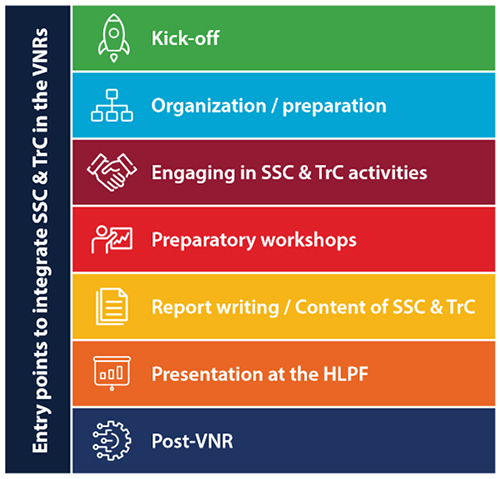
The Handbook suggests Member States consider seven entry points in integrating South-South and triangular cooperation in their VNRs. For 2024, the Member States have reached the presentation stage of their VNRs at HLPF. At the presentation stage, Member States may consider to feature South-South and triangular cooperation results within their main messages; and peer-countries may consider co-organizing or collaborating during side events at HLPF. After presentations of VNRs, Member States may consider including South-South and triangular cooperation elements into follow up of VNR actions, and monitor and report progress their implementation.
 One delegation noted the importance of VNR reporting on South-South cooperation work toward accelerating the SDGs, highlighting that ‘successes and lessons that are not reported do not exist, are not recognized and cannot be shared for scaling up’.
Concluding the GoF meeting, UNDESA colleagues addressed logistical arrangements for the engagement of delegations during VNR country presentations.
For more information please contact: Bhushan Shrestha, UNOSSC Results-Based Management Specialist (bhushan.shrestha@unossc.org)
One delegation noted the importance of VNR reporting on South-South cooperation work toward accelerating the SDGs, highlighting that ‘successes and lessons that are not reported do not exist, are not recognized and cannot be shared for scaling up’.
Concluding the GoF meeting, UNDESA colleagues addressed logistical arrangements for the engagement of delegations during VNR country presentations.
For more information please contact: Bhushan Shrestha, UNOSSC Results-Based Management Specialist (bhushan.shrestha@unossc.org)
One delegation noted the importance of VNR reporting on South-South cooperation work toward accelerating the SDGs, highlighting that ‘successes and lessons that are not reported do not exist, are not recognized and cannot be shared for scaling up’.
Concluding the GoF meeting, UNDESA colleagues addressed logistical arrangements for the engagement of delegations during VNR country presentations.
For more information please contact: Bhushan Shrestha, UNOSSC Results-Based Management Specialist (bhushan.shrestha@unossc.org)