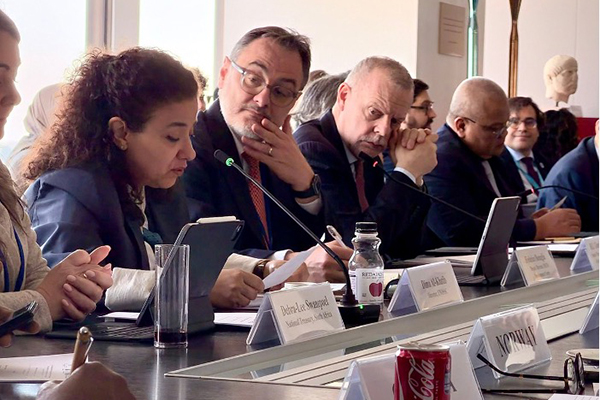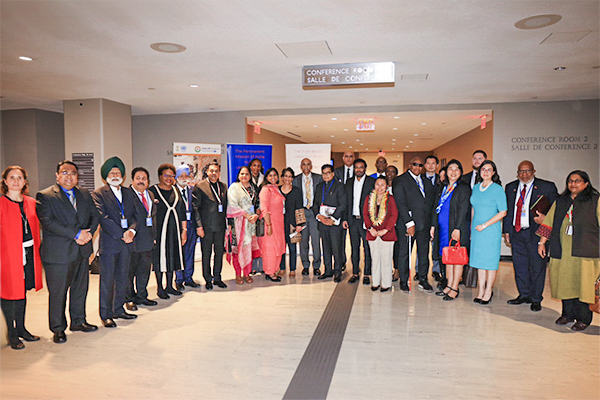
Twelve high-ranking Parliamentarians from India convened with Permanent Representatives to the United Nations from countries partnering with the India-UN Development Partnership Fund, for an interactive dialogue.
The event highlighted the Fund’s achievements and provided an opportunity to jointly review the project portfolio, showcasing how it is helping partner countries advance the Sustainable Development Goals (SDGs) and address local challenges.
The India-UN Development Partnership Fund is a flagship initiative of India’s commitment to South-South cooperation and sustainable development. Since its establishment in 2017 with a $150 million pledge, the Fund, managed by the United Nations Office for South-South Cooperation (UNOSSC), has supported 84 projects in 62 countries. Through Southern-owned and led, demand-driven projects, it focuses on eradicating poverty, fostering gender equality, and ensuring access to quality education, basic services, and economic opportunity across the developing world.
During the event, Honorable Member of the Indian Parliament, Professor Ram Gopal Yadav, affirmed “India has always been a champion of the South,” underscoring India’s dedication to supporting equitable sustainable development through South-South cooperation.
“Partnering with the United Nations in creating the India-UN Development Partnership Fund, we are supporting living examples of South-South cooperation. We do this from our own experiences on the ground, and how we scaled those to our 1.5 billion people,” said H.E. Parvathaneni Harish, Ambassador Permanent Representative of India to the United Nations. “As India progresses, we want our friends to join us,” he said, highlighting India’s commitment to raising the voice of fellow countries from the South and working jointly through multilateral approaches.
In a collaborative effort to support the 2030 Agenda for Sustainable Development, the Fund operates with a strong emphasis on Least Developed Countries (LDCs), Landlock Developing Countries (LLDCs) and Small Island Developing States (SIDS), offering partnerships in various areas including climate resilience, livelihood development, health, education, agriculture, food security, and infrastructure.
By promoting innovation and strengthening global partnerships, the Fund continues to transform the lives of vulnerable populations in partner countries.
“The Fund has a unique focus on LDCs, SIDS and the most vulnerable; and India insists on non-conditionality and no qualifying criteria in terms of its wider political objectives,” said H.E. Mr. Dennis Francis, Permanent Representative of Trinidad and Tobago and President of the 78th Session of the United Nations General Assembly. “In its purest sense, this is a development fund.”
“UNDP is proud be a partner of India, as well as to implement close to half of the India-UN Development Partnership Fund projects on the ground,” said Ms. Kanni Wignaraja, Assistant Secretary-General, and UNDP Regional Director for Asia and the Pacific. “We have learned that the moment you learn to scale in India, you can apply this learning in different contexts around the world.”
“The projects supported by the Fund are changing the lives of people today and building more resilient communities across the Global South for the future,” said Xiaojun Grace Wang, UNOSSC Officer-in-Charge and Trust Fund Director. “As we speak, in Nigeria, 4,000 community members are being equipped with biodiversity business skills, like beekeeping, mushroom farming, and fish cultivation, supported by UNESCO. In Trinidad and Tobago, in partnership with PAHO-WHO, the Fund supported a future-ready health infrastructure with the deployment of healthcare robots. Across the Pacific, supported by UNDP, 11 Small Island Developing States installed solar systems in key government buildings, demonstrating a glowing example and a united South-South push towards renewable energy.”
“I hope, through this dynamic and ever-evolving partnership, we can aspire to enhance and elevate the India-UN Development Partnership Fund’s role as a driving force for change, and a source of inspiration,” said Xiaojun Grace Wang. “As we look ahead, we hope to chart pathways together with all partners towards an ambitious future, driven by hope, solidarity, and the unyielding spirit of South-South cooperation.”
Since its inception, the India-UN Development Partnership Fund has achieved numerous milestones. Its projects have strengthened healthcare infrastructure, ensuring better access to quality services for vulnerable populations. Renewable energy initiatives have reduced carbon emissions, contributing to a sustainable energy future. Education programs, particularly focused on girls and marginalized communities, have enhanced literacy and access to quality education, while numerous initiatives have advanced gender equality, women’s empowerment, and entrepreneurship.
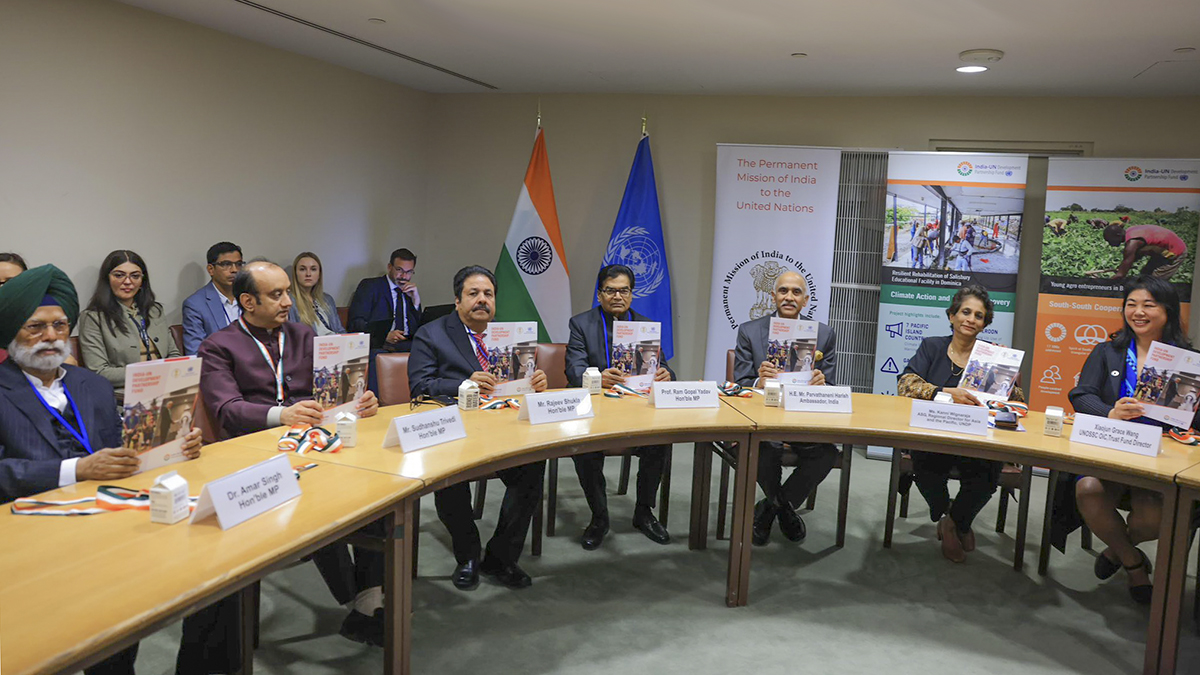 The event also marked the launch of the India-UN Development Partnership Fund Annual Report, documenting the Fund’s achievements and insights into projects across the developing world.
The gathering facilitated a dialogue with the Permanent Representatives of El Salvador, Dominica, Malawi, Moldova, Rwanda, Sierra Leone, Suriname and Ambassadors Charge-d’Affairs of Barbados, Belize, Lao PDR and the Federated States of Micronesia, moderated by Ines Tofalo, UNOSSC Trust Fund and Project Management Specialist. Their remarks conveyed widespread support and appreciation of the successful projects undertaken by the Fund.
The conversation underscored India’s extraordinary commitment to a sustainable, inclusive future, demonstrating how collective action and South-South cooperation can bring about lasting positive change across the global South.
The event also marked the launch of the India-UN Development Partnership Fund Annual Report, documenting the Fund’s achievements and insights into projects across the developing world.
The gathering facilitated a dialogue with the Permanent Representatives of El Salvador, Dominica, Malawi, Moldova, Rwanda, Sierra Leone, Suriname and Ambassadors Charge-d’Affairs of Barbados, Belize, Lao PDR and the Federated States of Micronesia, moderated by Ines Tofalo, UNOSSC Trust Fund and Project Management Specialist. Their remarks conveyed widespread support and appreciation of the successful projects undertaken by the Fund.
The conversation underscored India’s extraordinary commitment to a sustainable, inclusive future, demonstrating how collective action and South-South cooperation can bring about lasting positive change across the global South.
The event also marked the launch of the India-UN Development Partnership Fund Annual Report, documenting the Fund’s achievements and insights into projects across the developing world.
The gathering facilitated a dialogue with the Permanent Representatives of El Salvador, Dominica, Malawi, Moldova, Rwanda, Sierra Leone, Suriname and Ambassadors Charge-d’Affairs of Barbados, Belize, Lao PDR and the Federated States of Micronesia, moderated by Ines Tofalo, UNOSSC Trust Fund and Project Management Specialist. Their remarks conveyed widespread support and appreciation of the successful projects undertaken by the Fund.
The conversation underscored India’s extraordinary commitment to a sustainable, inclusive future, demonstrating how collective action and South-South cooperation can bring about lasting positive change across the global South.