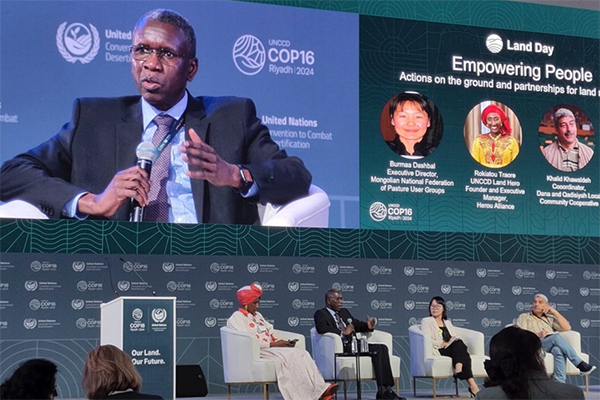
By deepening partnerships, we can transform green finance challenges into opportunities for land restoration
The 16th Session of the Conference of the Parties (COP16) of the United Nations Convention to Combat Desertification (UNCCD), held 2-13 December 2024, in Riyadh, Saudi Arabia, was particularly important for the Global South. It provided a crucial opportunity for developing countries to shape global policies, access resources, and implement projects that combat desertification, improve livelihoods, and enhance resilience to climate change, all of which are vital for their sustainable development.
The nearly 200 countries gathered at the 16th Conference of the Parties (COP16) to the UN Convention to Combat Desertification (UNCCD) and committed to prioritising land restoration and drought resilience in national policies and international cooperation as an essential strategy for food security and climate adaptation. Parties adopted a strong political declaration and 39 decisions shaping the way forward.
UNCCD COP16 was the first major UN conference hosted by the Kingdom of Saudi Arabia. It was also the first time a UNCCD COP was held in the Middle East and North Africa (MENA) region, which knows firsthand the impacts of desertification, land degradation and drought (DLDD).
“Desertification disproportionately affects vulnerable populations of the South,” noted UNOSSC Senior Policy Development Advisor Samba Harouna Thiam, representing UNOSSC at COP16. “COP16 is a key opportunity to advocate for increased financial support, technical assistance, and partnerships aimed at restoring degraded land and improving resilience,” he said. “COP16 is also critical for making progress on multiple Sustainable Development Goals, particularly SDG 15 (Life on Land), which aims to halt and reverse land degradation.”
“The crisis of land degradation exemplifies the interconnected challenges we face,” said Mr. Thiam, speaking at a panel discussion on Catalyzing Green Finance for the Arab States region, organized by UNDP RBAS, UNCDF in collaboration with key stakeholders.
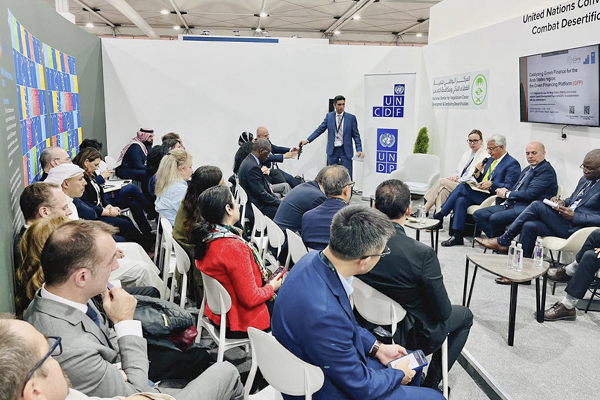 Mr. Thiam added that to truly accelerate the transition to a green and sustainable future we must harness the power of South-South and triangular cooperation by sharing knowledge and resources amongst countries of the Global South. It is imperative, he said, to enhance the triangular cooperation. UNOSSC has launched a Triangular Window of the United Nations Fund for South-South Cooperation which is promoting partnership with countries and partners from the North.
“The land restoration moonshot is one of the pressing challenges of our time, which reminds us that no nation, regardless of size or strength, can tackle the challenges of land degradation and drought alone. South-South cooperation offers not just a path forward, but a beacon of hope,” he said. “At the heart of South-South cooperation lies the sharing of knowledge and expertise.”
The countries of the Global South possess a wealth of knowledge, innovation, and experience. These assets – rooted in shared challenges and aspirations – must be harnessed collectively to build a more sustainable, equitable, and resilient future.
“We all know that Contexts matter,” said Mr. Thiam. “We need solutions rooted in local context and knowledge, shaped by stakeholders who know their own needs and informed by what already works in similar situations. I therefore, invite you to engage in our South-South Galaxy that offers over 950 solutions specific to Global South priorities mainly from local communities. We need to build ecosystems of support and networked capacities in areas that can help amplify impact.”
From Africa’s Great Green Wall initiative to Latin America’s community-driven agroforestry programs, the Global South has pioneered solutions that restore degraded land, support livelihoods, and build resilience against climate shocks. These efforts embody the spirit of collaboration that South-South partnerships can amplify. This is not a one-way transfer but a dynamic, reciprocal exchange and learning including from local communities.
Mr. Thiam added that to truly accelerate the transition to a green and sustainable future we must harness the power of South-South and triangular cooperation by sharing knowledge and resources amongst countries of the Global South. It is imperative, he said, to enhance the triangular cooperation. UNOSSC has launched a Triangular Window of the United Nations Fund for South-South Cooperation which is promoting partnership with countries and partners from the North.
“The land restoration moonshot is one of the pressing challenges of our time, which reminds us that no nation, regardless of size or strength, can tackle the challenges of land degradation and drought alone. South-South cooperation offers not just a path forward, but a beacon of hope,” he said. “At the heart of South-South cooperation lies the sharing of knowledge and expertise.”
The countries of the Global South possess a wealth of knowledge, innovation, and experience. These assets – rooted in shared challenges and aspirations – must be harnessed collectively to build a more sustainable, equitable, and resilient future.
“We all know that Contexts matter,” said Mr. Thiam. “We need solutions rooted in local context and knowledge, shaped by stakeholders who know their own needs and informed by what already works in similar situations. I therefore, invite you to engage in our South-South Galaxy that offers over 950 solutions specific to Global South priorities mainly from local communities. We need to build ecosystems of support and networked capacities in areas that can help amplify impact.”
From Africa’s Great Green Wall initiative to Latin America’s community-driven agroforestry programs, the Global South has pioneered solutions that restore degraded land, support livelihoods, and build resilience against climate shocks. These efforts embody the spirit of collaboration that South-South partnerships can amplify. This is not a one-way transfer but a dynamic, reciprocal exchange and learning including from local communities.
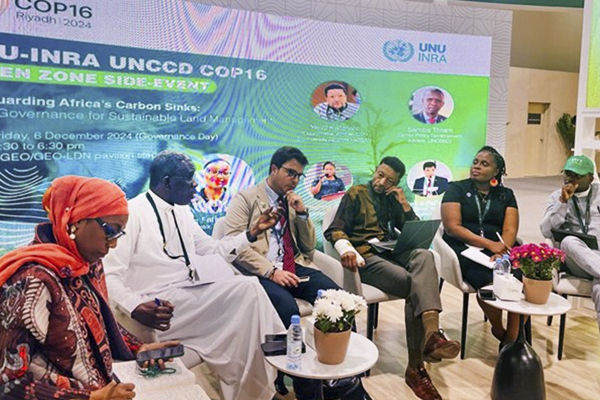 UNOSSC is committed to supporting best-fit, context specific South-South and triangular cooperation approaches that can help the region leverage and grow from its own assets, and to accompany its locally-owned pathways to a sustainable future, he said at the “Safeguarding Africa’s Carbon Sinks: Local Governance for Sustainable Land Management”, organized by the UNU Institute for Natural Resources in Africa (UNUINRA).
Governance for sustainable land management must be responsive and tailored to the local context. This means, on the one hand, building the technical and resource capacities of local governments to function as required, to understand their sensitive ecosystems better, to develop and implement policies and regulations that protect their land and natural resources, to promote sustainable land use practices, and to be able to address illegal activities, among others.
This also means, on the other hand, supporting and leveraging further the key role played by local communities and indigenous peoples as key stewards of our ecosystems and the existing knowledge and local solutions that can be showcased as important knowledge resources.
UNOSSC is committed to supporting best-fit, context specific South-South and triangular cooperation approaches that can help the region leverage and grow from its own assets, and to accompany its locally-owned pathways to a sustainable future, he said at the “Safeguarding Africa’s Carbon Sinks: Local Governance for Sustainable Land Management”, organized by the UNU Institute for Natural Resources in Africa (UNUINRA).
Governance for sustainable land management must be responsive and tailored to the local context. This means, on the one hand, building the technical and resource capacities of local governments to function as required, to understand their sensitive ecosystems better, to develop and implement policies and regulations that protect their land and natural resources, to promote sustainable land use practices, and to be able to address illegal activities, among others.
This also means, on the other hand, supporting and leveraging further the key role played by local communities and indigenous peoples as key stewards of our ecosystems and the existing knowledge and local solutions that can be showcased as important knowledge resources.
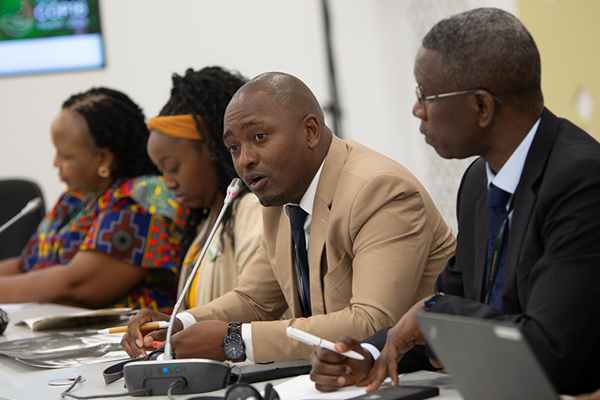 Mr. Thiam moderated the session: “Showcasing the contribution of local actors to the implementation of the Great Green Wall strategy at the community level in the SADC region and exploring synergies for expanding their reach” organized by the African Union Commission, the GEF Small Grants Program, the Southern African Development Community.
“The solutions are where the challenges are,” he said. “South-South knowledge sharing of context-specific scientific advancements and technologies enhance sustainable land management in areas such as water management, land restoration, and resilience building.”
Through South-South cooperation developing countries can advance equitable land governance, especially in regions where vulnerable populations are disproportionately affected by changing climate. By sharing governance frameworks and inclusive policies, countries can better promote fair resource use, crucial for sustainable development and addressing land degradation challenges.
“By deepening partnerships, sharing resources and building capacities,” Mr. Thiam said, “We can transform the current green finance challenges into opportunities for growth and innovation.”
Within the collaborative framework between UNDP and UNOSSC, UNDP also shared examples from UNDP’s work on sustainable land management promoting South-South and triangular cooperation.
Mr. Thiam also attended the high-level session launching the World Drought Atlas, which serves as a wake-up call, offering insights into the stark realities of drought and calling for urgency in response. It reminds us that drought lacks regard for borders, leaving no region or country, regardless of their level of development, immune to its impacts.
Mr. Thiam moderated the session: “Showcasing the contribution of local actors to the implementation of the Great Green Wall strategy at the community level in the SADC region and exploring synergies for expanding their reach” organized by the African Union Commission, the GEF Small Grants Program, the Southern African Development Community.
“The solutions are where the challenges are,” he said. “South-South knowledge sharing of context-specific scientific advancements and technologies enhance sustainable land management in areas such as water management, land restoration, and resilience building.”
Through South-South cooperation developing countries can advance equitable land governance, especially in regions where vulnerable populations are disproportionately affected by changing climate. By sharing governance frameworks and inclusive policies, countries can better promote fair resource use, crucial for sustainable development and addressing land degradation challenges.
“By deepening partnerships, sharing resources and building capacities,” Mr. Thiam said, “We can transform the current green finance challenges into opportunities for growth and innovation.”
Within the collaborative framework between UNDP and UNOSSC, UNDP also shared examples from UNDP’s work on sustainable land management promoting South-South and triangular cooperation.
Mr. Thiam also attended the high-level session launching the World Drought Atlas, which serves as a wake-up call, offering insights into the stark realities of drought and calling for urgency in response. It reminds us that drought lacks regard for borders, leaving no region or country, regardless of their level of development, immune to its impacts.
Key messages
1. South-South knowledge sharing builds capacity for sustainable land management. And nature based solutions.- The solutions are where the challenges are. South-South knowledge sharing of context-specific scientific advancements and technologies that enhance sustainable land management in areas such as water management, land restoration, and resilience building.
- Through South-South cooperation developing countries can advance equitable land governance, especially in regions where vulnerable populations are disproportionately affected by changing climate. By sharing governance frameworks and inclusive policies, countries can better promote fair resource use, crucial for sustainable development and addressing land degradation challenges.
- South-South and triangular cooperation offer opportunities to leverage private sector investment in green technologies, land restoration and nature-positive solutions. Meanwhile, civil society organizations and grassroots movements are essential in advocating for inclusive climate policies that ensure context-specific solutions. By empowering local communities, particularly those most affected by land degradation and drought, South-South partnerships will help achieve a just transition that uplifts the most vulnerable.
Mr. Thiam added that to truly accelerate the transition to a green and sustainable future we must harness the power of South-South and triangular cooperation by sharing knowledge and resources amongst countries of the Global South. It is imperative, he said, to enhance the triangular cooperation. UNOSSC has launched a Triangular Window of the United Nations Fund for South-South Cooperation which is promoting partnership with countries and partners from the North.
“The land restoration moonshot is one of the pressing challenges of our time, which reminds us that no nation, regardless of size or strength, can tackle the challenges of land degradation and drought alone. South-South cooperation offers not just a path forward, but a beacon of hope,” he said. “At the heart of South-South cooperation lies the sharing of knowledge and expertise.”
The countries of the Global South possess a wealth of knowledge, innovation, and experience. These assets – rooted in shared challenges and aspirations – must be harnessed collectively to build a more sustainable, equitable, and resilient future.
“We all know that Contexts matter,” said Mr. Thiam. “We need solutions rooted in local context and knowledge, shaped by stakeholders who know their own needs and informed by what already works in similar situations. I therefore, invite you to engage in our South-South Galaxy that offers over 950 solutions specific to Global South priorities mainly from local communities. We need to build ecosystems of support and networked capacities in areas that can help amplify impact.”
From Africa’s Great Green Wall initiative to Latin America’s community-driven agroforestry programs, the Global South has pioneered solutions that restore degraded land, support livelihoods, and build resilience against climate shocks. These efforts embody the spirit of collaboration that South-South partnerships can amplify. This is not a one-way transfer but a dynamic, reciprocal exchange and learning including from local communities.
UNOSSC is committed to supporting best-fit, context specific South-South and triangular cooperation approaches that can help the region leverage and grow from its own assets, and to accompany its locally-owned pathways to a sustainable future, he said at the “Safeguarding Africa’s Carbon Sinks: Local Governance for Sustainable Land Management”, organized by the UNU Institute for Natural Resources in Africa (UNUINRA).
Governance for sustainable land management must be responsive and tailored to the local context. This means, on the one hand, building the technical and resource capacities of local governments to function as required, to understand their sensitive ecosystems better, to develop and implement policies and regulations that protect their land and natural resources, to promote sustainable land use practices, and to be able to address illegal activities, among others.
This also means, on the other hand, supporting and leveraging further the key role played by local communities and indigenous peoples as key stewards of our ecosystems and the existing knowledge and local solutions that can be showcased as important knowledge resources.
Mr. Thiam moderated the session: “Showcasing the contribution of local actors to the implementation of the Great Green Wall strategy at the community level in the SADC region and exploring synergies for expanding their reach” organized by the African Union Commission, the GEF Small Grants Program, the Southern African Development Community.
“The solutions are where the challenges are,” he said. “South-South knowledge sharing of context-specific scientific advancements and technologies enhance sustainable land management in areas such as water management, land restoration, and resilience building.”
Through South-South cooperation developing countries can advance equitable land governance, especially in regions where vulnerable populations are disproportionately affected by changing climate. By sharing governance frameworks and inclusive policies, countries can better promote fair resource use, crucial for sustainable development and addressing land degradation challenges.
“By deepening partnerships, sharing resources and building capacities,” Mr. Thiam said, “We can transform the current green finance challenges into opportunities for growth and innovation.”
Within the collaborative framework between UNDP and UNOSSC, UNDP also shared examples from UNDP’s work on sustainable land management promoting South-South and triangular cooperation.
Mr. Thiam also attended the high-level session launching the World Drought Atlas, which serves as a wake-up call, offering insights into the stark realities of drought and calling for urgency in response. It reminds us that drought lacks regard for borders, leaving no region or country, regardless of their level of development, immune to its impacts.