Pérez-Guerrero Trust Fund for South-South Cooperation (PGTF) projects continue to play a significant role supporting South-South cooperation among institutions, academia, local actors, and communities of the Global South. Through its catalytic small grants – managed by UNOSSC on behalf of the Group of 77 – the PGTF continues to support research, exchange of knowledge, awareness, capacity development, technological solutions, environmental protection, and much more.
During the last 12-month period, PGTF small grants projects have brought together more than 100 institutions in Southern countries, benefiting almost 4,000 people.
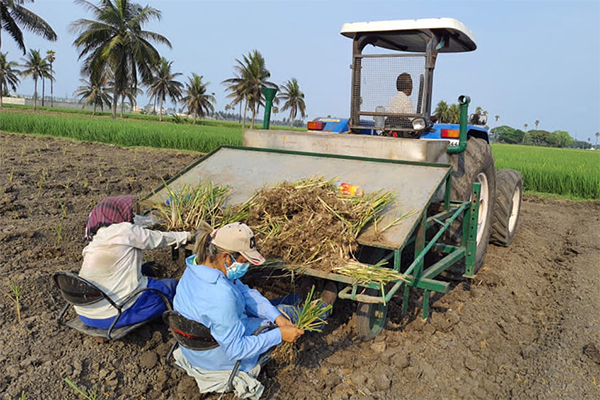
For example, during 2024, PGTF projects contributed towards increased agriculture production, and prevention of diseases in agricultural crops and animals. Through scientific research, technological innovations, and development of communities’ capacities for management of natural resources, the PGTF small grants projects contributed to improved livelihoods. For example, the project entitled “Production of isolated sugarcane buds”, involving cooperation of experts from Colombia, Costa Rica, Cuba, and India, is successfully promoting higher productivity of sugarcane buds and improved crop varieties and yields, all leading to economic benefits. More than 120 producers and stakeholders are considering scaling up the project’s methodology. Furthermore, three seed banks in the region, América Libre, Dos Ríos, and INICA Santiago de Cuba, have added the project’s results in their banks.
Another project, “Production of enzymatic biocatalysts (a-amylase, dextranase)” in Costa Rica, Cuba, and Mexico is producing enzymatic biocatalysts from renewable sugarcane by-products.
Yet another PGTF project, titled “A proposal to enhance the diagnostic capacities and biosecurity of anthrax”, brought together experts from Afghanistan, Algeria, Pakistan, Jordan and Yemen to enhance diagnostic capacities, biosafety, and biosecurity against zoonotic diseases in animals. This project has an emphasis on sharing knowledge on pathology, epidemiology, and zoonotic protocols.
Another project, titled “Obtaining derivatives of steroidal compounds” – through South-South cooperation among four universities from Brazil, Colombia, and Cuba – enabled at least 400 faculty members and students to be engaged on discussions, trainings, exchanges, and scientific research, including on the extraction of useful chemicals from the Agave plant and exploration of technical solutions for economic impact.
Other PGTF projects contributed towards environmental protection, including forest management, biodiversity, climate change mitigation, and renewable energy. For example, a recently completed project, “Cooperative Action in Recycling and Reuse of Olive Mill Waste”, brought together researchers from Egypt, Jordan, and Tunisia. The three countries are among the largest producers of olive oil, with 2 million hectares planted, and over 97 million olive trees. The project explored options for utilization of solid and liquid waste of olive oil mills, such as biogas production from olive mill solid waste, and utilization of the liquid waste for crop irrigation.
Another PGTF project, titled “International training demand-oriented strategy formulation for forest sustainable development”, is focused on forest management through capacity building of at least 190 specialists from 62 institutions from Argentina, Brazil, Democratic Republic of Congo and Uganda.
In another project, “Rethinking climate change mitigation strategies by improving phenological adaptability and tolerance”, specialists from Argentina, Chile, and Uruguay are collaborating to support farmers in optimizing crop yields to cope with climate changes. They are designing a simple quantitative model on frost and heat shock risks for cereals and oilseeds that will empower farmers to establish the best sowing timeframe for these crops.
On another continent, the PGTF project “Development and application of solar pumping irrigation technology”, is contributing to a deeper understanding of crops’ solar and water resources’ needs and suitable solar irrigation technologies for various agricultural fields in ASEAN countries.
The PGTF catalytic small grants projects are providing benefits to the institutions and stakeholders directly involved in implementing projects on the ground – and the results are being shared widely among researchers and communities across the South.