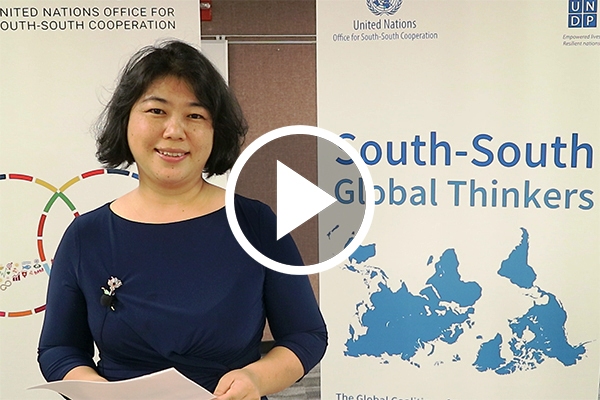
Xiaojun Grace Wang
Deputy Director, UNOSSC
20 September 2018
Video Message for the Inter-Ministerial Conference on South-South and Triangular Cooperation: Emerging Population and Development Issues Influencing the 2030 Agenda (Bali, Indonesia, from 18 to 20 September 2018)
Good afternoon everyone. Thank you for inviting me to contribute to this important discussion on South-South and triangular cooperation impact assessments.
While traditional monitoring and evaluation frameworks are concerned with measuring results against a pre-defined set of targets and criteria of efficiency and effectiveness, we understand that impact assessments focus on the effects of an intervention and the extent to which these interventions are making a difference in the lives of people.
If we apply the two purposes of evaluation – learning and accountability here, in essence, impact assessments are learning exercise – they are designed to find out what change has taken place, and why. It can also serve an accountability purpose at an outcome level. However, it is not designed to account for things such as how much money has been involved, how these funds are being spent, whether activities are occurring in the most efficient and effective manner, etc.
In many ways, these high-level purposes of impact assessments are very much aligned with the characteristics of South-South cooperation, which highlights mutual learning and long-term capacity gains benefiting the developing countries in partnership with each other. Therefore, in the discourse of South-South Cooperation, while evaluation is often inviting controversial views in relation to “on whose terms and for what purpose”, impact assessment seems to be more acceptable to many Southern partners, especially with the Sustainable Development Goals providing a clear common vision for the world.
There are also technical challenges faced in evaluating, or even assessing impact of the SSC agenda. For example:
- Different views exist on the extent to which information should be provided and to whom. Some Southern partners see their primary accountability is mutual between the governments involved in a certain South-South initiative, not to any external parties to evaluate, nor should it be applicable to use frameworks defined by “others”.
- The diversity of South-South and triangular activities presents a range of modalities including financial support; technical cooperation; knowledge exchange; some including also South-South trade facilitation and investment promotion measures, which often coming in a package between South-South cooperation countries. Different views exist on how to measure these elements of inputs. Some like to monetize their contributions. Others oppose this, arguing that it leads to underestimation of the real and mutual contribution, or does not accurately reflect the spirit and principles of South-South cooperation.