India-UN Fund: Transforming Lives Across the Global South
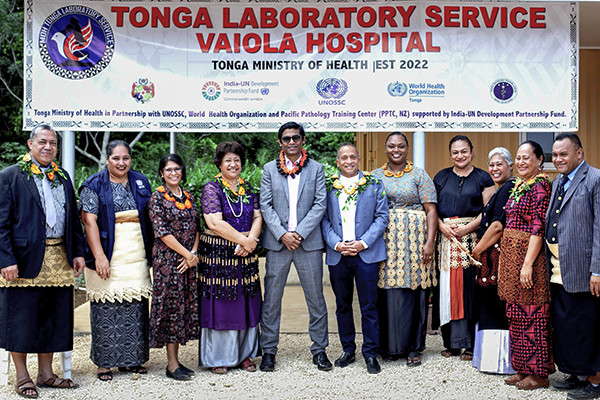
This project – involving the Tonga Ministry of Health and Medical Services, Health Department and WHO – supported the strengthening of the health sector by providing medical equipment, supplies and personal protective equipment.
The India-UN Development Partnership Fund is a dedicated facility established in 2017 within United Nations Fund for South-South Cooperation. It is supported and led by the Government of the Republic of India, managed by UNOSSC, and implemented in collaboration with the United Nations system.
The India-UN Development Partnership Fund supports Southern-owned and led, demand-driven, and transformational sustainable development projects across the developing world, with a focus on least developed countries and small island developing states. United Nations agencies implement the Fund’s projects in close collaboration with partnering governments.
2024 Impact Overview
In 2024, under the guidance of its Board of Directors, the India-UN Development Partnership Fund continued to support South-South cooperation through 28 projects, implemented by 8 UN agencies, in cooperation with national stakeholders in 30 countries. As a result of these projects, almost 2.9 million people (52% females) were supported in improving livelihoods and gaining knowledge and expertise.
The India-UN Fund projects contributed to all SDGs, with a special focus on gender equality, renewable energy, technology and digitalization for improved living conditions, health, education, and environmental protection.
For example, a project in Kyrgyzstan is improving maternal health services in five maternity hospitals through the introduction of obstetric surveillance systems, tele-networking, and tele-counseling.
In Moldova, the second phase of a project focused on digitalization of national statistical systems, is bringing technology to critical national data systems. This is allowing for data-informed policy making and implementation in education, national insurance, gender surveys, and border management.
A project in Tuvalu is working to improve water supply for the island’s 400 students and almost 100 staff members of the Motufoua middle secondary school.
A project in Trinidad and Tobago developed a draft “Policy on the use of Digital Health Technologies in the Delivery of Health Services in the Public Sector”. This initiative also deployed eight healthcare robots into the country’s health system.
In Nigeria, a project is supporting 2,500 families in developing sustainable, environmentally friendly businesses that will contribute to improved livelihoods and environmental protection.
A project in El Salvador is encouraging literacy and reading at home by distributing 27,000 books to 7,000 children in 84 schools, and helping at least 8,000 families in strategies for advancing reading at home.
A summary of the India-UN Fund projects and their results can be found at this link.