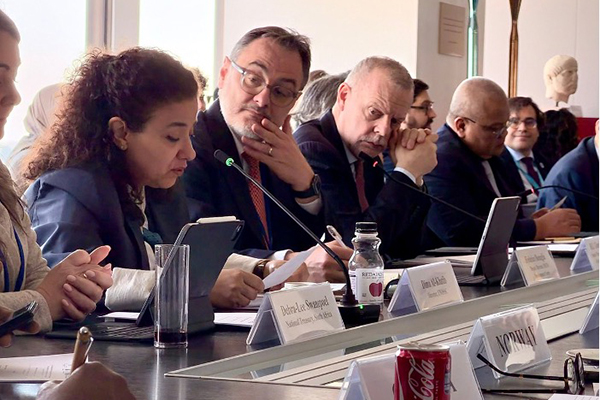
As the international community prepares for the Fourth International Conference on Financing for Development (FfD4) in Spain, a timely workshop brought together leading voices from international financial institutions (IFIs), multilateral development banks, governments, the United Nations, the private sector, and academia. The event, “Evolving the International Financial Institutions for Reinvigorated Global Development and Multilateralism”, was hosted by the Konrad-Adenauer-Stiftung (KAS) offices in Washington, D.C. and New York.
Marking 80 years since the founding of the Bretton Woods institutions, the workshop served as a platform to reassess and reimagine the roles of global financial institutions in light of today’s development and climate crises. With a global financing gap for the Sustainable Development Goals (SDGs) now surpassing $4 trillion, and nearly 40% of the world’s population living in countries where debt interest payments exceed education and health spending, the call for IFI evolution has never been more urgent.
A System Under Pressure
The workshop opened with a powerful reflection on the need to reshape IFIs to meet today’s interconnected global challenges. From persistent climate threats and global health risks to widening digital divides and geopolitical volatility, the discussions emphasized that IFIs must be retooled to ensure economic stability and inclusive development.
The first session focused on Global Economic Governance and Financial Institutions, where participants explored how IFIs are responding to shifting priorities, including efforts to enhance representation, modernize mandates, and align with the 2030 Agenda for Sustainable Development. Speakers underscored that future-fit IFIs must move beyond traditional approaches, incorporating perspectives from developing countries and advancing inclusive economic governance models.
A recurring theme was the role of cooperation – particularly South-South and triangular cooperation – in enhancing connectivity and shared learning across developing economies. Highlighted were opportunities to better integrate IFI’s into broader United Nations frameworks and intergovernmental processes.
During the workshop, UNOSSC Director Dima Al-Khatib emphasized the importance of inclusive and representative governance in IFIs, aligning their operations with the 2030 Agenda for Sustainable Development, and increasing access to affordable, long-term financing for developing countries. The Director also highlighted the necessity for IFIs to provide agile contingency financing and support fair and timely debt restructuring.
The Director further elaborated on UNOSSC’s role in fostering dialogue on global economic governance through policy advocacy, promoting policy briefs, and partnerships with various IFIs. Her intervention underscored the strategic opportunities for strengthening synergies between IFIs, the UN, and Member States, particularly through aligning development frameworks, scaling up South-South and triangular technical cooperation, and promoting innovative financing partnerships. In closing, the Director reaffirmed UNOSSC’s commitment to supporting the Global South in amplifying their voices, strengthening capacities, and mobilizing partnerships to create a more inclusive and effective global financial architecture.
Unlocking Private Capital for Sustainable Development
The second session focused on Mobilizing Domestic and International Private Finance. The conversation highlighted the growing recognition of private capital as a critical enabler of sustainable development, particularly in sectors such as climate resilience, infrastructure, and digital transformation.
It was noted that IFIs play a key role in creating enabling environments for private sector engagement. Examples shared illustrated successful public-private partnerships and catalytic financing approaches. However, challenges such as regulatory fragmentation, lack of capacity, and limited pipeline development remain.
Moving forward, it was emphasized that stronger collaboration between IFIs, national governments, the private sector, and civil society to unlock scalable solutions was necessary – aligned with national development priorities.
Bridging Multilateral Processes
The workshop concluded with a forward-looking discussion on the importance of sustaining momentum as the world moves toward FfD4. Participants affirmed the value of multi-stakeholder engagement in driving actionable outcomes and fostering a more inclusive, transparent, and resilient global financial system that advances the SDG achievement.