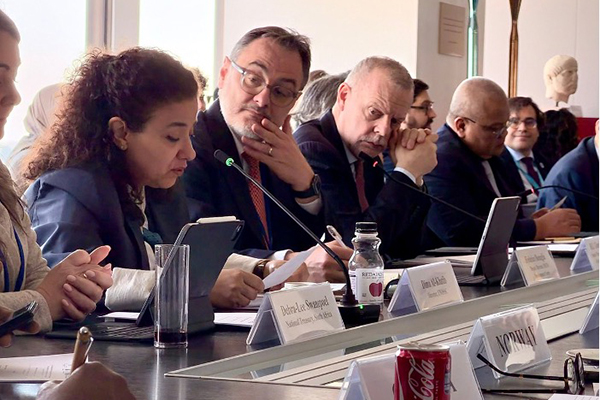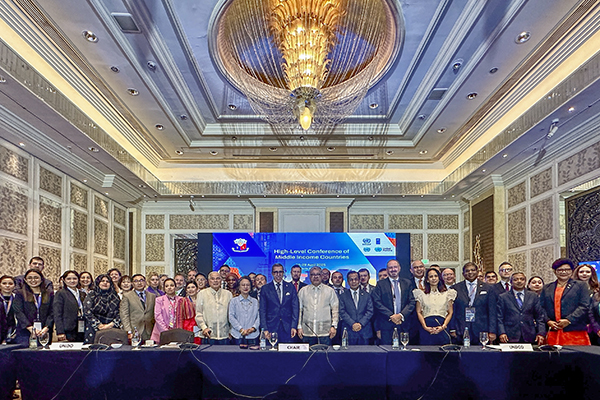
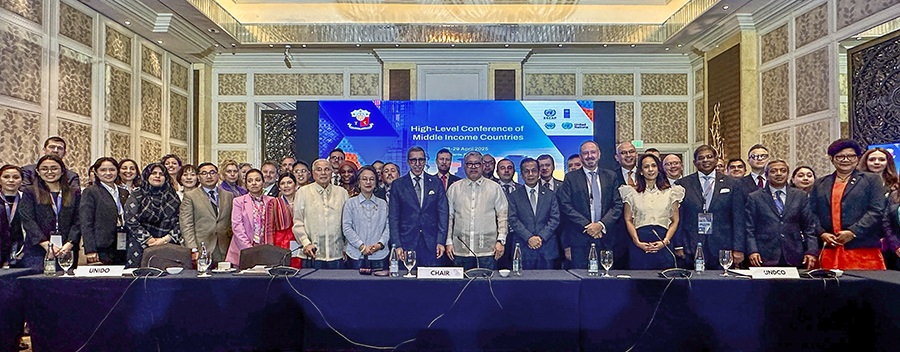
 A new global action plan aimed at supporting middle-income countries (MICs) was officially adopted in the Philippines this week. Known as the Makati Declaration, the plan was the outcome of the High-Level Conference of Middle-Income Countries (HLC-MICs) hosted by the Philippine government as incoming MICs Chair, in Makati City from April 28 to 29.
The High-Level Conference brought together more than 200 leaders and senior representatives from 24 MICs. Their shared goal: to craft strategies that help MICs grow sustainably, and play a stronger role in shaping the global development agenda.
The Makati Declaration endorses recommendations to help MICs achieve sustainable growth and avoid falling into the so-called “middle-income trap,” among others.
A new global action plan aimed at supporting middle-income countries (MICs) was officially adopted in the Philippines this week. Known as the Makati Declaration, the plan was the outcome of the High-Level Conference of Middle-Income Countries (HLC-MICs) hosted by the Philippine government as incoming MICs Chair, in Makati City from April 28 to 29.
The High-Level Conference brought together more than 200 leaders and senior representatives from 24 MICs. Their shared goal: to craft strategies that help MICs grow sustainably, and play a stronger role in shaping the global development agenda.
The Makati Declaration endorses recommendations to help MICs achieve sustainable growth and avoid falling into the so-called “middle-income trap,” among others.
The Makati Declaration on Middle-Income Countries
The list of measures adopted at the High-Level Conference of Middle-Income Countries:
- Productive capacity development
- Human and social development
- Environment and climate change
- Science, technology and innovation and digital transformation
- Inclusive development cooperation
- Global multi-stakeholder partnerships
- South-South and Triangular cooperation (SSTC)
- Measures for sustainable development beyond GDP
- Building resilience to global shocks and multidimensional crisis.
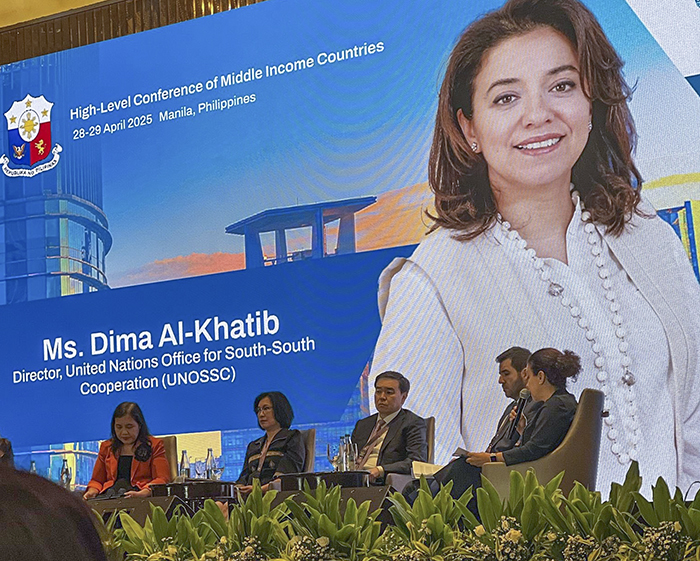 “South-South cooperation and triangular cooperation are anchored in the Makati Declaration and will be vital for the MICs unique development challenges,” said United Nations Office for South-South Cooperation Director Dima Al-Khatib during the High-Level Conference. “Cooperation between MICs is key. Through South-South partnerships, we are creating solutions that work locally and drive sustainable growth. This shared approach is how we build resilient economies.”
For example, the South-South trust funds managed by UNOSSC – such as the India-UN Development Partnership Fund and the IBSA Fund – support MICs in implementing demand-driven development projects that respond to national and regional priorities. These initiatives not only deliver tangible development outcomes but also serve as living laboratories – producing policy-relevant knowledge, demonstrating scalable models, and strengthening MIC capacities in areas such as climate adaptation, renewable energy, digital transformation, and public health.
Through platforms such as South-South Galaxy, UNOSSC is documenting and disseminating MIC-led solutions and good practices, making them accessible for peer learning and policy replication.
UNOSSC further strengthens MIC leadership by supporting their participation in high-level global platforms – such as the High-level Committee on South-South Cooperation, and regional dialogues.
“Regional partnerships drive innovation and shared prosperity, the Director added. “Together, middle-income countries are fostering inclusive solutions and strengthening capacities for shared prosperity across regions,” said the Director.
However, since 2000, only 27 countries transitioned from middle income to high-income status, and many have experienced reversals back to middle-income level: 11 nations switched back and forth at least once before reaching their current high-income status.
Approximately 60 per cent of the world’s poor live in MICs, indicating that fighting poverty is not achievable by focusing only on the lowest income nations.
“The transition of middle-income countries to high-income status while meeting sustainable development ambitions calls for the bolstering of financing for development,” said Armida Salsiah Alisjahbana, Executive Secretary of the UN Economic and Social Commission for Asia and the Pacific (ESCAP).
MICs continue to face challenges like inequality, climate risks, and limited access to global markets and finance. Philippine Foreign Affairs Secretary Enrique Manalo stressed that the declaration calls on the global community, especially the UN system, to provide more tailored support to address these unique needs.
“This gives new life to multilateralism,” said Arsenio Balisacan, Secretary of the Philippines’ Department of Economy, Planning, and Development, emphasizing the importance of shared action on global issues like trade, technology, and finance.
The HLC-MIC was organized by the Like-Minded Group in support of Middle-Income Countries (LMG-MICs), under the chairmanship of Morocco. Member states include Chile, Colombia, Jamaica, Mexico, Namibia, the Philippines, and others, with additional participation from countries such as Indonesia, Malaysia, and Fiji.
“South-South cooperation and triangular cooperation are anchored in the Makati Declaration and will be vital for the MICs unique development challenges,” said United Nations Office for South-South Cooperation Director Dima Al-Khatib during the High-Level Conference. “Cooperation between MICs is key. Through South-South partnerships, we are creating solutions that work locally and drive sustainable growth. This shared approach is how we build resilient economies.”
For example, the South-South trust funds managed by UNOSSC – such as the India-UN Development Partnership Fund and the IBSA Fund – support MICs in implementing demand-driven development projects that respond to national and regional priorities. These initiatives not only deliver tangible development outcomes but also serve as living laboratories – producing policy-relevant knowledge, demonstrating scalable models, and strengthening MIC capacities in areas such as climate adaptation, renewable energy, digital transformation, and public health.
Through platforms such as South-South Galaxy, UNOSSC is documenting and disseminating MIC-led solutions and good practices, making them accessible for peer learning and policy replication.
UNOSSC further strengthens MIC leadership by supporting their participation in high-level global platforms – such as the High-level Committee on South-South Cooperation, and regional dialogues.
“Regional partnerships drive innovation and shared prosperity, the Director added. “Together, middle-income countries are fostering inclusive solutions and strengthening capacities for shared prosperity across regions,” said the Director.
However, since 2000, only 27 countries transitioned from middle income to high-income status, and many have experienced reversals back to middle-income level: 11 nations switched back and forth at least once before reaching their current high-income status.
Approximately 60 per cent of the world’s poor live in MICs, indicating that fighting poverty is not achievable by focusing only on the lowest income nations.
“The transition of middle-income countries to high-income status while meeting sustainable development ambitions calls for the bolstering of financing for development,” said Armida Salsiah Alisjahbana, Executive Secretary of the UN Economic and Social Commission for Asia and the Pacific (ESCAP).
MICs continue to face challenges like inequality, climate risks, and limited access to global markets and finance. Philippine Foreign Affairs Secretary Enrique Manalo stressed that the declaration calls on the global community, especially the UN system, to provide more tailored support to address these unique needs.
“This gives new life to multilateralism,” said Arsenio Balisacan, Secretary of the Philippines’ Department of Economy, Planning, and Development, emphasizing the importance of shared action on global issues like trade, technology, and finance.
The HLC-MIC was organized by the Like-Minded Group in support of Middle-Income Countries (LMG-MICs), under the chairmanship of Morocco. Member states include Chile, Colombia, Jamaica, Mexico, Namibia, the Philippines, and others, with additional participation from countries such as Indonesia, Malaysia, and Fiji.