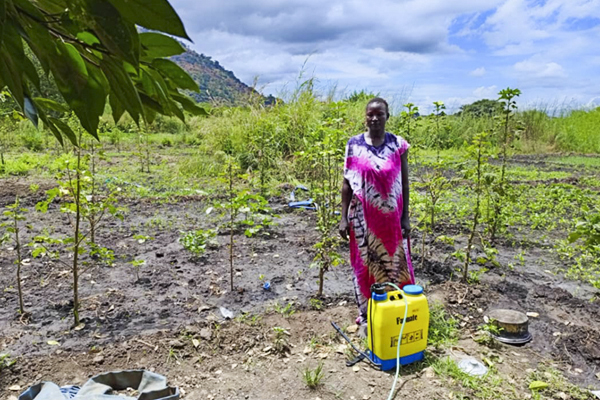
In a major step toward climate-resilient agriculture, smallholder farmers in South Sudan are gaining access to clean, affordable energy for irrigation — thanks to a South-South cooperation initiative scaling up the use of solar-powered water pumps. Supported by the IBSA facility for poverty and hunger alleviation (IBSA Fund) and implemented by UNDP in collaboration with the International Solar Alliance (ISA), the project is transforming lives by replacing costly, fuel-based irrigation systems with sustainable solar technologies.
“With this new project, we finally have hope for affordable, sustainable energy that will reduce our costs and help us earn more from our hard work,” says Selina Juan, a small-scale farmer from Luri, South Sudan. “We’ve already started training on how to use the new pumps — many thanks to UNDP and IBSA for this support.”
The initiative emerged in response to overwhelming demand for solar water pumps expressed through a call for Expressions-of-Interest by ISA to its Member States. In South Sudan, UNDP joined forces with the India, Brazil and South Africa (IBSA) Facility for Poverty and Hunger Alleviation to design a project tailored to the needs of smallholder farmers. The project focuses on reducing farmers’ dependence on diesel-powered pumps, which are expensive to maintain and fuel, and prone to breakdowns.
So far, twenty farmers in the areas of Luri, Rajav, and Torit have been shortlisted for the initial rollout. A local contractor has been selected to design, procure, and install the solar-powered irrigation systems. Each system uses a submersible pump powered by photovoltaic panels to draw water from a nearby source into an elevated storage tank, which then distributes water through gravity-fed piping across the farm.
Beyond installation, the project emphasizes long-term sustainability through capacity building. Training is being provided to farmers, local technicians, and government staff, equipping them with the knowledge and tools to operate and maintain the systems effectively. Financial training is also helping to establish a supportive ecosystem for the continued adoption of clean energy solutions in agriculture.
This innovative approach comes at a time when South Sudan’s smallholder farmers face increasing challenges due to unpredictable rainfall and climate variability. By enabling solar-powered irrigation, the project not only boosts agricultural productivity but also strengthens livelihoods, reduces operational costs, and supports the country’s environmental goals.
While focused on immediate community impact, the project aligns with South Sudan’s broader climate priorities. These include mitigation in energy efficiency, sustainable transportation, green technologies, and waste management, as well as adaptation in agriculture, environment, policy and institutional frameworks, and water resource management. The solar irrigation initiative contributes directly to these national strategies, demonstrating how targeted, locally grounded efforts can help meet global climate and development goals.
Although South Sudan continues to face one of the most severe energy access challenges globally — with just 6.7% of the population connected to electricity — this project offers a scalable model for progress. With approximately 10.3 million people still lacking modern energy services, initiatives like this signal a meaningful step toward inclusive, sustainable development powered by South-South collaboration.