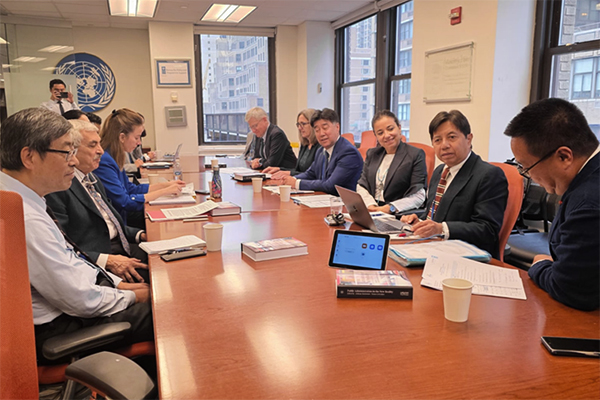
“Through South-South and triangular cooperation, countries with relatable socio-political systems and contexts can accompany each one’s transformation through directly relevant experience and expertise – support that poses no burden and ensures mutual benefit,” said Director of the United Nations Office for South-South Cooperation (UNOSSC), Ms. Dima Al-Khatib, delivering a compelling call to action at the high-level roundtable ‘Public Administration in the New Reality: Challenges and Prospects’, convened by the Astana Civil Service Hub (ACSH) in partnership with UNDP’s Governance for Public Goods and Services (GPGS) team.
“Governments worldwide are navigating complexities and uncertainties, requiring public sector capacities that can meet increased demands and new expectations,” said the UNOSSC Director. “As development partners, we need to also transform the way we support and work with governments, leveraging development cooperation that also fits the new realities.”
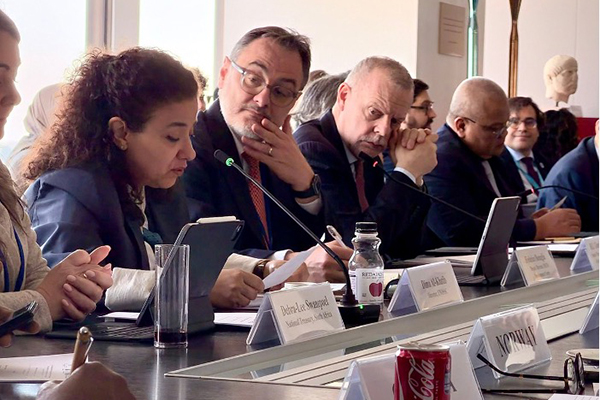
Held at the UNDP Bureau for Policy and Programme Support in New York, the roundtable brought together leaders and experts in public governance to address how civil service and governance systems can adapt to a rapidly shifting global context marked by socio-economic reordering, growing inequalities, and technological transformation.
In her opening remarks, Ms. Al-Khatib underscored that public administration – the backbone of how governments operate and serve their people – is being called to transform to fit new realities. She noted that these realities are especially visible in the Global South, where governments are confronting layered development challenges while also playing increasingly prominent roles in shaping global governance.
The roundtable, which also marked the launch of the new ACSH publication Public Administration in the New Reality, served as a platform to reflect on how institutions must evolve to meet citizens’ demands while remaining responsive, inclusive, and accountable. The event featured remarks from Mr. Larbi Djacta, Chairman of the International Civil Service Commission; Ms. Sarah Lister, Co-Director of the UNDP Governance, Rule of Law and Peacebuilding Hub; Mr. Alikhan Baimenov, Chairman of the ACSH Steering Committee; Mr. Juwang Zhu, Director, Division for Public Institutions and Digital Government, UN DESA; Mr. Guido Bertucci, Executive Director, International Government Solutions; and Mr. Alex Brillantes, Secretary General, EROPA.
Ms. Al-Khatib emphasized the unique and growing influence of countries in the Global South in international cooperation and governance. “Among the countries we know traditionally as the Global South are some of the world’s most dynamic economies today,” she said, highlighting how many have moved from being aid recipients to becoming development partners. She cited the successive G20 presidencies of India (2023), Brazil (2024), and South Africa (2025) as symbols of this transformation, as well as the evolving role of the BRICS grouping and its newly expanded membership, including Kazakhstan.
The Director pointed to the unprecedented milestone where South-South trade surpassed North-South trade, contributing up to 42 percent of global GDP. This, she said, has permanently altered the development landscape by expanding markets and fostering cooperation built on mutual benefit.
“South-South cooperation is more crucial than ever,” she stressed, especially in shaping public institutions that are embedded within specific political and social contexts. UNOSSC’s repository, the South-South Galaxy, has catalogued more than 960 examples of such cooperation models, showcasing the tangible value of solidarity-based collaboration across the Global South.
While celebrating innovation and reform, Ms. Al-Khatib also issued a note of caution. “The new reality is also of multilateralism under threat,” she said, urging partners to see South-South cooperation not only as a mechanism of development, but as a platform to uphold the principles of solidarity and shared progress in a fragmented world.
She concluded by reaffirming UNOSSC’s commitment to working closely with the ACSH, UNDP, and other partners to build institutional capacity that is agile, resilient, and fit for purpose in this era of change. “In keeping with the mandate that Member States have given us, we look forward to cooperation anchored in solidarity, delivering support that poses no burden.”