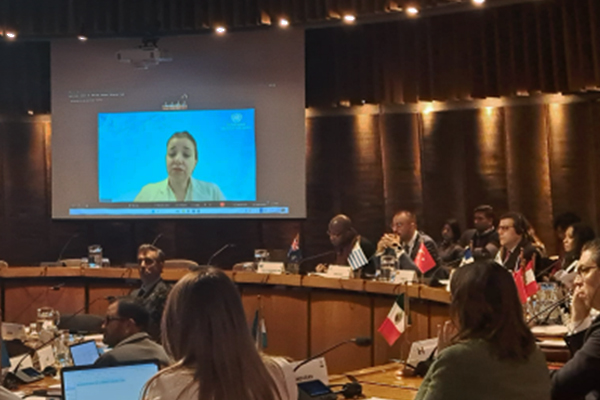
Watch UNOSSC Director Dima Al-Khatib’s statement in the opening session.
In her remarks, Dima Al‑Khatib underscored how Latin America and the Caribbean have been foundational in transforming development cooperation. She recalled how, in 1978, Member States in the region first converged to reshape development paradigms – moving from “aid” to cooperation. These early efforts culminated in the Buenos Aires Plan of Action (BAPA), widely considered one of the first concrete expressions of solidarity among developing countries. The legacy of BAPA, later reaffirmed at its 40th anniversary (BAPA+40), helped institutionalize South‑South and triangular cooperation – with Latin America and the Caribbean as a recognized pioneer. Director Al‑Khatib framed South‑South cooperation as a forward‑looking response to “tectonic, multidimensional shifts” in global dynamics – a mission dating back to the original concerns of BAPA – and essential in navigating today’s polycrisis marked by geopolitical fragmentation, financial stress, and instability. She reiterated that South‑South cooperation, born to adapt to systemic change, remains a powerful modality for solidarity and resilience. She also pointed to the region’s notable achievements: between 1990 and 2014, poverty dropped from 51% to 27%, driven by South‑South cooperation through integration frameworks like CELAC, MERCOSUR, CELAC, and the Pacific Alliance. These efforts built both economic and institutional “muscle,” enabling broader cooperation beyond trade. Turning to current dynamics, Director Al‑Khatib noted that countries of the Global South are no longer passive aid recipients – they are dynamic development partners. She pointed to evidence, including recent G20 presidencies in 2023–2025 held by India, Brazil, and South Africa; expanding BRICS membership; and Southern‑led Trust Funds like IBSA managing initiatives that combat poverty and hunger. Highlighted was the rise in South‑South trade, now surpassing North‑South exchanges and contributing up to 42% of global GDP, reflecting deepening economic ties and mutually beneficial development pathways. This shift reinforces regional institutions and funds, such as sovereign wealth vehicles and development banks, solidifying Southern collective agency. The Director emphasized that meeting today’s challenges requires greater coherence across global, regional, and national levels. At the 22nd High‑Level Committee (HLC), member countries called for enhanced collaboration within and across regions. UNOSSC stands ready to deepen collaboration, said the Director, linking this Regional Conference with the HLC and leveraging cross‑regional synergies. Director Al‑Khatib closed with a call to “systematically leverage the transformative potential of South‑South and triangular cooperation, as complement to traditional development cooperation,” honoring the visions of Bandung, BAPA, BAPA+40 – and the leadership of UNECLAC. Mateo Estremé, Director General of International Cooperation at the Argentine Foreign Ministry, affirmed that measuring cooperation among developing countries is key to strengthening their global leadership, improving their effectiveness and moving together towards sustainable development. He also underlined the relevance of incorporating multi-stakeholder cooperation modalities: “In a context of reduced official resources for international cooperation, it is vital that we design strategies that would allow us to incorporate the participation of the private sector, academia and other actors, and to integrate these sectors in the design and implementation of cooperation activities.” Challenges of international cooperation in shaping the new regional and global context After the opening ceremony, a panel discussion entitled ‘The challenges of international cooperation in shaping the new regional and global context’ was held, featuring presentations by José Manuel Salazar-Xirinachs, ECLAC’s Executive Secretary; Dima Al-Khatib, Director of UNOSSC (virtually); Máximo Torero, acting Regional Representative for Latin America and the Caribbean of the Food and Agriculture Organization of the United Nations (FAO); and Enrique O’Farrill Julien, Executive Director of the Chilean Agency for International Development Cooperation (AGCID). José Manuel Salazar-Xirinachs noted that the Conference’s second session is taking place in a global context marked by multiple crises, significant geopolitical changes and competition between major economies and powers. “This is a context that I would even describe as a crisis in international cooperation,” he stated, “where certain countries and views are questioning multilateralism, the United Nations system, and international cooperation. That is why we must rethink the role of South-South and triangular cooperation as a critical mechanism for strengthening capacities, mobilizing resources and promoting solutions tailored to regional and national realities.” The Executive Secretary stressed that international cooperation is essential for ensuring security, stability and collective well-being in a deeply interconnected world, and he added that at times of crisis, it is not just an ethical option but rather a strategic necessity for surviving and prospering together. Finally, he emphasized that the current scenario requires courage, creativity, pragmatism, conviction and commitment, along with a long-term vision. “Global economic and geopolitical conditions could not be more complex, and while there are opportunities, this is an unfriendly time for growth and development efforts,” he said. “My hope is that this Conference can be a game changer: a platform for renewing commitments, building bridges, activating concrete solutions and accelerating fulfillment of the Sustainable Development Goals. The future is not set in stone: it is in our hands, and it starts with what we decide to do together, today, here and now.” In her presentation, the UNOSSC Director Dima Al-Khatib, highlighted that South-South and triangular cooperation are playing an increasingly pivotal role in driving sustainable development across Latin America and the Caribbean (LAC). Recent trends show that over 80% of UN agency strategic plans now incorporate South-South and triangular cooperation, with 117 UN Country Teams integrating these approaches into their frameworks as of 2024 and that, 68% of programme countries in this region prioritize South-South and triangular cooperation in their development strategies, reflecting a strong commitment to collaborative solutions. Notably, regional trade and investment are surging, she said, with intraregional trade being championed through regional groups like the MERCOSUR trading block and cross-regional trade such as that between China-LAC more than doubling over the past decade. Regional digital transformation is also accelerating, supported by initiatives like the LAC Digital Agenda 2026, while innovative financing from mechanisms such as the Belt and Road Initiative and the New Development Bank are reshaping development finance in the region. Despite these advances, the UNOSSC Director noted, the region continues to face significant challenges, particularly in mobilizing adequate financial resources and addressing capacity gaps at the country level. These obstacles, however, can be seen as opportunities for deepening engagement and support. The LAC region is uniquely positioned to leverage South-South and triangular cooperation frameworks not only to address shared vulnerabilities and accelerate digital and green transitions, but also to serve as a model for peer learning and knowledge exchange with other regions. During Panel 5 discussion that focused on ‘Enhancing United Nations System-wide Coordination on South-South and Triangular Cooperation’, Denis Nkala, UNOSSC Chief of Intergovernmental and UN System Affairs, noted that UNOSSC support to UN agencies’ South-South cooperation capacity building will always be targeted at making the agencies better equipped to support member states in their endeavor to implement SSC. Also participating in the same panel was Roberto Valent, Regional Director of the UN Development Coordination Office for Latin America and the Caribbean, who concluded his remarks by stating, “As we commemorate the 80th anniversary of the United Nations, South-South and triangular cooperation must be seen not merely as modalities, but as strategic tools for reinforcing the UN’s relevance” ?? RESOLUTION 2 (II) of the Regional Conference on South-South Cooperation in Latin America and the Caribbean, at its second session, held in Santiago on 17 and 18 June 2025