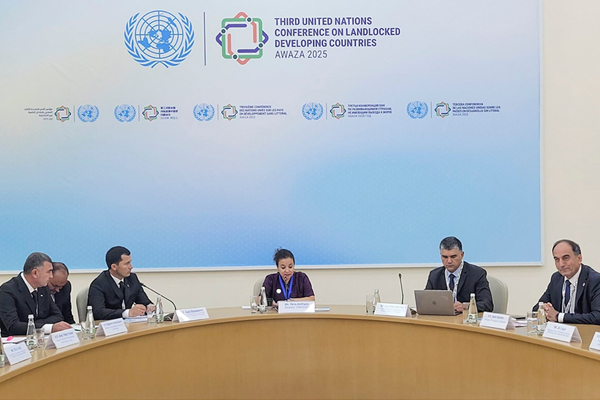
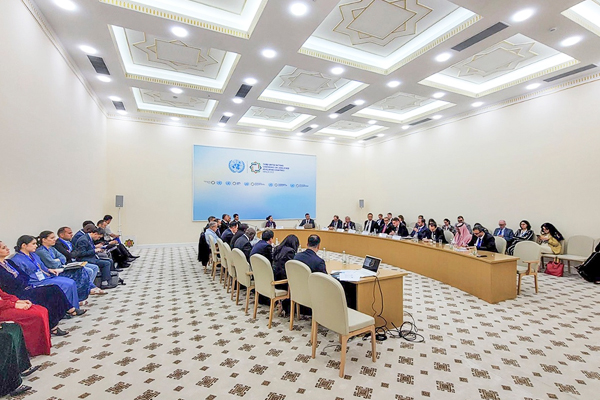
A high-level side event at the Third United Nations Conference on Landlocked Developing Countries (LLDC3) put the spotlight on how South-South and triangular cooperation can unlock more sustainable, affordable, and resilient transport systems for the world’s landlocked nations.
Co-organized by the Government of Turkmenistan, the Government of Uzbekistan, and the United Nations Office for South-South Cooperation (UNOSSC), the event, “Sustainable Transport for Landlocked Developing Countries: Leveraging South-South Cooperation”, convened ministers, development banks, international organizations, and regional experts to share solutions and partnerships.
“No country should be left behind due to geography alone”
Opening the event, Ms. Dima Al-Khatib, Director of UNOSSC, underscored both the urgency and the opportunity of tackling transport-related challenges for LLDCs.
“The high cost of transport, limited infrastructure, and dependence on transit countries continue to undermine trade competitiveness and sustainable growth,” the Director said. “Yet these challenges are not insurmountable. With South-South cooperation, LLDCs can reimagine transport systems as enablers of economic diversification, regional integration, climate resilience, and inclusive growth.”
The Director noted that LLDCs face trade costs on average 1.4 times higher than coastal developing countries, while spending nearly twice as much of their export earnings on transport and insurance compared to other developing nations. “These elevated costs erode competitiveness, discourage foreign direct investment, and limit LLDCs’ integration into global markets,” she said, adding that the Awaza Programme of Action for LLDCs (2024–2034) provides a vital blueprint for reducing bottlenecks and accelerating connectivity.
Highlighting global examples of South-South cooperation in action – from the Maputo Corridor in Africa to Paraguay’s Bioceanic Corridor in Latin America and the China-Lao PDR Railway in Southeast Asia – Director Al-Khatib stressed that harmonized procedures, joint investments, and digital innovations are transforming connectivity across regions. “Let us remember that no country should be left behind due to geography alone. With sustained commitment, coordinated action, and shared knowledge, we can unlock the full development potential of LLDCs,” she said.
 Global voices for regional solutions
The opening segment also featured:
Global voices for regional solutions
The opening segment also featured:
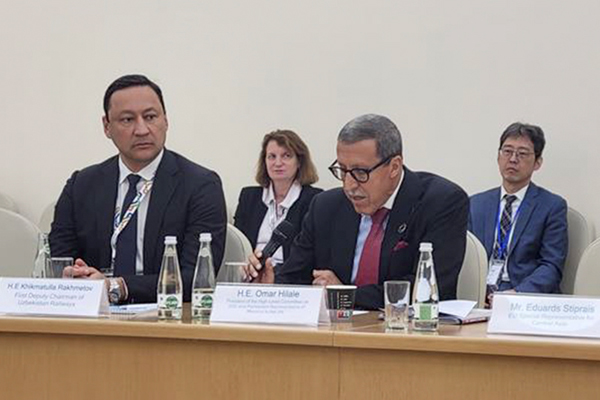 The session concluded with H.E. Ambassador Omar Hilale, President of the High-Level Committee on South-South Cooperation and Permanent Representative of Morocco to the UN, who called for scaling up inclusive partnerships and investments in sustainable transport.
The event demonstrated that South-South and triangular cooperation are not only complementary to North-South support, but also vital mechanisms for enabling LLDCs to turn geographical constraints into opportunities. With shared knowledge, innovative financing, and solidarity, participants affirmed that sustainable transport can become a cornerstone of integration and growth for landlocked countries worldwide.
The session concluded with H.E. Ambassador Omar Hilale, President of the High-Level Committee on South-South Cooperation and Permanent Representative of Morocco to the UN, who called for scaling up inclusive partnerships and investments in sustainable transport.
The event demonstrated that South-South and triangular cooperation are not only complementary to North-South support, but also vital mechanisms for enabling LLDCs to turn geographical constraints into opportunities. With shared knowledge, innovative financing, and solidarity, participants affirmed that sustainable transport can become a cornerstone of integration and growth for landlocked countries worldwide.
Global voices for regional solutions
The opening segment also featured:
- H.E. Azat Shanazarov, Chairman of the State Service of Maritime and River Transport, Government of Turkmenistan, underscored his country’s role in advancing multimodal connectivity and promoting sustainable corridors.
- Mr. Jin Liqun, President and Chair of the Board of Directors, Asian Infrastructure Investment Bank (AIIB), highlighted AIIB’s commitment to mobilizing investment for resilient and low-carbon transport systems.
- Ms. Dima Al-Khatib, Director, UNOSSC, called for harnessing South-South cooperation to reduce transport costs and foster inclusive growth.
- H.E. Begench Annadurdyyev, Minister of Automobile Transport, Turkmenistan, described how the Trans-Caspian International Transport Route (TITR) is boosting trade, jobs, and regional value chains.
- H.E. Azim Ibrohim, Minister of Transport, Tajikistan, stressed that the CAREC programme and Trans-Caspian Corridor are helping his country overcome mountainous terrain and achieve tangible trade and employment gains.
- H.E. Khikmatulla Rakhmetov, First Deputy Chairman, Uzbekistan Railways, showcased Uzbekistan’s progress in expanding rail networks and logistics hubs, positioning the country as a regional transport hub.
- Mr. Eric Livny, Head of Office in Turkmenistan, European Bank for Reconstruction and Development (EBRD), outlined EBRD’s role in sustainable infrastructure financing and capacity-building for project preparation.
- Mr. Artur Andrysiak, Country Director of Turkmenistan, Asian Development Bank (ADB), spoke on the bank’s efforts to develop digital transport and trade corridors, including scalable e-platforms for transit facilitation.
- Dr. Aleksandr Prodan, Senior Transport Economist, World Bank, emphasized the importance of corridor governance, logistics planning, and data systems for sustainable regional integration.
- Mr. Eduards Stiprais, EU Special Representative for Central Asia, presented EU-backed initiatives on green infrastructure, digital transport solutions, and cross-border coordination.
- Mr. Igor Runov, Executive Secretary, International Center for Transport Diplomacy and the Group of Friends of Sustainable Transport, stressed the role of transport diplomacy and dialogue platforms in advancing the Awaza Programme of Action.
- H.E. Ambassador Peter Huber, Director General for International Partnerships, Austria, illustrated how North-South and triangular cooperation can complement SSC efforts in sustainable transport.
- Mr. Victor Djemba, Chief, Africa Regional Bureau, UNIDO, linked value chain integration and SME development to improved connectivity in Africa’s landlocked countries.
The session concluded with H.E. Ambassador Omar Hilale, President of the High-Level Committee on South-South Cooperation and Permanent Representative of Morocco to the UN, who called for scaling up inclusive partnerships and investments in sustainable transport.
The event demonstrated that South-South and triangular cooperation are not only complementary to North-South support, but also vital mechanisms for enabling LLDCs to turn geographical constraints into opportunities. With shared knowledge, innovative financing, and solidarity, participants affirmed that sustainable transport can become a cornerstone of integration and growth for landlocked countries worldwide.