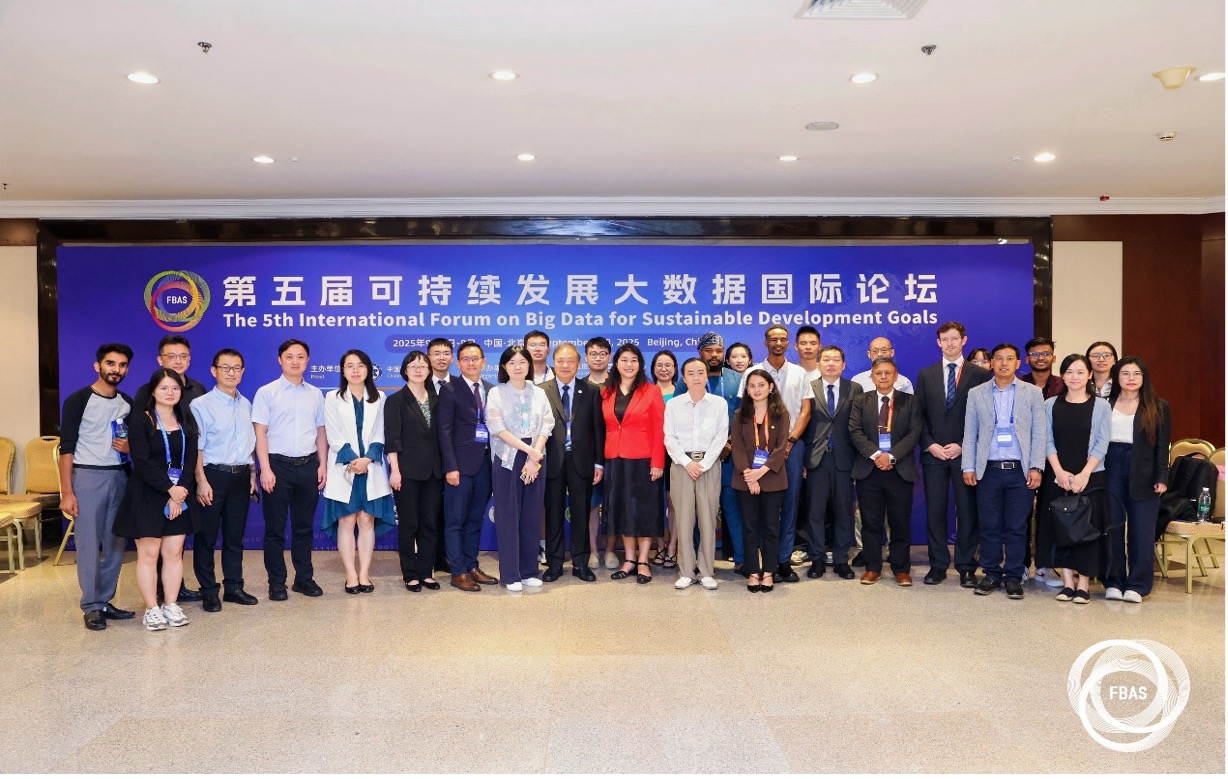
During the 5th International Forum on Big Data for Sustainable Development Goals (FBAS 2025) in Beijing, the United Nations Office for South-South Cooperation (UNOSSC) and the International Research Center of Big Data for Sustainable Development Goals (CBAS) jointly organized the seminar “From Innovation to Impact: Scaling Digital and Data Solutions through South-South and Triangular Cooperation.” The event was convened under the framework of the Global South-South Development Center (GSSDC) Project, Phase II.
The seminar, moderated by Ms. Xiaojun Grace WANG, Trust Fund Director of UNOSSC, highlighted exemplary practices of digital solutions and big data applications in agriculture, environmental protection, and energy, while exploring opportunities to replicate and scale them across developing countries. It also examined how existing South-South cooperation platforms—including the UN Fund for South-South Cooperation and the China-UN Global South-South Development Facility—can be leveraged to mobilize resources and inspire new partnerships.
Strong Call for Collaboration
In her opening remarks, Ms. Liu Jie, Deputy Director-General of CBAS, emphasized that scaling up innovations in digital and data applications in the global South requires stronger collaboration, inclusive capacity building, and trusted frameworks for data governance. “South-South and triangular cooperation can make a real difference,” she said, “by moving from isolated pilot projects to systemic applications and policy integration.”
Showcasing Good Practices in Digital and Data Solutions
The session on good practice sharing highlighted a diverse range of digital and data-driven innovations across agriculture, energy, and environmental protection.
Mr. Liu Wenyu, Director of the Secretariat of the ASEM Water Resources Research and Development Center, presented a case from Chenzhou City, Hunan Province, where integrated digital and big data approaches—including space-air-ground remote sensing, continuous hyperspectral imaging, and cross-sectoral digital solutions—successfully addressed heavy metal pollution and delivered significant environmental benefits.
From the energy sector, Mr. Wu Tong, Assistant to the Director-General of the Xiamen Research Institute of New-Type Power Systems, shared Xiamen’s experience in building an efficient, low-carbon, and intelligent digital energy management model. The city has deployed a smart platform integrating photovoltaics, power storage, and charging facilities, supported by advanced sensing devices and multi-source data fusion technologies.
The agriculture sector was also strongly represented. Mr. Jin Wei, Deputy Director of the Yangtze River Delta Integration Development Center, Pinghu Municipal Development and Reform Bureau, highlighted the digital agriculture platform that successfully adapted and applied the “Zhejiang Agricultural Service” model to Mao County, Sichuan Province. The platform integrates digital farm input management, visualized product traceability, and e-commerce circulation to address challenges of low standards, unstable quality control, and limited channels. Farmers have benefited from an estimated additional income of USD 6,400 per hectare.
From a regional perspective, Mr. Birendra Bajracharya, Regional Programme Manager of the Mountain Environment and Regional Information System (MERIS) at the International Centre for Integrated Mountain Development (ICIMOD), described how pooling expertise, data, and technologies can help establish robust regional information systems—such as interactive visualization platforms and regional databases. These systems transcend national boundaries and enhance forecasting, early warning, and climate adaptation strategies.
Nanjing’s agricultural digitalization efforts were introduced by Mr. Zhou Yibo, Director of the Market and Information Division, Nanjing Municipal Bureau of Agriculture and Rural Affairs. Building on pilot projects, the city has advanced the upgrading of digital facilities and platforms, and developed smart farms, ranches, and fisheries. These innovations have reduced land use, curtailed water pollution, increased yields, lowered production costs, and improved incomes across agricultural sectors.
Advancing Dialogue on Cooperation and Inclusion
The moderated discussion session focused on the role of digital and big data solutions in empowering developing countries, sharing resources, and advancing cross-regional collaboration.
Mr. Shu Yong, Vice President of Enlightened Art Academy, proposed the development of large-scale cross-border AI models to integrate cultural and economic data, link more people, and reduce inequalities arising from technological change. He emphasized the need for developing countries to proactively embrace artificial intelligence to avoid marginalization.
Ms. Huang Yan, Deputy Director of the International Center on Small Hydro Power (ICHSP), highlighted the lack of water resource data as a key challenge for small hydropower development in many developing countries. She called for enhanced international cooperation, including joint reporting with UNIDO, to strengthen data collection and sharing. Responding to a question on private sector engagement, she underscored the importance of government support for initial investment and tripartite collaboration among governments, international organizations, and enterprises.
Ms. Yu Haomiao, Division Director for International Organizations at the Foreign Economic Cooperation Center, Ministry of Agriculture and Rural Affairs of China, shared experiences of South-South cooperation in smart agriculture. She recommended differentiated approaches, providing basic agricultural technologies to countries with weaker infrastructure, such as those in Sub-Saharan Africa, while deepening digital integration with more advanced partners, such as in Latin America and ASEAN. She further suggested that Nanjing’s smart agriculture practices could be promoted internationally through cooperation channels including national delegations and international agricultural exhibitions, supported by branding and knowledge sharing.
Mr. Bai Xiaofeng, Secretary-General of the China-Africa Business Council, focused on policy and financial enablers for China-Africa cooperation. He stressed that African governments need to establish industrial policies to attract investment, noting that Chinese enterprises prioritize policy stability over high-risk, high-return opportunities. He proposed the creation of non-bank industrial funds to help African small and medium-sized enterprises overcome barriers to accessing affordable credit.
Speaking on behalf of African youth, Mr. Lemi Chala Tamire, Lecturer and Researcher at Haramaya University in Ethiopia, highlighted the urgent need to address challenges in internet connectivity, long-term knowledge transfer, and joint innovation financing, calling for stronger international collaboration to close these gaps.
Moving forward
Mr. Lu Shanlong, International Coordinator of SDG 6, CBAS, concluded in his closing remarks that through the sharing of good practices and discussions on replicating and scaling up successful development experiences via South-South and triangular cooperation, we achieved the objectives of mutual learning, identifying context-specific adaptation strategies, and exploring opportunities for future collaboration. This seminar served as a meaningful convergence of technological innovation and practical action between UNOSSC and CBAS. It represents both innovation and action. We hope that all participants will continue to learn from one another, share platforms and resources, and jointly advance digital technologies to contribute to the achievement of the SDGs.
About GSSDC Phase II:
The Global South-South Development Center (GSSDC) is a flagship initiative of the UNOSSC, funded by the Government of China, under the framework of the UN Fund for South-South Cooperation (UNFSSC). Jointly implemented with the China International Center for Economic and Technical Exchanges (CICETE), GSSDC Phase II (2025–2030) will expand both thematically and geographically, prioritizing: agriculture and rural transformation, green and resilient development, new industrialization, cultural and creative economy. Phase II seeks to leverage the technical expertise and resources of the China South-South Cooperation Network (CSSCN) to advance practical and technological cooperation, capacity development, knowledge exchange and network-building, while promoting South-South and triangular cooperation among cities and sub-national entities globally.