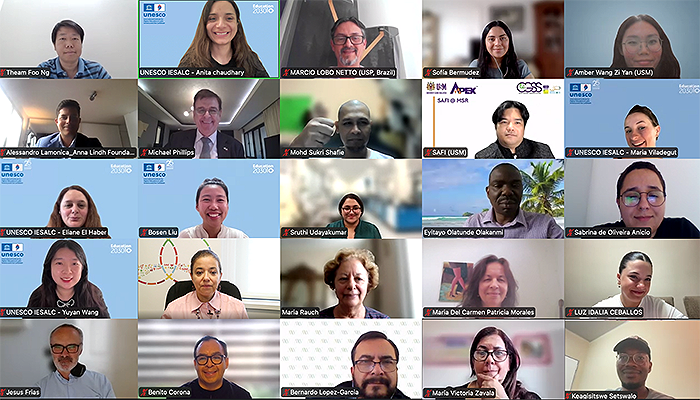
UNESCO International Institute for Higher Education (IESALC) and the United Nations Office for South-South Cooperation (UNOSSC) co-hosted a global dialogue to mark the International Day of Science, Technology, and Innovation for the South. The session brought together academia representatives, students, youth, civil society representatives, and intergovernmental organizations representatives from around the globe to highlight how universities can strengthen partnerships with communities and industries to advance sustainability across the Global South. The event underscored that the Global South is not a weak entity in need of saving but a powerful driver of solutions, affirming its power to lead its own sustainability agenda.
Why This Day Matters
Formally endorsed by the United Nations General Assembly in 2024, the International Day of Science, Technology, and Innovation for the South recognizes that science, technology, and innovation are essential for achieving the Sustainable Development Goals. Many countries, however, continue to face barriers to access, inclusion, and scaling innovation.
South-South and triangular cooperation offers a way forward: a model based not on dependency but on equal partnerships, where countries of the South share knowledge, contextualize solutions, and co-create innovations that reflect their own realities.
UNESCO IESALC also reaffirms its commitment to the Pact for the Future, adopted by Member States in September 2024, which devotes an entire chapter to Science, Technology, Innovation, and Digital Cooperation. The Pact calls on us to seize the opportunities of Science, Technology, Innovation (STI) for the benefit of people and planet, to scale up support for developing countries, to bridge divides, and to ensure that innovation strengthens human rights and the inclusion of Indigenous and local knowledge.
The Role of Universities, Youth, and Students
Universities are strongly positioned to mobilize knowledge, connect with industries, and engage communities in building innovation ecosystems that respond to real-world challenges. Youth and students are central to this effort, not only as beneficiaries of higher education but as innovators, leaders, and bridge-builders who are already piloting projects that scale from campus living labs to national and regional solutions.
The South-South University Cooperation Network (SUCN) was launched by UNESCO IESALC and UNOSSC, with funding support from the Government of China under the framework of the UN Fund for South-South Cooperation. SUCN’s Regional University Cooperation Hubs across Africa, the Arab States, Asia-Pacific, and Latin America represent a concrete step forward. These hubs serve as catalysts for regional partnerships, enabling universities to pool expertise, link academic research with community needs, and create collaborative platforms with industry. By anchoring innovation locally while connecting across regions, they demonstrate the Global South’s ability to lead its own sustainability agenda with confidence, creativity, and solidarity together with its youth and students.
 Setting the Stage
Opening the event, Dima Al-Khatib, Director of UNOSSC, called science, technology, and innovation “a pathway to inclusive, sustainable development” and highlighted the transformative potential of the South-South University Cooperation Network, which in just 18 months supported 250 youth and student innovators in prototyping 22 green technologies.
Bosen Liu, Head of the Partnership and Agenda-Setting Unit at UNESCO IESALC, stressed that “South-South and Triangular cooperation is essential for addressing the gaps we face in science, technology, and innovation, even before we can fully harness their potential for sustainable development.”
Regional Action
Four Regional University Cooperation Hubs shared experiences.
In Africa, Eyitayo Olatunde Olakanmi from Botswana International University of Science and Technology explained, “We involve industries from the conceptual stage of our projects,” stressing that co-design and joint grant applications with industry are central.
In the Arab States, Michael Phillips from the University of Doha for Science and Technology described an integrated ecosystem. “Our strategy is not a series of isolated initiatives, but a fully connected system linking curriculum, research, industry partnerships, and community outreach.”
In Asia-Pacific, Ng Theam Foo from Universiti Sains Malaysia distilled three lessons: start with available resources, link research to real-world living labs, and mobilize student volunteers. “We do not wait for perfect conditions, we start with what we have.”
In Latin America, Marcio Lobo Netto from the University of São Paulo emphasized scaling collaboration. “By presenting successful cases, understanding real problems, and promoting appropriate solutions, we intend to contribute to a better world.”
Student Perspectives
Students showcased the power of youth-led and student-led innovation.
Shruti Udayakumar from Qatar piloted food waste disposal solutions on campus, noting, “A campus is like a small city, students can use it as a testing ground for sustainability solutions that scale into the real world.”
Amber Wang Zi Yan from Malaysia highlighted the role of student-led projects in connecting research with communities. “It is about building bridges between research and people, and across the Global South.”
Civil Society and Intergovernmental Perspectives
Sofía Bermudez, youth leader from Argentina, underlined the importance of trust. “Universities and industries must value community voices as the starting point, not as an afterthought.”
Alessandro Lamonica of the Anna Lindh Foundation added, “Regional integration, mobility, responsible research, and open science are key to building lasting, inclusive partnerships.”
Looking Ahead
Closing the event, Bosen Liy Liu stressed that this was only the beginning. “Let us renew our commitment to build bridges of knowledge and cooperation that span the Global South and extend to the world.”
The dialogue not only celebrated the International Day of Science, Technology, and Innovation for the South, it also highlighted how universities can serve as anchors for collaboration with industry and communities. Across four continents, participants showed that youth and students are not only learners but innovators, turning campuses into living laboratories for sustainability.
What emerged was a shared conviction: scaling these efforts will require deeper cooperation, mutual learning, and solidarity across the South. Partnerships with the North will remain important, but as contributors that support South-led initiatives rather than directing them. Regional synergies and university cooperation will be key in driving this vision forward, fostering collective innovation, supporting youth and students, and ensuring that sustainable solutions are built in, with, and for the Global South.
Setting the Stage
Opening the event, Dima Al-Khatib, Director of UNOSSC, called science, technology, and innovation “a pathway to inclusive, sustainable development” and highlighted the transformative potential of the South-South University Cooperation Network, which in just 18 months supported 250 youth and student innovators in prototyping 22 green technologies.
Bosen Liu, Head of the Partnership and Agenda-Setting Unit at UNESCO IESALC, stressed that “South-South and Triangular cooperation is essential for addressing the gaps we face in science, technology, and innovation, even before we can fully harness their potential for sustainable development.”
Regional Action
Four Regional University Cooperation Hubs shared experiences.
In Africa, Eyitayo Olatunde Olakanmi from Botswana International University of Science and Technology explained, “We involve industries from the conceptual stage of our projects,” stressing that co-design and joint grant applications with industry are central.
In the Arab States, Michael Phillips from the University of Doha for Science and Technology described an integrated ecosystem. “Our strategy is not a series of isolated initiatives, but a fully connected system linking curriculum, research, industry partnerships, and community outreach.”
In Asia-Pacific, Ng Theam Foo from Universiti Sains Malaysia distilled three lessons: start with available resources, link research to real-world living labs, and mobilize student volunteers. “We do not wait for perfect conditions, we start with what we have.”
In Latin America, Marcio Lobo Netto from the University of São Paulo emphasized scaling collaboration. “By presenting successful cases, understanding real problems, and promoting appropriate solutions, we intend to contribute to a better world.”
Student Perspectives
Students showcased the power of youth-led and student-led innovation.
Shruti Udayakumar from Qatar piloted food waste disposal solutions on campus, noting, “A campus is like a small city, students can use it as a testing ground for sustainability solutions that scale into the real world.”
Amber Wang Zi Yan from Malaysia highlighted the role of student-led projects in connecting research with communities. “It is about building bridges between research and people, and across the Global South.”
Civil Society and Intergovernmental Perspectives
Sofía Bermudez, youth leader from Argentina, underlined the importance of trust. “Universities and industries must value community voices as the starting point, not as an afterthought.”
Alessandro Lamonica of the Anna Lindh Foundation added, “Regional integration, mobility, responsible research, and open science are key to building lasting, inclusive partnerships.”
Looking Ahead
Closing the event, Bosen Liy Liu stressed that this was only the beginning. “Let us renew our commitment to build bridges of knowledge and cooperation that span the Global South and extend to the world.”
The dialogue not only celebrated the International Day of Science, Technology, and Innovation for the South, it also highlighted how universities can serve as anchors for collaboration with industry and communities. Across four continents, participants showed that youth and students are not only learners but innovators, turning campuses into living laboratories for sustainability.
What emerged was a shared conviction: scaling these efforts will require deeper cooperation, mutual learning, and solidarity across the South. Partnerships with the North will remain important, but as contributors that support South-led initiatives rather than directing them. Regional synergies and university cooperation will be key in driving this vision forward, fostering collective innovation, supporting youth and students, and ensuring that sustainable solutions are built in, with, and for the Global South.
Setting the Stage
Opening the event, Dima Al-Khatib, Director of UNOSSC, called science, technology, and innovation “a pathway to inclusive, sustainable development” and highlighted the transformative potential of the South-South University Cooperation Network, which in just 18 months supported 250 youth and student innovators in prototyping 22 green technologies.
Bosen Liu, Head of the Partnership and Agenda-Setting Unit at UNESCO IESALC, stressed that “South-South and Triangular cooperation is essential for addressing the gaps we face in science, technology, and innovation, even before we can fully harness their potential for sustainable development.”
Regional Action
Four Regional University Cooperation Hubs shared experiences.
In Africa, Eyitayo Olatunde Olakanmi from Botswana International University of Science and Technology explained, “We involve industries from the conceptual stage of our projects,” stressing that co-design and joint grant applications with industry are central.
In the Arab States, Michael Phillips from the University of Doha for Science and Technology described an integrated ecosystem. “Our strategy is not a series of isolated initiatives, but a fully connected system linking curriculum, research, industry partnerships, and community outreach.”
In Asia-Pacific, Ng Theam Foo from Universiti Sains Malaysia distilled three lessons: start with available resources, link research to real-world living labs, and mobilize student volunteers. “We do not wait for perfect conditions, we start with what we have.”
In Latin America, Marcio Lobo Netto from the University of São Paulo emphasized scaling collaboration. “By presenting successful cases, understanding real problems, and promoting appropriate solutions, we intend to contribute to a better world.”
Student Perspectives
Students showcased the power of youth-led and student-led innovation.
Shruti Udayakumar from Qatar piloted food waste disposal solutions on campus, noting, “A campus is like a small city, students can use it as a testing ground for sustainability solutions that scale into the real world.”
Amber Wang Zi Yan from Malaysia highlighted the role of student-led projects in connecting research with communities. “It is about building bridges between research and people, and across the Global South.”
Civil Society and Intergovernmental Perspectives
Sofía Bermudez, youth leader from Argentina, underlined the importance of trust. “Universities and industries must value community voices as the starting point, not as an afterthought.”
Alessandro Lamonica of the Anna Lindh Foundation added, “Regional integration, mobility, responsible research, and open science are key to building lasting, inclusive partnerships.”
Looking Ahead
Closing the event, Bosen Liy Liu stressed that this was only the beginning. “Let us renew our commitment to build bridges of knowledge and cooperation that span the Global South and extend to the world.”
The dialogue not only celebrated the International Day of Science, Technology, and Innovation for the South, it also highlighted how universities can serve as anchors for collaboration with industry and communities. Across four continents, participants showed that youth and students are not only learners but innovators, turning campuses into living laboratories for sustainability.
What emerged was a shared conviction: scaling these efforts will require deeper cooperation, mutual learning, and solidarity across the South. Partnerships with the North will remain important, but as contributors that support South-led initiatives rather than directing them. Regional synergies and university cooperation will be key in driving this vision forward, fostering collective innovation, supporting youth and students, and ensuring that sustainable solutions are built in, with, and for the Global South.