Op-Ed: A Fairer Future Through South-South and Triangular Cooperation
As the United Nations and the world navigate a period of fragmentation, revisiting Bandung’s call for cooperation among equals offers a powerful path forward.
The gathering of 29 mostly newly independent African and Asian nations at the Bandung Conference in 1955 was more than a diplomatic event; it was a collective act of political courage. Their leaders sought to assert their sovereignty, to accelerate their development and to free their people from the gravitational pull of Cold War rivalries.
The ten Bandung Principles – grounded in sovereignty, equality, non-interference, peaceful dispute settlement and solidarity – went beyond moral declarations; they offered a practical roadmap for inclusive international cooperation. At its core, Bandung championed the United Nations Charter as the anchor of international law and diplomacy, affirming that, even in a polarised world, a universal multilateral platform was indispensable. The principles are present in many UN processes and regional action plans. Taking Bandung a step further, the 2030 Agenda for Sustainable Development, with its 17 Sustainable Development Goals, now offers clear targets and indicators, defined implementation mechanisms and accountability structures.
Today, as the UN marks its 80th anniversary alongside the 70th commemoration of Bandung, multilateralism is again under strain. Geopolitical rivalries, economic fragmentation and eroding trust between countries threaten to paralyse collective action. Yet paradoxically, our interdependence – in confronting the climate crisis, pandemics, digital disruption or inequality – has never been clearer. The current challenge is not whether we need global cooperation and new institutions, but how to renew and adapt cooperation for a world where states increasingly engage in flexible, diverse and mutually beneficial partnerships that bridge traditional geopolitical divisions. This pivotal moment calls us to revisit, and to recommit to, Bandung’s legacy.
The ideals forged at Bandung did not remain abstract. Out of them emerged South-South and triangular cooperation, first as solidarity among newly independent states and later institutionalised across the multilateral system. Over time, South-South and triangular cooperation has evolved from a political aspiration into a practical development-cooperation partnership model, delivering demand-driven and context-specific development outcomes.
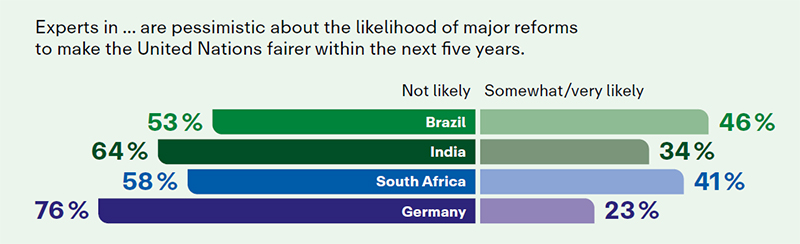
The survey was commissioned by Körber-Stiftung and conductedby Verian Germany among experts in Brazil, Germany, India and South Africa between 15 October and 2 December 2024 for the Emerging Middle Powers Report 2025. ISSN: 3052 – 2455.
As highlighted in the Global Report on South-South and Triangular Cooperation 2025: Bridging Horizons and Continents produced by the United Nations Office for South-South Cooperation (UNOSSC), this approach is now a key driver of global problem-solving. Whether through cross-border disaster-preparedness efforts in the Caribbean, collaborative health research between African and Asian laboratories or Latin American-led renewable-energy projects, countries of the Global South are not only recipients but also originators and co-creators of solutions.
To further embed the Bandung Principles within the multilateral system, UN members established South-South cooperation trust funds and entrusted them to the UNOSSC. These funds, with pioneering contributions from the Global South, created dedicated financial mechanisms to channel resources and to ensure that South-led priorities receive institutional backing from across the UN development system. They are an enduring testament to the leadership of developing countries in shaping cooperation on their own terms.
Each year, the international community marks the United Nations Day for South-South Cooperation on 12 September, not only to commemorate the 1978 Buenos Aires Plan of Action but also to recognise how far Bandung’s spirit has travelled. Cooperation among equals is no relic of the past; it is a living force for innovation, solidarity and collective action.
Triangular cooperation plays a distinctive bridging role, uniting the resources of countries in the North with the leadership and ownership of the South. It strengthens the capacity of developing countries while mobilizing global coalitions for lasting change. This is Bandung’s principle of equitable partnership brought to life on today’s global stage.
The UN retains a unique structural advantage: universality. It is the only platform where every state – regardless of its economic weight, geopolitical status or population – has equal standing. Yet universality alone does not guarantee relevance. Even as partnership patterns shift, equal standing in this forum strengthens legitimacy, coordination and collective action on problems no single alliance or partnership can resolve on its own.
The UN’s track record demonstrates real capacity for self-renewal. In 1960s and 1970s, after decolonisation, it integrated new states into the system and expanded the development agenda, launching agencies focused on health, education and trade for a new era. In the 1990s, after the Cold War, it entered new territory in peace operations, preventive diplomacy and human rights, while championing sustainable development. In the early 2000s, in the wake of humanitarian crises in Rwanda and the former Yugoslavia, it adopted ground-breaking reform ideas, like the Responsibility to Protect, and improved coordination.
Today, the UN stands again at a crossroads, with ever more urgent calls for reform. The debates on Security Council representation, the global financial architecture and the Pact for the Future highlight the need to integrate South-South and triangular cooperation into its core operating principles for inclusive policy-making and program delivery.
‘ The debates on Security Council representation, the global financial architecture and the Pact for the Future highlight the need to integrate South- South and triangular cooperation into its core operating principles for inclusive policy-making and program delivery.’
The Bandung Spirit was about mobilising collective purpose to reshape global power relations. Sustaining such energy in today’s complex order requires transformation on both sides. The South must deepen collective action through South-South and triangular frameworks, expand cross-regional knowledge corridors and institutionalise joint policy innovation. The North must move beyond donor-recipient paradigms, co-develop solutions, adjust financing frameworks to accommodate innovation and make long-term investments in partnerships built on trust and accountability.
One example is the South-South Galaxy platform, hosted by the UNOSSC, which connects policy-makers, practitioners and funders. It facilitates peer-to-peer learning; for example, enabling climate-smart technologies developed in Southeast Asia to be applied in Pacific Island states. It also supports the sharing of best practices and provides a Solutions Lab to pilot new ideas. Platforms like this are essential for accelerating the exchange of locally relevant solutions and scaling community-driven impact.
The UNOSSC’s new Triangular Cooperation Window is an example of making long-term investments in partnerships built on trust. It is a facility under the United Nations Fund for South- South Cooperation designed to mobilise resources, knowledge and expertise from a diverse range of stakeholders – including developing and developed countries – to accelerate progress.
Today, countries in the North and South are diversifying their partnerships, collaborating on infrastructure, digitalisation, sustainable agriculture and peace operations with multiple sets of partners. The UN’s distinctive mission is to remain the trusted convener and standard-setter amid this dense web of cooperation. In accordance with the principles of sovereign equality of all its members, peaceful settlement of disputes, respect for human rights and international cooperation, as established in the United Nations Charter, it must fulfil its role by continually fostering inclusive dialogue and national ownership, facilitating universally accepted standards, integrating innovative technologies, promoting South-South collaboration and enabling broad partnerships across sectors.
In 1955, Bandung reframed international cooperation as a partnership among equals – an idea that was radical and pragmatic. In 2025, South-South and triangular cooperation are the closest operational realisation of that vision: rooted in Bandung’s ethical framework yet adapted to a world where the North-South binary is increasingly fluid.
Pandemic risk and recovery, climate upheaval and rapid technological shifts are all trans-boundary; so too must be our solutions. The collaboration in disaster-risk management across the Global South, green hydrogen consortia led by developing countries and women’s entrepreneurship networks spanning continents all point to a more inclusive multilateralism. The High-level Committee on South-South Cooperation, the main UN policy-making body on this topic, is playing a central role in this, ensuring accountability and reinforcing the integration of South-South and triangular cooperation across the UN system.
‘ The UN, as convener and standard-setter, has a unique responsibility to weave together South-South, North- South and triangular partnerships into a more coherent and equitable multilateral fabric.’
As the UN turns 80 and Bandung turns 70, renewal must come not from defending the global system as it is but from re-imagining it as truly inclusive in purpose and practice. The Bandung Principles of trust, mutual respect and co-creation remain the foundation upon which this renewal must be built.
The enduring lesson of Bandung is that partnership among equals is not an aspiration but a necessity for stability and shared prosperity. The UN, as convener and standard-setter, has a unique responsibility to weave together South-South, North-South and triangular partnerships into a more coherent and equitable multilateral fabric.
Bandung’s message endures: cooperation among equals is essential. Today, South-South and triangular cooperation transform that message into practice – turning history into a pathway for our shared future.
Article by Dima Al-Khatib, director of the United Nations Office for South-South Cooperation (UNOSSC).
?? Download the publication