Ministerial Meeting marks FAO’s 80th Anniversary and decades of South-South and triangular Cooperation leadership
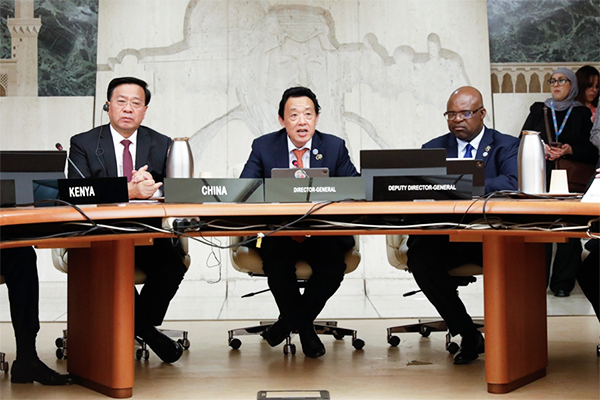
As part of the World Food Forum and the 80th anniversary celebrations of the Food and Agriculture Organization (FAO), Ministers, UN leaders, and development partners gathered in Rome on 15 October 2025 for a Ministerial Dialogue on “South-South and Triangular Cooperation – A Catalyst for Agrifood System Transformation.”
The high-level dialogue showcased FAO’s pioneering role in advancing South-South and triangular cooperation over the past four decades and charted new pathways for collaboration to accelerate agrifood systems transformation and the achievement of the Sustainable Development Goals (SDGs).
A legacy of cooperation and transformation
Opening the event, FAO Director-General Dr. Qu Dongyu celebrated FAO’s enduring commitment to South-South and triangular cooperation as “a strategic instrument for transformation,” emphasizing that it goes beyond a modality of cooperation. “South-South and triangular cooperation unlocks local knowledge, drives scientific and digital innovation, strengthens solidarity, and provides timely solutions to global challenges – especially during crises,” he said.
Dr. Qu highlighted FAO’s extensive contributions to the evolution of South-South and triangular cooperation since its inception within the Special Programme for Food Security in 1996. Over the past decade, FAO-supported initiatives have reached more than 110 countries, mobilizing USD 550 million, deploying over 3,000 experts, and directly or indirectly benefiting two million people.
He underscored that South-South and triangular cooperation’s strength lie in bridging divides – not only between countries of the Global South but also among the South, North, East, and West, and across sectors. “Agrifood systems are not a single sector, but a complex system,” he noted. “That is why we need triangular cooperation – it is not a slogan, but a necessity.”
Citing impactful partnerships with Brazil, Türkiye, China, Indonesia, and other countries, Dr. QU showcased how shared knowledge and innovation have multiplied results, from China’s USD 130 million Trust Fund supporting technology transfer and training, to Brazil’s long-standing partnership investing USD 120 million in trilateral projects.
UNOSSC: Solidarity, innovation, and shared agency
Delivering special remarks, Ms. Dima Al-Khatib, Director of the United Nations Office for South-South Cooperation (UNOSSC), commended FAO’s “decades of leadership in advancing agricultural development and fostering resilient rural communities,” while also celebrating the 70th anniversary of the Bandung Conference, which laid the foundation for South-South cooperation.
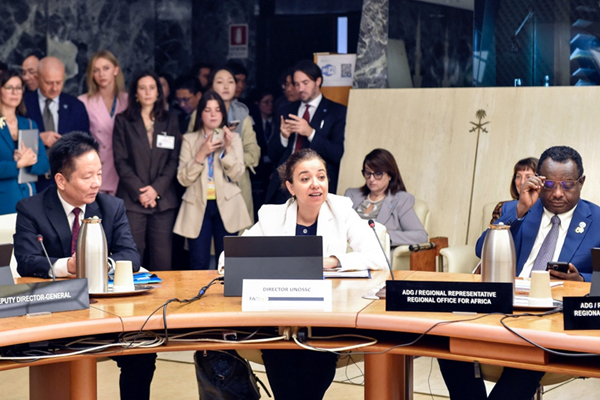 “South-South and triangular cooperation today stands not as an alternative but as an important bridge toward a sustainable future – a collective pathway forged by the Global South through solidarity, innovation, and shared agency,” Ms. Al-Khatib said, citing the recently launched UNOSSC Global Report on South-South and Triangular Cooperation 2025: Bridging Horizons and Continents – Forging Transformative Pathways in South-South and Triangular Cooperation.
She highlighted how developing countries are transforming agrifood systems through industrialization, agro-processing, and technology transfer, with South-South and triangular cooperation catalyzing progress through peer-to-peer exchanges, capacity-building, and digital innovation. “They are stories of farmers who have increased yields, women and youth who gained livelihoods, and communities that became more resilient,” she said.
Ms. Al-Khatib also emphasized the deep collaboration between FAO and UNOSSC through several South-South Trust Fund initiatives – including the United Nations Fund for South-South Cooperation, India-UN Development Partnership Fund, IBSA Fund, and Pérez-Guerrero Trust Fund for South-South Cooperation – which have supported sustainable agriculture, youth entrepreneurship, and women’s empowerment across regions.
Looking ahead: From solidarity to action
As FAO begins formulating its South-South and Triangular Cooperation Guidelines for Action 2026–2030, leaders called for greater investment, innovation, and inclusion. Ms. Al-Khatib outlined key priorities: integrating South-South and triangular cooperation into national strategies; strengthening data-driven planning and impact measurement; scaling up innovative and blended finance; and leveraging private sector partnerships and digital platforms such as UNOSSC’s South-South Galaxy, the South-South and Triangular Cooperation Solutions Lab, and FAO’s new South-South and Triangular Cooperation Gateway. The Director announced UNOSSC’s readiness to enhance collaboration with FAO through the Solutions Lab to jointly support the G20 Global Alliance against Poverty and Hunger, building a global portfolio of proven solutions around SDG 1 (No Poverty) and SDG 2 (Zero Hunger).
“South-South and triangular cooperation today stands not as an alternative but as an important bridge toward a sustainable future – a collective pathway forged by the Global South through solidarity, innovation, and shared agency,” Ms. Al-Khatib said, citing the recently launched UNOSSC Global Report on South-South and Triangular Cooperation 2025: Bridging Horizons and Continents – Forging Transformative Pathways in South-South and Triangular Cooperation.
She highlighted how developing countries are transforming agrifood systems through industrialization, agro-processing, and technology transfer, with South-South and triangular cooperation catalyzing progress through peer-to-peer exchanges, capacity-building, and digital innovation. “They are stories of farmers who have increased yields, women and youth who gained livelihoods, and communities that became more resilient,” she said.
Ms. Al-Khatib also emphasized the deep collaboration between FAO and UNOSSC through several South-South Trust Fund initiatives – including the United Nations Fund for South-South Cooperation, India-UN Development Partnership Fund, IBSA Fund, and Pérez-Guerrero Trust Fund for South-South Cooperation – which have supported sustainable agriculture, youth entrepreneurship, and women’s empowerment across regions.
Looking ahead: From solidarity to action
As FAO begins formulating its South-South and Triangular Cooperation Guidelines for Action 2026–2030, leaders called for greater investment, innovation, and inclusion. Ms. Al-Khatib outlined key priorities: integrating South-South and triangular cooperation into national strategies; strengthening data-driven planning and impact measurement; scaling up innovative and blended finance; and leveraging private sector partnerships and digital platforms such as UNOSSC’s South-South Galaxy, the South-South and Triangular Cooperation Solutions Lab, and FAO’s new South-South and Triangular Cooperation Gateway. The Director announced UNOSSC’s readiness to enhance collaboration with FAO through the Solutions Lab to jointly support the G20 Global Alliance against Poverty and Hunger, building a global portfolio of proven solutions around SDG 1 (No Poverty) and SDG 2 (Zero Hunger).
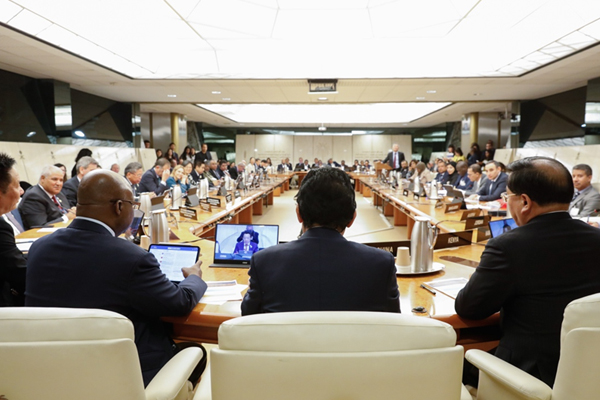 In closing, Dr. Qu and Ms. Al-Khatib echoed a shared call to action: to strengthen solidarity across borders and sectors. As FAO marks 80 years of service, the event reaffirmed that South-South and triangular cooperation remains one of the most powerful engines of global agrifood transformation – anchored in mutual learning, collective innovation, and the spirit of leaving no one behind.
“South-South and triangular cooperation today stands not as an alternative but as an important bridge toward a sustainable future – a collective pathway forged by the Global South through solidarity, innovation, and shared agency,” Ms. Al-Khatib said, citing the recently launched UNOSSC Global Report on South-South and Triangular Cooperation 2025: Bridging Horizons and Continents – Forging Transformative Pathways in South-South and Triangular Cooperation.
She highlighted how developing countries are transforming agrifood systems through industrialization, agro-processing, and technology transfer, with South-South and triangular cooperation catalyzing progress through peer-to-peer exchanges, capacity-building, and digital innovation. “They are stories of farmers who have increased yields, women and youth who gained livelihoods, and communities that became more resilient,” she said.
Ms. Al-Khatib also emphasized the deep collaboration between FAO and UNOSSC through several South-South Trust Fund initiatives – including the United Nations Fund for South-South Cooperation, India-UN Development Partnership Fund, IBSA Fund, and Pérez-Guerrero Trust Fund for South-South Cooperation – which have supported sustainable agriculture, youth entrepreneurship, and women’s empowerment across regions.
Looking ahead: From solidarity to action
As FAO begins formulating its South-South and Triangular Cooperation Guidelines for Action 2026–2030, leaders called for greater investment, innovation, and inclusion. Ms. Al-Khatib outlined key priorities: integrating South-South and triangular cooperation into national strategies; strengthening data-driven planning and impact measurement; scaling up innovative and blended finance; and leveraging private sector partnerships and digital platforms such as UNOSSC’s South-South Galaxy, the South-South and Triangular Cooperation Solutions Lab, and FAO’s new South-South and Triangular Cooperation Gateway. The Director announced UNOSSC’s readiness to enhance collaboration with FAO through the Solutions Lab to jointly support the G20 Global Alliance against Poverty and Hunger, building a global portfolio of proven solutions around SDG 1 (No Poverty) and SDG 2 (Zero Hunger).
In closing, Dr. Qu and Ms. Al-Khatib echoed a shared call to action: to strengthen solidarity across borders and sectors. As FAO marks 80 years of service, the event reaffirmed that South-South and triangular cooperation remains one of the most powerful engines of global agrifood transformation – anchored in mutual learning, collective innovation, and the spirit of leaving no one behind.