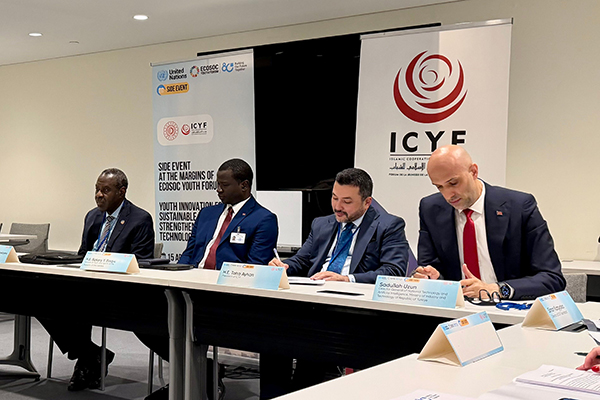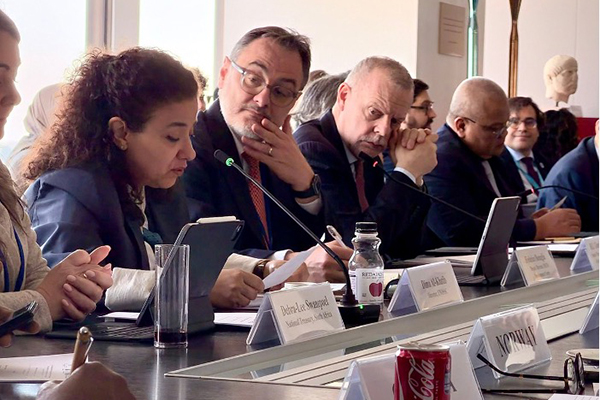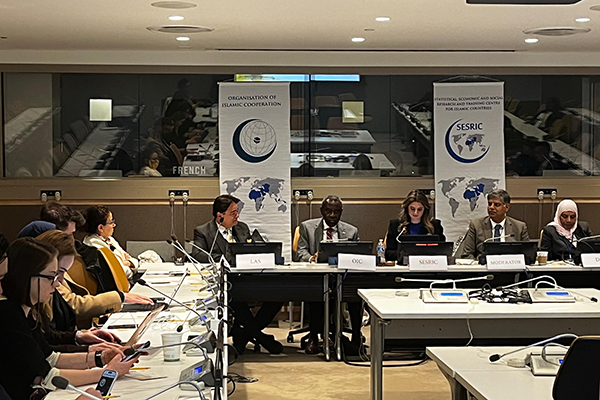
At the 64th session of the Commission for Social Development (CSocD64), a high-level panel titled “Activating the Ability Dividend: Policies for Socio-Economic Empowerment for Persons with Disabilities in OIC Member Countries” placed disability inclusion at the center of the global development agenda.
Convened by the Statistical, Economic and Social Research and Training Centre for Islamic Countries (SESRIC), and the Permanent Observer Mission of the Organization of Islamic Cooperation (OIC), the discussion highlighted the persistent and multidimensional barriers faced by persons with disabilities – spanning education, employment, healthcare, social protection, infrastructure, and digital access.
Globally, more than 1.3 billion people live with some form of disability, yet many continue to experience exclusion, poverty, and marginalization.
Delivering welcoming remarks, UNOSSC Director Dima Al-Khatib underscored that disability inclusion is fundamentally about dignity and human potential. “We see growing momentum and political will around the world to ensure that persons with disabilities are not left behind – not in education, not in employment, not in the digital space, not in public life. But we also recognize that progress remains very uneven,” she stated.
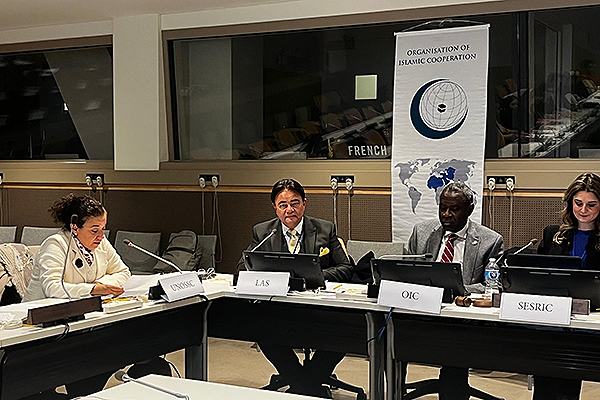 The Director emphasized that inclusion requires deliberate and sustained effort: “Inclusive development does not happen by default. It requires intentional collaboration, across sectors, across institutions, across policymakers, data people and across borders.”
The concept of the “ability dividend” reframes disability inclusion not as charity, but as smart development policy. As outlined by SESRIC, barriers to education, decent work, and social protection create cascading disadvantages throughout the life course. Unlocking the ability dividend involves enabling persons with disabilities to contribute fully to economic growth and social cohesion.
A central theme of the panel was the growing role of South-South and triangular cooperation in advancing disability inclusion across OIC Member States and the wider Global South.
“One of the most promising developments in recent years has been the increasing use of South-South and triangular cooperation to support disability inclusion,” Director Al-Khatib highlighted. Through South-South and triangular cooperation, countries are exchanging practical solutions on inclusive education, employment services, entrepreneurship support, disability-responsive social protection, and accessible infrastructure. Regional training centers, peer learning exchanges, and digital innovation initiatives are also helping governments co-design policies grounded in shared realities.
South-South knowledge exchange and capacity development remain at the heart of these efforts.
The panel stressed the importance of strengthening disability data systems, scaling up life-course policies, and improving multi-sectoral coordination to ensure evidence-based and inclusive decision-making. Director Al-Khatib emphasized the foundational role of data: “Inclusive development cannot be tracked or managed without reliable, disaggregated, and timely data – something many countries are still building capacity for,.”
UNOSSC is enabling exchanges of good practices and solutions through its South-South Galaxy platform. South-South Galaxy helps countries and partners find, connect, and scale proven solutions – linking evidence, demand, expertise, and financing through a trusted UNOSSC one-stop shop. Currently, the platform features around 20 solutions specifically focused on disability and inclusion, further strengthening peer learning and practical cooperation across the Global South.
Aligned with the United Nations Disability Inclusion Strategy and the 2030 Agenda, the discussion reaffirmed that disability inclusion is not a stand-alone issue. It reflects the fairness, accessibility, and resilience of development systems as a whole.
By leveraging South-South and triangular cooperation, countries are moving beyond rhetoric toward practical, scalable solutions. Activating the ability dividend means ensuring that persons with disabilities are not only beneficiaries of development, but active participants and leaders – shaping inclusive societies where dignity, opportunity, and human potential are fully realized.
The Director emphasized that inclusion requires deliberate and sustained effort: “Inclusive development does not happen by default. It requires intentional collaboration, across sectors, across institutions, across policymakers, data people and across borders.”
The concept of the “ability dividend” reframes disability inclusion not as charity, but as smart development policy. As outlined by SESRIC, barriers to education, decent work, and social protection create cascading disadvantages throughout the life course. Unlocking the ability dividend involves enabling persons with disabilities to contribute fully to economic growth and social cohesion.
A central theme of the panel was the growing role of South-South and triangular cooperation in advancing disability inclusion across OIC Member States and the wider Global South.
“One of the most promising developments in recent years has been the increasing use of South-South and triangular cooperation to support disability inclusion,” Director Al-Khatib highlighted. Through South-South and triangular cooperation, countries are exchanging practical solutions on inclusive education, employment services, entrepreneurship support, disability-responsive social protection, and accessible infrastructure. Regional training centers, peer learning exchanges, and digital innovation initiatives are also helping governments co-design policies grounded in shared realities.
South-South knowledge exchange and capacity development remain at the heart of these efforts.
The panel stressed the importance of strengthening disability data systems, scaling up life-course policies, and improving multi-sectoral coordination to ensure evidence-based and inclusive decision-making. Director Al-Khatib emphasized the foundational role of data: “Inclusive development cannot be tracked or managed without reliable, disaggregated, and timely data – something many countries are still building capacity for,.”
UNOSSC is enabling exchanges of good practices and solutions through its South-South Galaxy platform. South-South Galaxy helps countries and partners find, connect, and scale proven solutions – linking evidence, demand, expertise, and financing through a trusted UNOSSC one-stop shop. Currently, the platform features around 20 solutions specifically focused on disability and inclusion, further strengthening peer learning and practical cooperation across the Global South.
Aligned with the United Nations Disability Inclusion Strategy and the 2030 Agenda, the discussion reaffirmed that disability inclusion is not a stand-alone issue. It reflects the fairness, accessibility, and resilience of development systems as a whole.
By leveraging South-South and triangular cooperation, countries are moving beyond rhetoric toward practical, scalable solutions. Activating the ability dividend means ensuring that persons with disabilities are not only beneficiaries of development, but active participants and leaders – shaping inclusive societies where dignity, opportunity, and human potential are fully realized.
The Director emphasized that inclusion requires deliberate and sustained effort: “Inclusive development does not happen by default. It requires intentional collaboration, across sectors, across institutions, across policymakers, data people and across borders.”
The concept of the “ability dividend” reframes disability inclusion not as charity, but as smart development policy. As outlined by SESRIC, barriers to education, decent work, and social protection create cascading disadvantages throughout the life course. Unlocking the ability dividend involves enabling persons with disabilities to contribute fully to economic growth and social cohesion.
A central theme of the panel was the growing role of South-South and triangular cooperation in advancing disability inclusion across OIC Member States and the wider Global South.
“One of the most promising developments in recent years has been the increasing use of South-South and triangular cooperation to support disability inclusion,” Director Al-Khatib highlighted. Through South-South and triangular cooperation, countries are exchanging practical solutions on inclusive education, employment services, entrepreneurship support, disability-responsive social protection, and accessible infrastructure. Regional training centers, peer learning exchanges, and digital innovation initiatives are also helping governments co-design policies grounded in shared realities.
South-South knowledge exchange and capacity development remain at the heart of these efforts.
The panel stressed the importance of strengthening disability data systems, scaling up life-course policies, and improving multi-sectoral coordination to ensure evidence-based and inclusive decision-making. Director Al-Khatib emphasized the foundational role of data: “Inclusive development cannot be tracked or managed without reliable, disaggregated, and timely data – something many countries are still building capacity for,.”
UNOSSC is enabling exchanges of good practices and solutions through its South-South Galaxy platform. South-South Galaxy helps countries and partners find, connect, and scale proven solutions – linking evidence, demand, expertise, and financing through a trusted UNOSSC one-stop shop. Currently, the platform features around 20 solutions specifically focused on disability and inclusion, further strengthening peer learning and practical cooperation across the Global South.
Aligned with the United Nations Disability Inclusion Strategy and the 2030 Agenda, the discussion reaffirmed that disability inclusion is not a stand-alone issue. It reflects the fairness, accessibility, and resilience of development systems as a whole.
By leveraging South-South and triangular cooperation, countries are moving beyond rhetoric toward practical, scalable solutions. Activating the ability dividend means ensuring that persons with disabilities are not only beneficiaries of development, but active participants and leaders – shaping inclusive societies where dignity, opportunity, and human potential are fully realized.