• Home
  • /
  • IBSA Fund Story
  • /
  • IBSA Fund: Republic of Congo Advances Home-Grown School Feeding Through South-South Cooperation

IBSA Fund: Republic of Congo Advances Home-Grown School Feeding Through South-South Cooperation


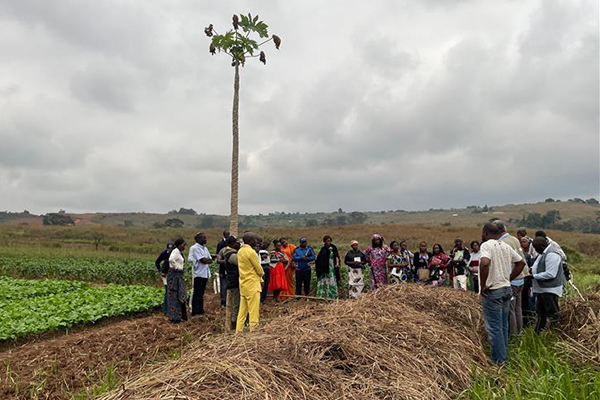
Brazzaville – A South-South and triangular cooperation initiative supported by the India-Brazil-South Africa Fund for the Alleviation of Poverty and Hunger is helping the Republic of the Congo turn school meals into a driver of rural transformation, linking family farmers to stable local markets while improving children’s nutrition and education outcomes. The project, “Strengthening access to local markets for family farmers in the Republic of Congo through South-South Cooperation,” brings together the IBSA Fund, the Government of the Republic of the Congo, the Government of Brazil and the World Food Programme (WFP), with the United Nations Office for South-South Cooperation serving as the IBSA Fund’s manager and secretariat. Backed by nearly USD 1 million in IBSA financing, the two-year pilot – known locally as “Seeds for Tomorrow” – demonstrates how public procurement for school feeding can simultaneously strengthen national systems, empower farmers and build human capital. At the heart of the initiative is a “home-grown school feeding” model: schools purchase food directly from local family farmers, creating predictable demand that enables smallholders to invest in production, storage and delivery. Technical support has been provided through WFP’s Centre of Excellence against Hunger in Brazil, drawing on lessons from Brazil’s nationally owned school feeding architecture. Building national systems Beyond service delivery, the project invested in institutional capacity to anchor local procurement within national policy frameworks. Sixty-five policymakers and technical staff from the Ministries of Agriculture and Education were trained through workshops, technical exchanges and study missions. Topics included agricultural market analysis, pricing and procurement protocols for family farming products, and monitoring and evaluation systems inspired by Brazil’s National School Feeding Programme (PNAE). Four technical manuals were developed and validated, covering agricultural policy options, operational steps for purchasing from family farmers, monitoring and evaluation mechanisms, and “social control” systems to strengthen transparency and community participation. These tools provide a practical roadmap for scaling up the nationally owned programme. The initiative has also generated important policy signals. In February 2025, the Republic of the Congo formalized its commitment to the Global School Meals Coalition, reinforcing high-level political support for expanding school feeding nationwide. Later that year, Decree No. 2025-450 established a national interministerial Task Force under the supervision of the Prime Minister to coordinate school feeding across sectors, embedding agriculture, education and nutrition within an integrated governance framework. Empowering family farmers At the community level, the project worked directly with more than 10 agricultural cooperatives across the departments of Bouenza, Pool and Plateaux, representing around 100 family farmers. Cooperatives received irrigation equipment, storage facilities and small-scale machinery, alongside training in production planning, savings management and market access. For farmers, supplying local schools has meant more than new buyers – it has meant stability. With predictable contracts, cooperatives have expanded cultivated areas, improved yields and strengthened their ability to meet quality and delivery standards. Women-led groups in particular reported gains in income security and household food availability. As one cooperative member in Bouenza noted, proximity to schools reduces transport costs and strengthens ties between producers and communities, keeping value circulating locally rather than flowing outward through imported food supply chains. Improving education and nutrition The pilot reached 10 schools and approximately 3,000 students, equipping facilities to safely store and prepare nutritious, locally sourced meals, including staples such as cassava. School staff received training in food handling and programme management to ensure quality and accountability. The educational impact has been tangible. Schools in Mouyondzi and Gamboma reported increases in enrolment and attendance, with some recording significant improvements in examination pass rates. By reducing short-term hunger and improving diet quality, school meals are enhancing concentration and learning, while also acting as a social protection measure for vulnerable families. A model for South-South cooperation Partners describe the initiative’s most significant contribution as both technical and paradigmatic. Locally sourced school feeding has been positioned not simply as a feeding modality, but as a policy instrument that connects agriculture, nutrition, education and rural employment. In doing so, it reflects the core principles reaffirmed in the Nairobi Outcome Document: national ownership, equality, mutual benefit and non-conditionality. A final evaluation published in late 2025 confirmed that planned targets were achieved and that the model is operationally viable in the Congolese context. A 2025-2030 transition plan is now under preparation to expand the approach to additional schools, while gradually shifting WFP’s role from direct implementation toward technical assistance as national systems assume greater responsibility. For communities in Bouenza, Pool and Plateaux, the results are immediate: children eat better, family farmers gain reliable markets, and institutions are better equipped to deliver integrated services. In the broader South-South cooperation community, the initiative offers practical evidence that solidarity – translated into locally rooted systems – can generate measurable development impact.
Related Post


  • All Post
  • ATCT Featured Publications POM
  • BAPA+40
  • Blog
  • Capacity Development Initiatives
  • CICETE Featured Publications POM
  • CIKD
  • Cities Clusters - Agriculture
  • Cities Clusters - COVID-19
  • Cities Clusters - COVID-19 Knowledge Products
  • Cities Clusters - DRR
  • Cities Clusters - E-commerce
  • Cities Clusters - Tourism
  • Cities Clusters - Tourism Knowledge Products
  • Cities Clusters - Transport
  • Cities Clusters - Waste
  • Cities Project
  • Cities Project COVID-19 Newsletters
  • Cities Project COVID-19 Response
  • Cities Project Knowledge Products
  • Classic (untouched)
  • Climate Action
  • COMSATS Featured Publications POM
  • COMSATS Featured Solutions POM
  • Converted from Divi
  • Converted from Mixed
  • Converted from WPBakery
  • COVID-19
  • COVID-19 Page Featured Solutions
  • DRR Knowledge Products
  • DRR News
  • Empty Post
  • Events
  • Featured Event UN-Habitat POM
  • Financing for Development
  • Financing Mechanisms
  • g7+
  • Gender Events
  • Gender News
  • Good Practices in SSTrC Series
  • Good Practices Publications
  • Good Practices Thematic Series & Special Editions
  • Good Practices Vol. 2
  • Good Practices Vol. 3
  • GSSDC
  • Highlighted
  • Highlighted Publications
  • IAEA Featured Solutions POM
  • IBRAF Featured Publications POM
  • IBSA Fund
  • IBSA Fund Annual Reports
  • IBSA Fund News and Stories
  • IBSA Fund Publication
  • IBSA Fund Story
  • ICGEB Featured Events POM
  • ICGEB Featured Publications POM
  • ICGEB Featured Solutions POM
  • ILO Featured Events POM
  • ILO Featured Publications POM
  • ILO Featured Solutions POM
  • India-UN Development Partnership Fund
  • India-UN Fund Publication
  • India-UN Fund Story
  • IsDB
  • IsDB Featured Publications POM
  • IsDB SCC
  • News
  • Norec Featured Publications POM
  • Norec Featured Solutions POM
  • Peace and Development
  • PGTF Publications
  • PGTF Story
  • PICA Featured News POM
  • PICA Featured Publications POM
  • PICA Featured Solutions POM
  • PIDF Featured Publications POM
  • Publications
  • Regional Updates
  • Research
  • ROK-UNOSSC Facility
  • SGP Featured Publication POM
  • SGP Featured Solutions POM
  • Solution
  • South South in Action
  • South-South Global Thinkers
  • South-South Ideas
  • South-South Ideas Series
  • South-South in Action Series
  • Southern Response to COVID-19
  • SSN4PSI Featured Publications POM
  • SSN4PSI Featured Solutions POM
  • Training
  • UN Day for SSC 2020
  • UN Fund for SSC
  • UN SSC Day Publications
  • UN-Habitat Featured Publications POM
  • UN-HABITAT Featured Solutions POM
  • UNCCT
  • UNEP Featured Publications POM
  • UNFPA
  • UNFSSC Publication
  • UNFSSC Story
  • UNIDO Featured Publications POM
  • UNIDO Featured Solutions POM
  • UNIDO POM Events
  • UNOCT Featured Publications POM
  • UNV
  • UNV Featured Publications POM
  • WB Featured Publications POM
  • WB Featured Solutions POM
  • Webinars
  • WFP Featured Events POM
  • WFP Featured Publication POM
  • WFP Featured Solutions POM
  • WIPO
  • Workshops and Seminars
  • Youth4South
  • z Across the Globe 1
  • z Across the Globe 2
  • z Across the Globe 4
  • z Across the Globe 5
  • z Across the Globe 6
  • z Across the Globe 7
  • z Across the Globe 8
  • z ES BAPA+40
  • z ES Eventos
  • z ES Noticias
  • z ES Noticias Destacadas
  • z ES Publicaciones
  • z ES Publicaciones Destacadas
  • z ES Serie Buenas Prácticas en la CSSyT
  • z ES Serie El Sur-Sur en Acción
  • z FR Actualités
  • z FR BAPA+40
  • z FR Événements
  • z FR Publications
  • z FR Publications en vedette
  • z FR Série Bonnes pratiques en CSST
  • z FR Série Sud-Sud en action
  • z Highlighted News
  • z Photos
  • z Videos
  • z ZH BAPA+40
  • z ZH Events
  • z ZH News

ABOUT

Terms of Service

Privacy Policy

Disclosures

RESOURCES

Terms of Service

Privacy Policy

Disclosures

ENGAGE

Terms of Service

Privacy Policy

Disclosures

Copyright © UNOSSC/UNDP

wpChatIcon
wpChatIcon

Alliance Application Form

Submit an Expression of Interest and/or Demand Signal. UNOSSC reviews submissions on a rolling basis.

1. Official name of organization / institution / government entity (exclusions to apply) *
2. Country *
3. Region *
4. SDG *
Secondary SDG *
5. Partner category *
6. Website *
7. Brief description of your institution (max. 150 words) *
Name for the Lead *
Title for the Lead *
Email address for the Lead *
Name for the co-lead
Title for the co-lead
Email address for the co-lead
Section 3. Expression of Interest in the Alliance *
Additional information on proposed areas of engagement may be requested through the platform following initial review by the Alliance Secretariat.
Section 4. Due Diligence and Integrity Declaration *

Submission Note:

  • Submission of this Expression of Interest form does not automatically confer participation in the Alliance.
  • All submissions will be reviewed by the Alliance Secretariat, including basic eligibility screening and proportionate due diligence, as appropriate.
  • Participation in Alliance activities is determined based on relevance to articulated cooperation needs, alignment with Alliance principles, and integrity considerations.
  • Engagement under the Alliance is voluntary, non-binding, and facilitative in nature, and does not constitute funding approval, contractual commitment, or institutional membership.
  • The Alliance Secretariat may contact submitting entities for additional information or clarification during the review process.

Submission of Demand Form

Description of Demand

Indicate the type of support or cooperation requested through the Alliance.
Please briefly describe the challenge, gap, or priority. (Max. 300 words)

Thematic and Geographic Focus

Please indicate the main focus areas of your demand:

A. Thematic Areas (select up to three)
B. Geographic Focus (select all that apply)

Proposed Engagement Modalities

Please indicate how you would like to engage through the Alliance (select all that apply):

Expected Outcomes

Please indicate the main results you seek to achieve through this engagement. (Max. 200 words)
Examples:
• Capacity strengthened
• Partnerships established
• Sectoral or regional strategies co-developed
• Solutions piloted
• Knowledge generated
• Policies informed

Timeline and Readiness (if applicable)

1. Expected timeframe for engagement:
2. Current stage:

Additional Information

Please provide any additional information, documents, or links relevant to this submission.
(Max. 200 words or upload link)

Submission of Offer Form

Description of Contribution

Indicate the type of contribution your institution can provide and describe the expertise, resources, or solutions you may offer.
Please briefly describe your proposed contribution. (Max. 300 words)

Thematic and Geographic Focus

Please indicate the main focus areas of your interest:

A. Thematic Areas (select up to three)
B. Geographic Focus (select all that apply)

Proposed Engagement Modalities

Please indicate how you would like to engage through the Alliance (select all that apply):

Expected Outcomes

Please indicate the main results you aim to achieve through this engagement. (Max. 200 words)
Examples:
• Capacity strengthened
• Partnerships established
• Sectoral or regional strategies co-developed
• Solutions piloted
• Knowledge generated
• Policies informed

Timeline and Readiness (if applicable)

1. Expected timeframe for engagement:
2. Current stage:

Additional Information

Please provide any additional information, documents, or links relevant to this submission.
(Max. 200 words or upload link)

Organization Registration

Authentication & Due Diligence This prototype simulates identity verification, due diligence confirmation, and an authentication step before submission. *

First Name *
Last Name *
Email address *
Password *
Confirm Password *
Name of institution / organization *
Country / Region *
Organization Type *
Organization other *
Function / role *
Organization logo *
Maximum file size: 1 GB

Login

Login / email *
Password *
Remember me

Forgot password?

Connect form

Your name *
Email *
Organization / institution *
Job title / role *
Reason for connecting:
Short message

Scroll to Top