Through the India, Brazil and South Africa Facility for Poverty and Hunger Alleviation (IBSA Fund) – a flagship South-South cooperation financing mechanism – the Food and Agriculture Organization of the United Nations, in partnership with national institutions, is supporting young farmers in The Gambia to strengthen agricultural productivity, improve postharvest management, and enhance climate resilience.
Under the project “Enhanced Vegetable Production and Processing for Rural Women and Youth in The Gambia,” implemented in collaboration with the Ministry of Agriculture, Livestock and Food Security and the Ministry of Youth and Sports, FAO has delivered targeted training in postharvest handling, pest management, agro-processing, and production planning. These interventions are equipping young food producers with practical skills and knowledge to increase yields, reduce losses, and improve livelihoods.
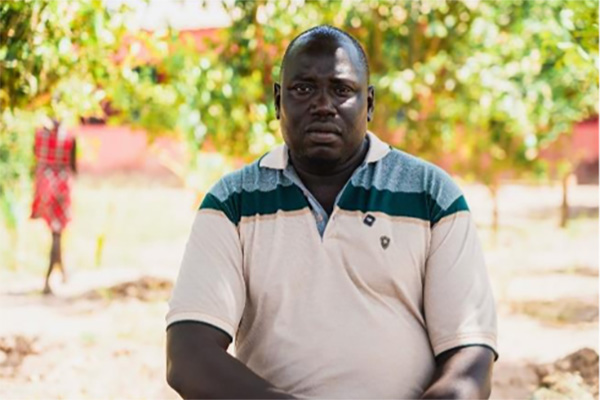
For Alfu Sarr, a young farmer from Niumi, the initiative has marked a turning point. Having previously relied on traditional methods shaped by trial and error, limited access to technical knowledge constrained both productivity and income. Participation in FAO-supported trainings has enabled him to adopt improved farming practices, including structured production planning and integrated pest management.
“The trainings introduced me to a new way of farming,” Alfu Sarr said. “I learned how to process food better, plan production, and manage pests and diseases. I now understand what each crop needs and how to protect it.”
With enhanced technical capacity, Alfu has transitioned from reactive to proactive farm management. He now applies nature-based solutions, including biopesticides derived from neem leaves, garlic, and pepper, alongside organic fertilization methods. These approaches, grounded in local knowledge and reinforced through training, have strengthened his ability to manage pests and diseases effectively.
Improved production planning has further enabled Alfu to align planting cycles with optimal growing periods, resulting in increased yields and reduced losses. His farm now produces up to four harvests annually, supplying tomatoes, okra, and other vegetables to markets across the Greater Banjul Area and surrounding communities. The resulting income supports his extended household and generates additional employment, including for a trained agricultural graduate overseeing farm operations.
Complementary support provided through the IBSA Fund – including irrigation infrastructure such as a borehole, a 30,000-litre water tank, and mechanized equipment – has further enhanced his productive capacity. Together, these interventions illustrate the catalytic role of triangular cooperation in combining financial resources, technical expertise, and local knowledge to deliver sustainable development outcomes.
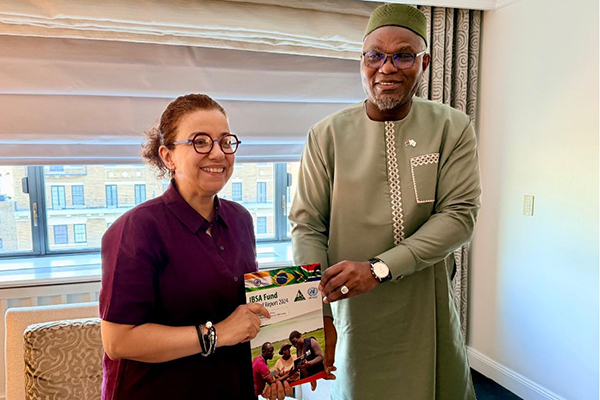 The significance of these efforts extends beyond individual farms. On 15 April 2026, the Director of the United Nations Office for South-South Cooperation (UNOSSC) met with H.E. Muhammed B.S. Jallow, Vice President of the Republic of The Gambia, in New York. During the meeting, the Vice President highlighted agricultural transformation as a national priority, underscoring the importance of transitioning from raw exports to value-added production – particularly in horticulture and rural value chains. He expressed appreciation for UNOSSC’s funding support through various trust funds, including the ongoing IBSA-supported project, and called for accelerated implementation and stronger local-level interventions to deliver results for farmers and communities on the ground.
Alfu’s experience reflects broader efforts under South-South and triangular cooperation frameworks to empower smallholder farmers, particularly youth, through integrated support models that link capacity development with access to appropriate technologies. With focused technical assistance, access to proven technologies, and peer-to-peer knowledge exchange across the Global South, farmers like Alfu Sarr are increasingly positioned not only to feed their families and communities, but to become agents of sustainable rural transformation.
The significance of these efforts extends beyond individual farms. On 15 April 2026, the Director of the United Nations Office for South-South Cooperation (UNOSSC) met with H.E. Muhammed B.S. Jallow, Vice President of the Republic of The Gambia, in New York. During the meeting, the Vice President highlighted agricultural transformation as a national priority, underscoring the importance of transitioning from raw exports to value-added production – particularly in horticulture and rural value chains. He expressed appreciation for UNOSSC’s funding support through various trust funds, including the ongoing IBSA-supported project, and called for accelerated implementation and stronger local-level interventions to deliver results for farmers and communities on the ground.
Alfu’s experience reflects broader efforts under South-South and triangular cooperation frameworks to empower smallholder farmers, particularly youth, through integrated support models that link capacity development with access to appropriate technologies. With focused technical assistance, access to proven technologies, and peer-to-peer knowledge exchange across the Global South, farmers like Alfu Sarr are increasingly positioned not only to feed their families and communities, but to become agents of sustainable rural transformation.
The significance of these efforts extends beyond individual farms. On 15 April 2026, the Director of the United Nations Office for South-South Cooperation (UNOSSC) met with H.E. Muhammed B.S. Jallow, Vice President of the Republic of The Gambia, in New York. During the meeting, the Vice President highlighted agricultural transformation as a national priority, underscoring the importance of transitioning from raw exports to value-added production – particularly in horticulture and rural value chains. He expressed appreciation for UNOSSC’s funding support through various trust funds, including the ongoing IBSA-supported project, and called for accelerated implementation and stronger local-level interventions to deliver results for farmers and communities on the ground.
Alfu’s experience reflects broader efforts under South-South and triangular cooperation frameworks to empower smallholder farmers, particularly youth, through integrated support models that link capacity development with access to appropriate technologies. With focused technical assistance, access to proven technologies, and peer-to-peer knowledge exchange across the Global South, farmers like Alfu Sarr are increasingly positioned not only to feed their families and communities, but to become agents of sustainable rural transformation.