
• Home
  • /
  • 2026 UN Joint Certificate Training Programme Concludes, Strengthening Global Capacities for Urban Disaster and Climate Resilience

2026 UN Joint Certificate Training Programme Concludes, Strengthening Global Capacities for Urban Disaster and Climate Resilience


The 2026 edition of the Joint Certificate Training Programme, “Leveraging Technological Innovation, Evidence-Based Decision-Making and South-South Cooperation to Address Systemic Urban Risk and Strengthen Disaster Resilience,”successfully concluded its final session 20 May.

With support from Governments of China and Turkiye contributions to the UN Fund for South-South Cooepration, Co-organized by the United Nations Office for South-South Cooperation (UNOSSC), the United Nations Office for Disaster Risk Reduction (UNDRR) Global Education and Training Institute (GETI), the Pan American Health Organization (PAHO/WHO), and the United Nations Technology Bank for the Least Developed Countries (UNTB), this flagship initiative has firmly established itself as a leading multilateral platform for South-South and triangular cooperation (SSTC) in disaster risk reduction (DRR) and public health emergency preparedness.

Since its launch in 2020, the Joint Certificate Training Programme has reached more than 11,000 live-session participants and over 6,500 self-paced learners across 155 countries and territories.

The 2026 edition builds on this momentum and focuses on leveraging technological innovations, practical tools, and SSTC to enhance evidence-based decision-making and address systemic urban risks while strengthening disaster resilience and health emergency preparedness.

It received over 4,680 online registrations and recorded over 3,050 participants attending the live sessions from 169 countries and territories. Over 42% of participants were women, 39% youth, and 7% persons with disabilities.
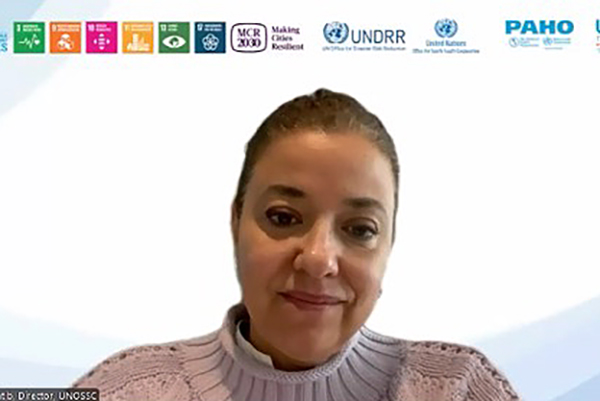
During Opening Session on 29 April, led by UNDRR, Dima Al-Khatib, Director of UNOSSC, underscored the proactive stance of developing countries amid escalating climate threats, stating that as climate-related shocks intensify and multiply, the Global South is not waiting for permission. On the contrary, it is leading the development and deployment of innovative, practical, and scalable regional solutions. Through South-South and triangular cooperation, these frameworks are being shared, localized, and scaled to ensure they remain context-specific, cost-effective, and highly impactful.
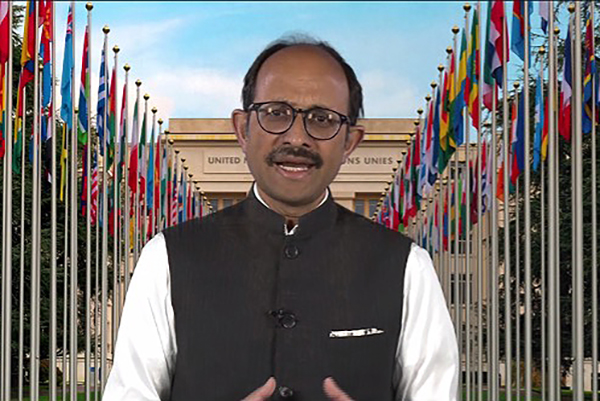
Kamal Kishore, Special Representative of the United Nations Secretary-General (SRSG) for Disaster Risk Reduction and Head of UNDRR, emphasized that the Midterm Review of the Sendai Framework calls for accelerated adoption of innovation and emerging technologies to strengthen disaster risk management. He noted that building institutional capacities, improving access to data systems, and deepening cross-border cooperation are essential to addressing these challenges effectively.
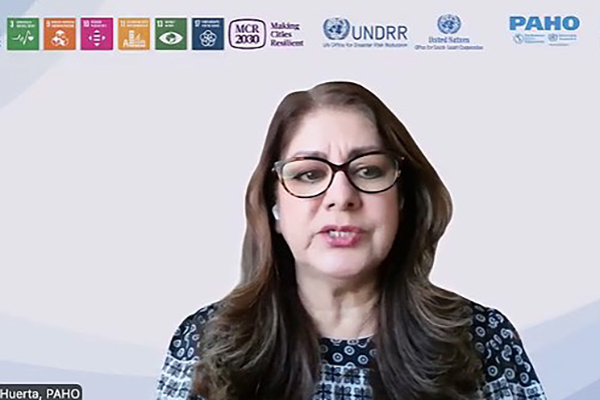
Piedad Huerta, Head of the Office of Country and Subregional Coordination (CSC) at PAHO/WHO, highlighted that urban areas globally—and across the Americas specifically—face increasingly complex and intersecting risks. She reiterated that PAHO prioritizes the resilience, preparedness, response, and recovery of public health systems. In this context, evidence-based decision-making supported by data, geospatial intelligence, and technological innovation remains critical to anticipating risks and ensuring the continuity of essential health services.
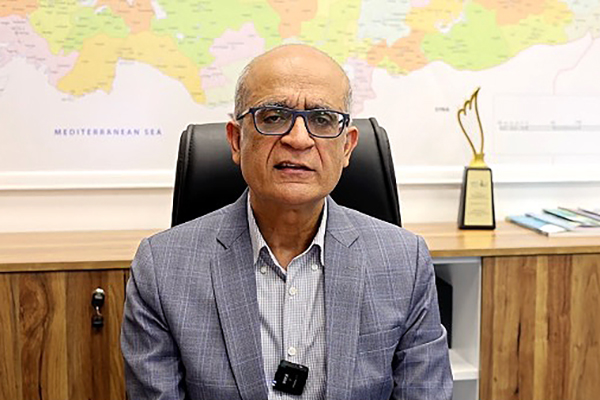
Deodat Maharaj, Managing Director of UNTB, added that modern resilience relies on anticipating risks, leveraging data, and integrating technology into governance systems rather than merely responding to crises. This paradigm demands robust institutions, skilled professionals, sustained partnerships, and continuous investment in science and innovation as vital enablers of sustainable development.
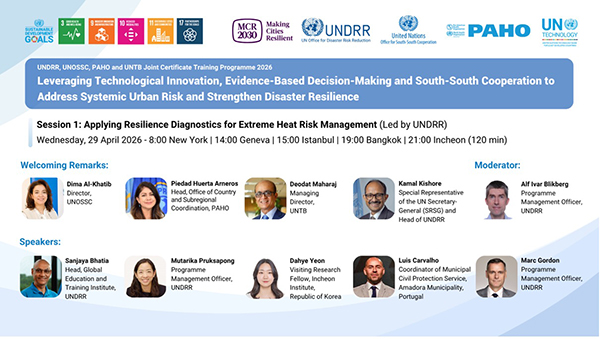
The curriculum unfolded over four targeted thematic blocks: Session 1 introduced practical diagnostics to enhance extreme heat risk management, showcasing local government case studies alongside the newly developed Extreme Heat Risk Governance Framework and Toolkit.
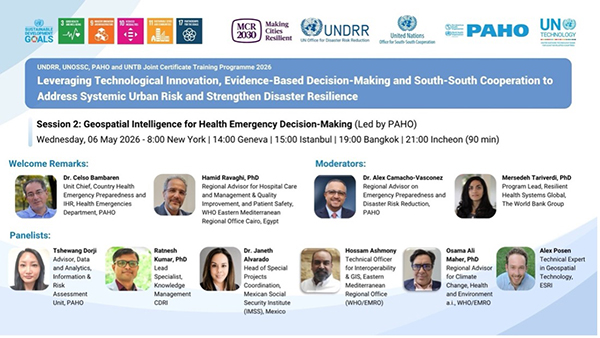
Session 2, led by PAHO, demonstrated the utility of Geospatial Intelligence (GEOINT)—including GIS, satellite imagery, and spatial analytics—to guide evidence-based urban planning and health emergency response.
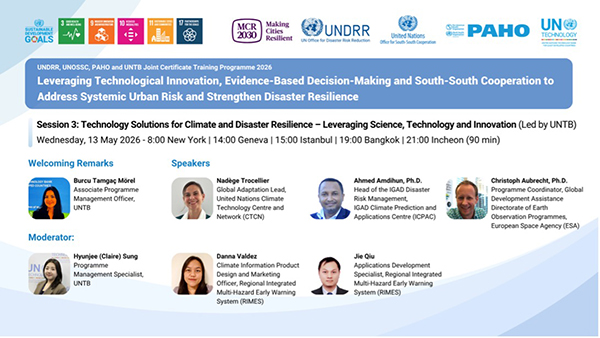
Session 3, led by UNTB, explored scalable, technology-driven solutions designed to bolster climate resilience within risk-exposed and resource-constrained environments, with a particular focus on Least Developed Countries (LDCs).
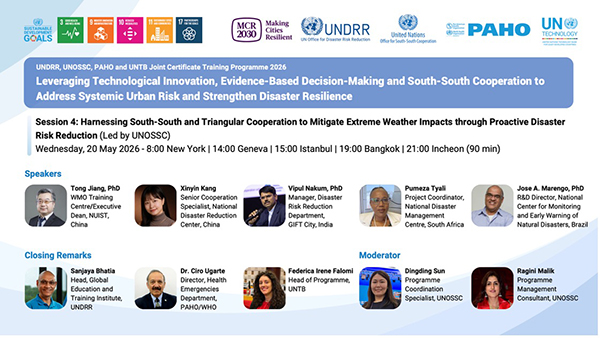
The final Session 4, led by UNOSSC, showcased local- and national-level good practices and technological solutions in DRR from the Global South, emphasizing peer-to-peer knowledge exchange in mitigating extreme weather impacts.

 South-South experience sharing in mitigating extreme weather impacts

The concluding panel brought together leading experts from Brazil, China, India, South Africa, and the World Meteorological Organization (WMO) Regional Training Centre to share innovative, high-impact and cooperative solutions.

Tong Jiang (WMO Regional Training Centre / Nanjing University of Information Science & Technology, China) presented on climate risk assessments and impact-based early warning systems, demonstrating the practical application of index-based insurance and flood threshold models.

Xinyin Kang (National Disaster Reduction Center, Ministry of Emergency Management, China) shared how the NDRCC leverages AI imagery extraction and coordinated drone and satellite fleets to optimize pre-disaster prevention and national monitoring.

Vipul Nakum (Disaster Risk Reduction Department, GIFT City, India) shared experiences in urban resilience, detailing GIFT City\’s deployment of smart infrastructure, AI-based flood management, and its alignment with the Making Cities Resilient 2030 initiative.

Pumeza Tyali (National Disaster Management Centre of South Africa) outlined South Africa’s strategic approach for proactive DRR, highlighting early warning mechanisms, anticipatory action, and regional partnerships for climate resilience.

Jose Marengo (National Center for Monitoring and Early Warning of Natural Disasters, Brazil) presented CEMADEN’s science-based approaches to climate resilience, showcasing integrated drought monitoring, risk forecasting, and community preparedness.

Reflecting on these contributions, Dingding Sun, Programme Specialist at UNOSSC, noted that South-South and triangular cooperation provides vital platforms to co-create scalable solutions, strengthen alliances, and inspire collective action for resilient community building.

In their closing remarks, Sanjaya Bhatia (Head of UNDRR GETI), Dr. Ciro Ugarte (Director of Health Emergencies Department, PAHO/WHO), and Federica Irene Falomi (Head of Programme of UNTB), reaffirmed that South-South cooperation remains foundational to this educational initiative. They concluded that the seamless transfer of expertise between developing nations and cities facing parallel emergencies forms the ultimate backbone of community-level resilience.

Related Post


No Posts Found!

Connect with UNOSSC

Stay updated with the latest trends in South-South cooperation and access our vast repository of knowledge.

Copyright © UNOSSC/UNDP

Alliance Application Form

Submit an Expression of Interest and/or Demand Signal. UNOSSC reviews submissions on a rolling basis.

1. Official name of organization / institution / government entity (exclusions to apply) *
Organization logo
Maximum file size: 20 MB
2. Country *
3. Region *
4. Select relevant SDGs *
5. Partner category *
6. Website *
7. Brief description of your institution (max. 150 words) *
Name for the Lead *
Title for the Lead *
Email address for the Lead *
Name for the co-lead
Title for the co-lead
Email address for the co-lead
Section 3. Expression of Interest in the Alliance *
Additional information on proposed areas of engagement may be requested through the platform following initial review by the Alliance Secretariat.
Section 4. Due Diligence and Integrity Declaration *

Submission Note:

  • Submission of this Expression of Interest form does not automatically confer participation in the Alliance.
  • All submissions will be reviewed by the Alliance Secretariat, including basic eligibility screening and proportionate due diligence, as appropriate.
  • Participation in Alliance activities is determined based on relevance to articulated cooperation needs, alignment with Alliance principles, and integrity considerations.
  • Engagement under the Alliance is voluntary, non-binding, and facilitative in nature, and does not constitute funding approval, contractual commitment, or institutional membership.
  • The Alliance Secretariat may contact submitting entities for additional information or clarification during the review process.

Submission of Demand Form

Description of Demand

Indicate the type of support or cooperation requested through the Alliance.
Please briefly describe the challenge, gap, or priority. (Max. 300 words)

Thematic and Geographic Focus

Please indicate the main focus areas of your demand:

A. Thematic Areas (select up to three)
B. Geographic Focus (select all that apply)

Proposed Engagement Modalities

Please indicate how you would like to engage through the Alliance (select all that apply):

Expected Outcomes

Please indicate the main results you seek to achieve through this engagement. (Max. 200 words)
Examples:
• Capacity strengthened
• Partnerships established
• Sectoral or regional strategies co-developed
• Solutions piloted
• Knowledge generated
• Policies informed

Timeline and Readiness (if applicable)

1. Expected timeframe for engagement:
2. Current stage:

Additional Information

Please provide any additional information, documents, or links relevant to this submission.
(Max. 200 words or upload link)

Submission of Offer Form

Description of Contribution

Indicate the type of contribution your institution can provide and describe the expertise, resources, or solutions you may offer.
Please briefly describe your proposed contribution. (Max. 300 words)

Thematic and Geographic Focus

Please indicate the main focus areas of your interest:

A. Thematic Areas (select up to three)
B. Geographic Focus (select all that apply)

Proposed Engagement Modalities

Please indicate how you would like to engage through the Alliance (select all that apply):

Expected Outcomes

Please indicate the main results you aim to achieve through this engagement. (Max. 200 words)
Examples:
• Capacity strengthened
• Partnerships established
• Sectoral or regional strategies co-developed
• Solutions piloted
• Knowledge generated
• Policies informed

Timeline and Readiness (if applicable)

1. Expected timeframe for engagement:
2. Current stage:

Additional Information

Please provide any additional information, documents, or links relevant to this submission.
(Max. 200 words or upload link)

Organization Registration

Authentication & Due Diligence This prototype simulates identity verification, due diligence confirmation, and an authentication step before submission. *

First Name *
Last Name *
Email address *
Password *
Confirm Password *
Name of institution / organization *
Country / Region *
Organization Type *
Organization other *
Function / role *
Organization logo *
Maximum file size: 1 GB

Login

Login / email *
Password *
Remember me

Forgot password?

Connect form

Your name *
Email *
Organization / institution *
Job title / role *
Reason for connecting:
Short message

Create Meeting Room

Purpose:
Use this form to create a virtual meeting room to consult with experts and partners on specific thematic areas. A coordinator will confirm expert availability and meeting details.

Mandatory Information

Meeting purpose / consultation topic *
Type of meeting *
Main thematic area *
SDG (select multiple)
Expert(s) requested from roster
Brief description of discussion *

Preferred meeting date(s) (up to 3)

Date 1
Date 2
Date 3
Preferred time window *
Time zone *
Requesting institution / organization *

Contact person

Name *
Email *

Optional Information

Related Galaxy item
Urgency level *
Preferred language(s)
Other participants to invite
Additional notes

Knowledge Products form

A. Publication Basics (Mandatory)

Exact Title of the Publication *
Executive Summary *
Submitting Organization *
Publication Available Online *
Direct Link to Publication (if online)

B. Publication Details

Subtitle
Publication Type
Publications Type Other
Year of Publication
Authors / Editors
Key Messages

C. Organizations & Contacts

Partner Organizations

Contact Person

Name
Title
Email

D. Discoverability (Optional)

Topics / Themes
Keywords
SDGs
Geographic Coverage
Language(s)

Good Practices form

SECTION 1. BASIC INFORMATION

Title of the Good Practice *
Name of the Solution(s) *
Short Summary *
max. 60 words
Lead Implementing Institution *
Partner Institutions *
Countries / Territories Involved *
Regions Involved *
Type of Cooperation *

SECTION 2. DEVELOPMENT CONTEXT & SDG ALIGNMENT

Primary SDG(s) Addressed *
SDG Target(s) *
Secondary SDGs (if applicable)
Development Challenge Addressed *
100–150 words

SECTION 3. DESCRIPTION OF THE GOOD PRACTICE & SOLUTION

Objectives of the Good Practice *
max. 100 words
Description of the Solution(s) *
max. 300 words
Innovation Dimension *
max. 150 words

SECTION 4. SOUTH-SOUTH & TRIANGULAR COOPERATION VALUE

South-South Knowledge Exchange *
max. 200 words
Role of Triangular Partners (if applicable)

SECTION 5. PARTICIPATION & GOVERNANCE

Participatory Approach *
max. 150 words
Governance & Institutional Arrangements *

SECTION 6. PRODUCED IMPACT (Partner-Validated)

Description of Produced Impact *
max. 250 words
Quantitative Results *
Qualitative Results
Timeframe of Impact *

SECTION 7. SUSTAINABILITY & SCALABILITY

Sustainability of the Good Practice *
max. 150 words
Replicability & Adaptability of the Solution *
max. 150 words

SECTION 8. RISKS & LESSONS LEARNED

Key Risks and Mitigation Measures
max. 100 words
Lessons Learned *
max. 150 words

SECTION 9. RESOURCES & EVIDENCE

Supporting Materials
Maximum file size: 1 GB
manuals, toolkits, evaluations, media
URL of the Good Practice / Solution

SECTION 10. CONTACT INFORMATION & VALIDATION

Focal Point – Lead Institution

Name *
Title *
Organization *
Email *
Focal Point – Partner Institution (Impact Validation)* (name, title, organization, email) *
Declaration *

Scroll to Top