The Regional Commissions of the United Nations conduct annual Sustainable Development Forums to review progress on five SDGs around a specific theme, with outcomes feeding into the High-Level Political Forum (HLPF) in New York each July. For 2025, the SDGs under review are SDG 3 (health and wellbeing), SDG 5 (gender equality), SDG 8 (decent work and economic growth), SDG 14 (life below water), and SDG 17 (partnerships, reviewed every year). The 2025 theme is “Advancing sustainable, inclusive, science- and evidence-based solutions for the 2030 Agenda and its SDGs for leaving no one behind”.
The Arab Forum for Sustainable Development (AFSD) convened 14-16 April 2025 on the theme “Restoring hope, raising ambition”, calling attention to inclusive, science- and evidence-based solutions for the 2030 Agenda and its Sustainable Development Goals (SDGs). A high-level segment during the Forum (at Ministerial level) focused on financing for development, given the upcoming Fourth Conference on Financing for Development (FfD4) in Seville, Spain 30 June – 3July 2025.
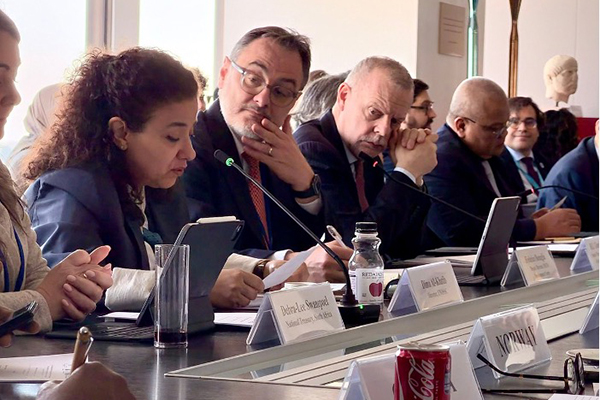
The Ministerial-level discussion at AFSD on 15 April (“On the Road to FfD4: Advancing a renewed global FfD framework and reforming the international financial architecture”) addressed the regional position on financing for development in the lead up to the FfD4 and deliberated on the First Draft Outcome Document released on 10 March (leaning on the priorities of the region). In the session were:
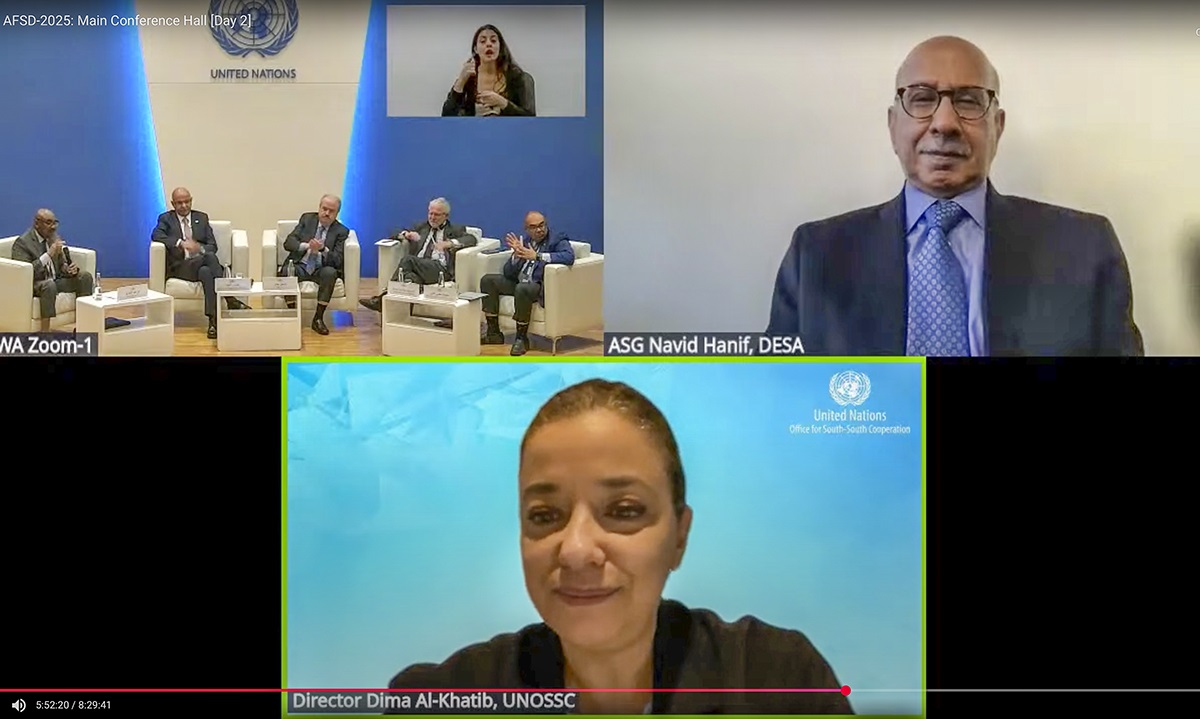 During the Ministerial dialogue on financing for development at AFSD, the UNOSSC Director Dima Al-Khatib framed the imperatives for leveraging the full potential of South-South and triangular cooperation to advance regional aspirations for fairer financial architecture. She raised the need to rethink the way we view the Global South, to recognize their evolution alongside the shifts in the development landscape; and, to also rethink the way we do development, recognizing the assets that the Global South also possess and could be leveraged for the benefit of peers. Please click here to read full remarks of UNOSSC Director Dima Al-Khatib). The G77 Chair pointed out that, in the context of financing for development, South-South and triangular cooperation needs to be viewed as additional strengths that serve as complements, and not alternatives, to traditional development cooperation (please see full session here).
?? Download UNOSSC Director Dima Al-Khatib’s statement.
During the Ministerial dialogue on financing for development at AFSD, the UNOSSC Director Dima Al-Khatib framed the imperatives for leveraging the full potential of South-South and triangular cooperation to advance regional aspirations for fairer financial architecture. She raised the need to rethink the way we view the Global South, to recognize their evolution alongside the shifts in the development landscape; and, to also rethink the way we do development, recognizing the assets that the Global South also possess and could be leveraged for the benefit of peers. Please click here to read full remarks of UNOSSC Director Dima Al-Khatib). The G77 Chair pointed out that, in the context of financing for development, South-South and triangular cooperation needs to be viewed as additional strengths that serve as complements, and not alternatives, to traditional development cooperation (please see full session here).
?? Download UNOSSC Director Dima Al-Khatib’s statement.
- Moderator: Ibrahim Ahmed Elbadawi Founder and Managing Director of the Gulf Economic Policy and Research Center
- Panelists: Yassine Jaber, Minister of Finance of Lebanon; Abbas Kadhom Obaid, Chair of the Group of 77 and Permanent Representative of the Republic of Iraq to the United Nations; Jesús Ignacio Santos Aguado, Ambassador of Spain to Lebanon; and, Mahmoud Mohieldin, United Nations Special Envoy on Financing the 2030 Agenda for Sustainable Development
- Discussants (live from New York): Navid Hanif, Assistant Secretary-General for Economic Development, United Nations Department of Economic and Social Affairs (UNDESA) and Dima Al-Khatib Director of the United Nations Office for South-South Cooperation.
The Arab region is diverse in socio-economic makeup, reflected in the groupings of the 22 Arab States used in the Arab Sustainable Development Report (ASDR): Gulf Cooperation Council (GCC) subregion: Bahrain, Kuwait, Oman, Qatar, Saudi Arabia and the United Arab Emirates; Middle-income countries (MICs) subregion excludes countries in situations of conflict and those classified as least developed countries: Algeria, Egypt, Jordan, Lebanon, Morocco and Tunisia; Least developed countries (LDCs) subregion follows the United Nations classification: the Comoros, Djibouti, Mauritania, Somalia, the Sudan and Yemen; Countries in conflict subregion: Iraq, Libya, Somalia, the State of Palestine, the Sudan, the Syrian Arab Republic and Yemen (Somalia, Sudan and Yemen are grouped in both LDCs and countries in conflict).
The Arab Sustainable Development Report 2024 highlights key challenges that need urgent attention to protect or speed up progress on the Sustainable Development Goals (SDGs). These include:
- Food security: The region imports most of its staple foods, and one-third of its countries are affected by conflict. This makes it especially vulnerable to price spikes and food shortages.
- Climate crisis: The region faces rising temperatures and water scarcity, along with more frequent droughts, sandstorms, and other natural disasters that worsen the effects of shocks.
- Ongoing conflict: Many countries – such as Iraq, Libya, Somalia, Sudan, Syria, and Yemen – are affected facing major setbacks in development and human suffering.
During the Ministerial dialogue on financing for development at AFSD, the UNOSSC Director Dima Al-Khatib framed the imperatives for leveraging the full potential of South-South and triangular cooperation to advance regional aspirations for fairer financial architecture. She raised the need to rethink the way we view the Global South, to recognize their evolution alongside the shifts in the development landscape; and, to also rethink the way we do development, recognizing the assets that the Global South also possess and could be leveraged for the benefit of peers. Please click here to read full remarks of UNOSSC Director Dima Al-Khatib). The G77 Chair pointed out that, in the context of financing for development, South-South and triangular cooperation needs to be viewed as additional strengths that serve as complements, and not alternatives, to traditional development cooperation (please see full session here).
?? Download UNOSSC Director Dima Al-Khatib’s statement.