Advancing Women’s Empowerment through South-South Cooperation
Equality and horizontality are fundamental principles of South-South cooperation, inscribed into its core international instruments, including the Outcome of the Second High-level United Nations Conference on South-South Cooperation, or BAPA+40. These priciples should not be construed to simply apply to equality among nations. Instead, equality must include all stakeholders and permeate all layers of cooperation from the supra-national to the individual.
South-South cooperation, that focuses on empowering women, and mainstreaming gender into activities across all SDGs – be it in agriculture, technology, financial inclusion, health or others – is instrumental at contributing to long-lasting benefits for those furthest behind.
In a proof of case, the South-South Trust Funds and programmes managed by the United Nations Office for South-South Cooperation (UNOSSC) provide rich examples of impactful and innovative approaches through which women have enhanced their livelihoods, improved their health and further fulfilled their potential – impacting not only themselves, but generating lasting change for the betterment of their communities.
Marking International Women’s Day, let us celebrate some of the projects improving the lives of women across the Global South.
The India-UN Development Partnership Fund makes strides toward financial inclusion and reproductive health
Established in 2017, the $150 million India-UN Development Partnership Fund supports Southern-owned sustainable development projects across the developing world, focusing on least developed countries and small island developing states. While its projects span all 17 Sustainable Development Goals, gender considerations are mainstreamed across its initiatives implemented through various United Nations Entities.
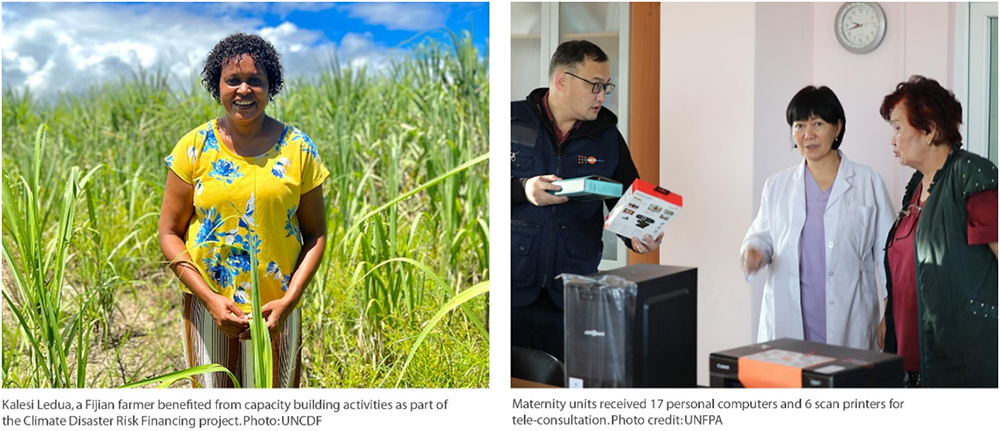
An illustrative example is a UNCDF-implemented project in Fiji. With a particular emphasis on supporting women, the initiative Developing Climate Disaster Risk Financing Framework and Parametric Insurance supported by the India-UN Fund draws on India’s expertise in FinTech and InsurTech. It utilized South-South cooperation to engage stakeholders, co-create solutions, raise awareness, build capacity, and explore innovative financing options.
In its initial phase, the project enabled about 50,000 women to enroll in parametric insurance despite the remote, low value and disaster-prone location of their agricultural households and businesses. In its second phase, this initiative seeks to benefit 5,000 households, including smallholder farmers, fishers, market vendors, and small businesses.
Another UNFPA-implemented project with a significant focus on women is the Increase access of rural women to quality reproductive and maternal health services in Kyrgyzstan. This initiative enhances obstetric care by integrating an obstetric surveillance system, tele-networking, and tele-counseling into five maternity hospitals. Its goal is to provide effective healthcare that places a high priority on the well-being of women and newborns, dramatically reducing maternal mortality.
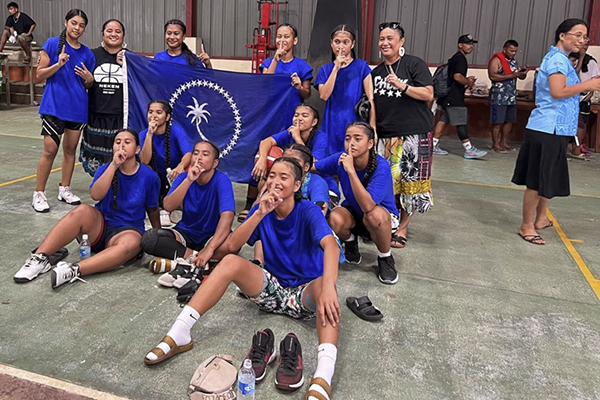
Further aiming to empower women, a UNDP-implemented project in the Federal State of Micronesia focuses on increasing women’s involvement in water and sanitation management. This project supports the national machinery to integrate gender considerations into national and state programs through policy, institutional, and organizational approaches, promoting gender parity.
India, Brazil and South Africa (IBSA Fund) support to women – spanning health, education and livelihoods
The IBSA Fund is a remarkable initiative sponsored by three Southern, democratic, multi-ethnic countries that pioneered South-South cooperation with the United Nations system. Operational since 2016, IBSA Fund projects are concrete expressions of solidarity contributing to the achievement of the Sustainable Development Goals in other developing countries.
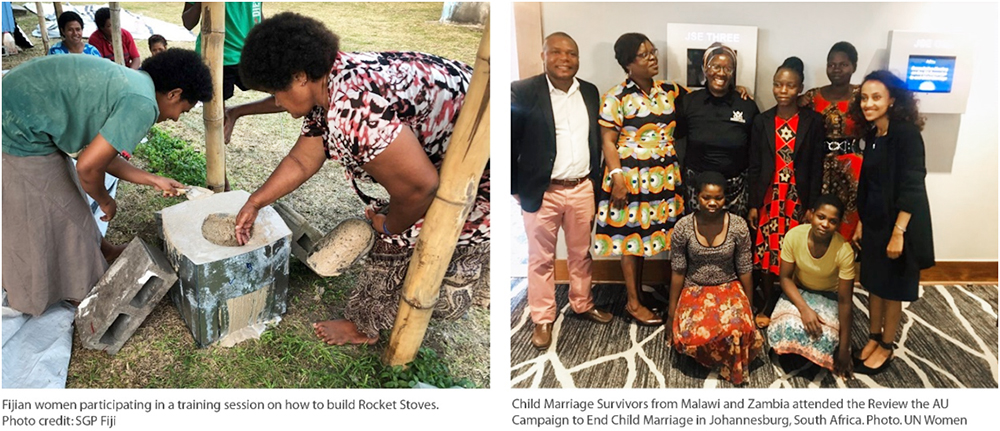
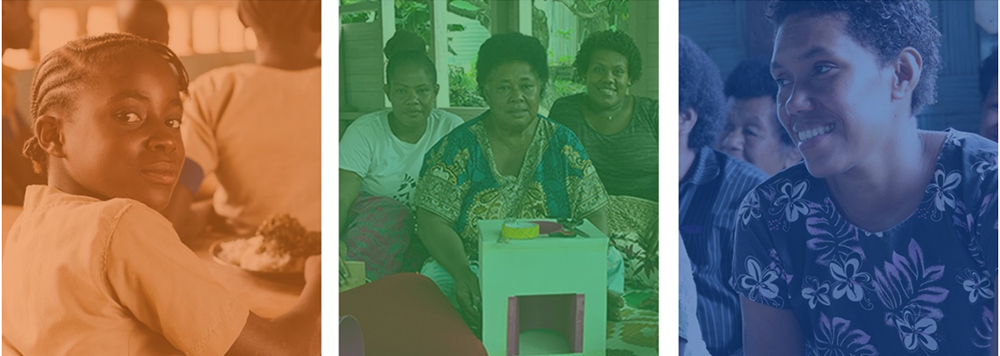
A significant and growing component of the IBSA Fund’s portfolio is its contribution to SDG 5, Gender Equality. For instance, the Empowering Rural Women in Fiji – Upscaling of Rocket Stove Project implemented by UNDP, empowered 1,530 women from 56 rural communities with new skills and opportunities for improved livelihoods through the training and production of 1,580 rocket stoves.
The Ending Child Marriage in Malawi and Zambia project advanced by UNWomen supported over 2,000 child marriage survivors, helping them to re-enroll in school and providing them a second chance at education. This project not only offered financial support for their education but also raised collective awareness and policy commitment towards ending child marriage, thereby impacting gender equality and restoring human dignity to the survivors.
Other projects, such as the Enhancing inclusive sustainable economic development through Coconut Sector Development in Kiribati and the An Innovative e-Learning Approach for Health implemented by WHO in Vietnam, have provided youth with valuable skills and opportunities for economic participation and education.
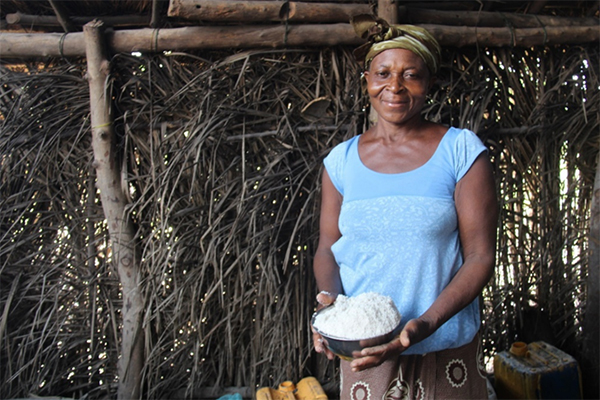
Salt production in Benin remains artisanal though it is one of the main income-generating activities for the populations of the coastal zone of southern Benin. Photo: UNDPUN Fund for South-South Cooperation – global, regional, country and city-level initiatives advancing the empowerment of women
The United Nations Fund for South-South Cooperation (UNFSSC) implements development activities across the Global South characterized by broad and inclusive partnership. With leadership and governance by all stakeholders, UNFSSC has a 25+ year track record of strong results in supporting developing countries toward achieving their sustainable development goals.
For example, implemented by UNOSSC, the EMPOWER project supported women scientists from developing countries through six-month fellowships at the International Centre for Genetic Engineering and Biotechnology (ICGEB) in New Delhi and Cape Town. Aimed at advancing careers in biotechnology, the initiative under the Youth4South programme, facilitated both education and gender equality.
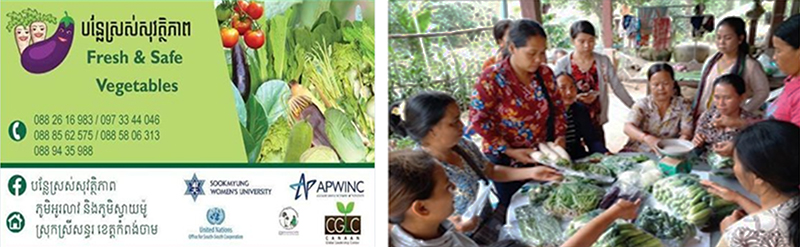
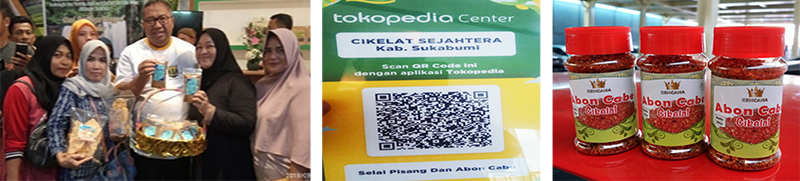
The South-South Cooperation among Maritime-Continental Silk Road Cities for Sustainable Development Project (Cities Project), advanced by UNOSSC, hosted exchanges in which city representatives and partners of Argentina, China, Ghana, Jordan, Pakistan and Peru exchanged experiences, success stories, and challenges in increasing women’s political participation, ensuring economic equality, or combating gender-based violence. Under the Republic of Korea-UNOSSC Triangular Facility on Science, Technology and Innovation (during its second phase 2016-2021) women farmers in Cambodia and Indonesia enhanced their digital and financial skills in agriculture, significantly benefiting their communities. As a result of the project, partnering with women farmer associations in Cambodia, increased vegetable sales by 13.71% through smart farming and effective use of ICT, including social media sales.
Cambodian women farmers association’s branding and capacity building training. Photo: Project Team
While in Indonesia, women entrepreneurs gained legal certification for their home-made food products, enhancing their business visibility and credibility. Their products are now sold in supermarkets and on Indonesia’s ecommerce platform, Tokopedia.
This project has elevated the socio-economic status of women, changing community perceptions and enabling them to contribute meaningfully to household incomes and their children’s education.
Indonesian entrepreneurs’ products and e-commerce store QR code. Photo: Project TeamPerez-Guerrero Trust Fund for South-South Cooperation
Established in 1983, The Perez-Guerrero Trust Fund (PGTF) for South-South Cooperation, managed by UNOSSC, enables and supports economic and technical cooperation activities among developing countries.
The Fund provides small project grants, with some directly focused on promoting gender equality across the Global South, from building capacities and supporting women-led community-based organizations in Argentina, Chile and India, to facilitating knowledge sharing and networking at a Businesswomen in Islamic Countries forum.
Forging Further South-South collaboration for women
Despite these evocative examples, and in spite of known overall progress, challenges to the realization of gender equity and women’s empowerment remain, with cultural norms, economic barriers, and political resistance continuing to impede such efforts.
As we commemorate International Women’s Day, the impact of the UNOSSC South-South Trust Funds and Programmes project portfolio on mainstreaming gender across sustainable development is a reminder that gender equality is achievable and that South-South collaborative efforts can lead to significant, lasting change. We look forward to continuing to walk this road, and to scaling said impact, jointly with Southern and triangular partners.

 An illustrative example is a UNCDF-implemented project in Fiji. With a particular emphasis on supporting women, the initiative Developing Climate Disaster Risk Financing Framework and Parametric Insurance supported by the India-UN Fund draws on India’s expertise in FinTech and InsurTech. It utilized South-South cooperation to engage stakeholders, co-create solutions, raise awareness, build capacity, and explore innovative financing options.
In its initial phase, the project enabled about 50,000 women to enroll in parametric insurance despite the remote, low value and disaster-prone location of their agricultural households and businesses. In its second phase, this initiative seeks to benefit 5,000 households, including smallholder farmers, fishers, market vendors, and small businesses.
Another UNFPA-implemented project with a significant focus on women is the Increase access of rural women to quality reproductive and maternal health services in Kyrgyzstan. This initiative enhances obstetric care by integrating an obstetric surveillance system, tele-networking, and tele-counseling into five maternity hospitals. Its goal is to provide effective healthcare that places a high priority on the well-being of women and newborns, dramatically reducing maternal mortality.
Further aiming to empower women, a UNDP-implemented project in the Federal State of Micronesia focuses on increasing women’s involvement in water and sanitation management. This project supports the national machinery to integrate gender considerations into national and state programs through policy, institutional, and organizational approaches, promoting gender parity.
India, Brazil and South Africa (IBSA Fund) support to women – spanning health, education and livelihoods
The IBSA Fund is a remarkable initiative sponsored by three Southern, democratic, multi-ethnic countries that pioneered South-South cooperation with the United Nations system. Operational since 2016, IBSA Fund projects are concrete expressions of solidarity contributing to the achievement of the Sustainable Development Goals in other developing countries.
An illustrative example is a UNCDF-implemented project in Fiji. With a particular emphasis on supporting women, the initiative Developing Climate Disaster Risk Financing Framework and Parametric Insurance supported by the India-UN Fund draws on India’s expertise in FinTech and InsurTech. It utilized South-South cooperation to engage stakeholders, co-create solutions, raise awareness, build capacity, and explore innovative financing options.
In its initial phase, the project enabled about 50,000 women to enroll in parametric insurance despite the remote, low value and disaster-prone location of their agricultural households and businesses. In its second phase, this initiative seeks to benefit 5,000 households, including smallholder farmers, fishers, market vendors, and small businesses.
Another UNFPA-implemented project with a significant focus on women is the Increase access of rural women to quality reproductive and maternal health services in Kyrgyzstan. This initiative enhances obstetric care by integrating an obstetric surveillance system, tele-networking, and tele-counseling into five maternity hospitals. Its goal is to provide effective healthcare that places a high priority on the well-being of women and newborns, dramatically reducing maternal mortality.
Further aiming to empower women, a UNDP-implemented project in the Federal State of Micronesia focuses on increasing women’s involvement in water and sanitation management. This project supports the national machinery to integrate gender considerations into national and state programs through policy, institutional, and organizational approaches, promoting gender parity.
India, Brazil and South Africa (IBSA Fund) support to women – spanning health, education and livelihoods
The IBSA Fund is a remarkable initiative sponsored by three Southern, democratic, multi-ethnic countries that pioneered South-South cooperation with the United Nations system. Operational since 2016, IBSA Fund projects are concrete expressions of solidarity contributing to the achievement of the Sustainable Development Goals in other developing countries.
 A significant and growing component of the IBSA Fund’s portfolio is its contribution to SDG 5, Gender Equality. For instance, the Empowering Rural Women in Fiji – Upscaling of Rocket Stove Project implemented by UNDP, empowered 1,530 women from 56 rural communities with new skills and opportunities for improved livelihoods through the training and production of 1,580 rocket stoves.
The Ending Child Marriage in Malawi and Zambia project advanced by UNWomen supported over 2,000 child marriage survivors, helping them to re-enroll in school and providing them a second chance at education. This project not only offered financial support for their education but also raised collective awareness and policy commitment towards ending child marriage, thereby impacting gender equality and restoring human dignity to the survivors.
Other projects, such as the Enhancing inclusive sustainable economic development through Coconut Sector Development in Kiribati and the An Innovative e-Learning Approach for Health implemented by WHO in Vietnam, have provided youth with valuable skills and opportunities for economic participation and education.
A significant and growing component of the IBSA Fund’s portfolio is its contribution to SDG 5, Gender Equality. For instance, the Empowering Rural Women in Fiji – Upscaling of Rocket Stove Project implemented by UNDP, empowered 1,530 women from 56 rural communities with new skills and opportunities for improved livelihoods through the training and production of 1,580 rocket stoves.
The Ending Child Marriage in Malawi and Zambia project advanced by UNWomen supported over 2,000 child marriage survivors, helping them to re-enroll in school and providing them a second chance at education. This project not only offered financial support for their education but also raised collective awareness and policy commitment towards ending child marriage, thereby impacting gender equality and restoring human dignity to the survivors.
Other projects, such as the Enhancing inclusive sustainable economic development through Coconut Sector Development in Kiribati and the An Innovative e-Learning Approach for Health implemented by WHO in Vietnam, have provided youth with valuable skills and opportunities for economic participation and education.
 For example, implemented by UNOSSC, the EMPOWER project supported women scientists from developing countries through six-month fellowships at the International Centre for Genetic Engineering and Biotechnology (ICGEB) in New Delhi and Cape Town. Aimed at advancing careers in biotechnology, the initiative under the Youth4South programme, facilitated both education and gender equality.
The South-South Cooperation among Maritime-Continental Silk Road Cities for Sustainable Development Project (Cities Project), advanced by UNOSSC, hosted exchanges in which city representatives and partners of Argentina, China, Ghana, Jordan, Pakistan and Peru exchanged experiences, success stories, and challenges in increasing women’s political participation, ensuring economic equality, or combating gender-based violence. Under the Republic of Korea-UNOSSC Triangular Facility on Science, Technology and Innovation (during its second phase 2016-2021) women farmers in Cambodia and Indonesia enhanced their digital and financial skills in agriculture, significantly benefiting their communities. As a result of the project, partnering with women farmer associations in Cambodia, increased vegetable sales by 13.71% through smart farming and effective use of ICT, including social media sales.
For example, implemented by UNOSSC, the EMPOWER project supported women scientists from developing countries through six-month fellowships at the International Centre for Genetic Engineering and Biotechnology (ICGEB) in New Delhi and Cape Town. Aimed at advancing careers in biotechnology, the initiative under the Youth4South programme, facilitated both education and gender equality.
The South-South Cooperation among Maritime-Continental Silk Road Cities for Sustainable Development Project (Cities Project), advanced by UNOSSC, hosted exchanges in which city representatives and partners of Argentina, China, Ghana, Jordan, Pakistan and Peru exchanged experiences, success stories, and challenges in increasing women’s political participation, ensuring economic equality, or combating gender-based violence. Under the Republic of Korea-UNOSSC Triangular Facility on Science, Technology and Innovation (during its second phase 2016-2021) women farmers in Cambodia and Indonesia enhanced their digital and financial skills in agriculture, significantly benefiting their communities. As a result of the project, partnering with women farmer associations in Cambodia, increased vegetable sales by 13.71% through smart farming and effective use of ICT, including social media sales.
 Forging Further South-South collaboration for women
Despite these evocative examples, and in spite of known overall progress, challenges to the realization of gender equity and women’s empowerment remain, with cultural norms, economic barriers, and political resistance continuing to impede such efforts.
As we commemorate International Women’s Day, the impact of the UNOSSC South-South Trust Funds and Programmes project portfolio on mainstreaming gender across sustainable development is a reminder that gender equality is achievable and that South-South collaborative efforts can lead to significant, lasting change. We look forward to continuing to walk this road, and to scaling said impact, jointly with Southern and triangular partners.
Forging Further South-South collaboration for women
Despite these evocative examples, and in spite of known overall progress, challenges to the realization of gender equity and women’s empowerment remain, with cultural norms, economic barriers, and political resistance continuing to impede such efforts.
As we commemorate International Women’s Day, the impact of the UNOSSC South-South Trust Funds and Programmes project portfolio on mainstreaming gender across sustainable development is a reminder that gender equality is achievable and that South-South collaborative efforts can lead to significant, lasting change. We look forward to continuing to walk this road, and to scaling said impact, jointly with Southern and triangular partners.