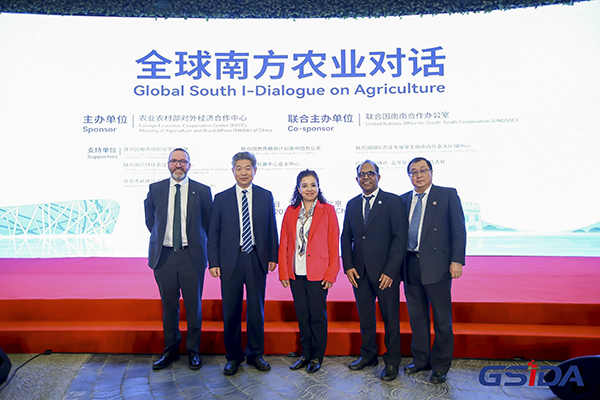
The Global South I-Dialogue on Agriculture (GSiDA), co-organized by the Foreign Economic Cooperation Center (FECC) of the Chinese Ministry of Agriculture and Rural Affairs and UNOSSC, was successfully held in Yanqing District, Beijing on Friday, November 8th.
Themed around exploring new opportunities in the Global South, GSiDA built a multi-level dialogue platform for global agriculture development cooperation across more areas and in greater depth, better implementing the Global Development Initiative in the field of agriculture.
The dialogue gathered about 200 domestic and foreign representatives, from relevant domestic ministries such as the Ministry of Foreign Affairs, the Ministry of Commerce, the Ministry of Agriculture and Rural Affairs and the China International Development Cooperation Agency; international organizations such as UNOSSC, the UN’s Food and Agriculture Organization (FAO), the World Food Programme (WFP) and the UN Resident Coordinator (UNRC) Office in China; and major financial institutions such as the World Bank and the African Development Bank.
Government representatives from developing countries, including Cape Verde, Morocco, Nigeria, Sri Lanka and Uganda; and representatives from departments of Agriculture and Rural Affairs of local governments, research institutes and enterprises joined the conference.
In his opening remarks, Zhang Lubiao, the director general of FECC, emphasized China’s commitment to leveraging South-South cooperation as a platform to explore new models for agricultural development in the Global South. He highlighted the importance of fostering collaboration among developing nations to tackle shared agricultural challenges. FECC is willing to use this platform to expand and deepen the development cooperation in the Global South to multiple fields, including science and technology, economy and trade, and investment. It will also enhance the capacity of policy formulation and technological innovation. FECC will also promote the construction of a network platform for agriculture development cooperation in the Global South, fostering implementation of the initiatives of the United Nations Summit of the Future.
UN’s China Resident Coordinator in China, Siddharth Chatterjee, noted that agriculture in the Global South faces serious obstacles, including climate change and resource scarcity. He stressed that increased cooperation between developing countries will offer a practical and effective means to address these issues and advance sustainable agricultural practices. In this context, cooperation between the Global South countries will undoubtedly offer practical and effective means to address these issues. This will require broad participation and close cooperation from governmental departments, international organizations and scientific and research institutions.
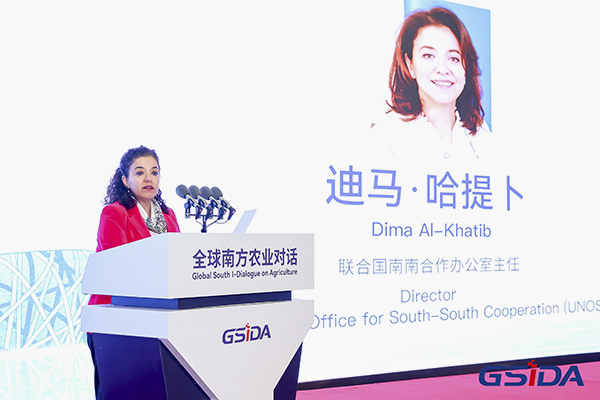 “By leveraging global partnerships and South-South and triangular cooperation, we can advance more robust solutions, empower communities to overcome food insecurity, and contribute to a world where zero hunger is not an aspiration but a reality,” said UNOSSC Director Dima Al-Khatib, highlighting the pivotal role of capacity building, technological cooperation, and global partnerships in tackling food insecurity, poverty and climate impact through South-South and triangular cooperation.
More information: Highlights of UNOSSC Director 2024 Official Visit to China
“By leveraging global partnerships and South-South and triangular cooperation, we can advance more robust solutions, empower communities to overcome food insecurity, and contribute to a world where zero hunger is not an aspiration but a reality,” said UNOSSC Director Dima Al-Khatib, highlighting the pivotal role of capacity building, technological cooperation, and global partnerships in tackling food insecurity, poverty and climate impact through South-South and triangular cooperation.
More information: Highlights of UNOSSC Director 2024 Official Visit to China
“By leveraging global partnerships and South-South and triangular cooperation, we can advance more robust solutions, empower communities to overcome food insecurity, and contribute to a world where zero hunger is not an aspiration but a reality,” said UNOSSC Director Dima Al-Khatib, highlighting the pivotal role of capacity building, technological cooperation, and global partnerships in tackling food insecurity, poverty and climate impact through South-South and triangular cooperation.
More information: Highlights of UNOSSC Director 2024 Official Visit to China