Commemorating TICAD’s 30th Anniversary: Evolution of South-South and triangular cooperation through the TICAD process
The Tokyo International Conference on African Development (TICAD) was established in 1993 and has evolved into a multilateral forum whose participants include African countries as well as international organizations, partner countries, private companies and civil society organizations involved in African development. It focuses on various development challenges facing Africa (economic growth, trade and investment, sustainable development, human security, peace, and stability, etc.) and serves as a platform for African countries and their partners to collaborate and devise strategies for addressing them. The two key development principles of the TICAD process have been “African ownership” and “international partnership” in support of Africa’s own efforts.
The commemorative symposium on the 30th anniversary of TICAD was held on 26 August 2023 in Tokyo, Japan. To enable the participation of stakeholders and partners from around the world and across time zones, and in line with TICAD’s development principles, the symposium included virtual side events spread from August to December 2023.
On 8 December, the UN Office for South-South Cooperation (UNOSSC) convened a dialogue as its contribution to the symposium, with the engagement of Member States, the President of the UN High-level Committee on South-South Cooperation, the Office of the Special Adviser to the UN Secretary-General on Africa (OSAA), the UN Economic Commission for Africa (ECA), the African Group in the United Nations, the African Union Commission (AUC), academia and other stakeholders.
The event centered on the evolution of South-South and triangular cooperation through the TICAD process. Specifically, it delved into the significance of Japan’s catalytic role in Asia’s regional industrialization and what this means for Africa’s regional industrialization efforts. Engaging in this insightful discussion were experts and contributors from Africa and Asia as well as from across the UN development system.
Japan is a pioneer country in triangular cooperation, a form of development collaboration that has been instrumental in propelling Asian development. Japan’s catalytic role in this context involves an innovative approach – assessing regional rather than individual country comparative advantages thereby spurring Asian regional industrialization. Japan promoted policies that strengthened regional cooperation and institution-building. Japan’s model of triangular cooperation also serves to enhance the technical cooperation expertise of countries providing assistance in the Global South thus creating a platform for shared learning and co-development, recognizing the unique strengths and needs of each partner. An example is JICA’s assistance to Indonesia in its effort to strengthen its capacity to provide South-South cooperation.
Moderated by H.E. Mr. Mohan Pieris, Permanent Representative of the Democratic Socialist Republic of Sri Lanka to the United Nations and President, UN High-level Committee on South-South Cooperation, the two-hour event commenced with an opening address from the Director of the United Nations Office for South-South Cooperation. In her remarks, the Director delved into the extensive history of development cooperation between Africa and Asia. Emphasizing the rich legacy of collaboration, she highlighted that the Global South has numerous innovative solutions and valuable knowledge that has been repeatedly shared through South-South and triangular cooperation. She added that the TICAD forum demonstrates solidarity among nations of the South through Southern-driven partnerships.
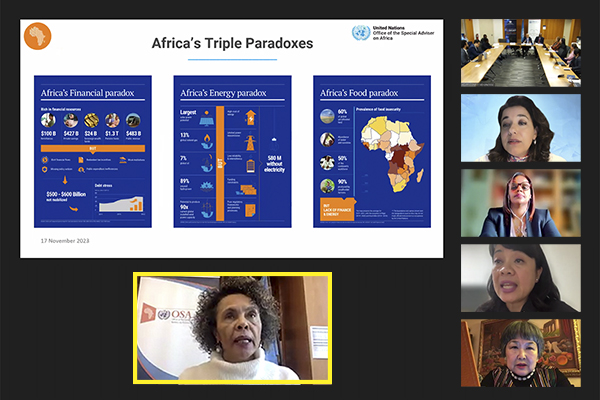
The Under-Secretary-General and Special Adviser on Africa to the United Nations Secretary-General, Ms. Cristina Duarte, spoke on Africa’s distinct development context and presented Africa’s triple paradoxes, financial, energy and food, their interconnectedness, and the role for South-South cooperation.
Dr. Marit Kitaw, Interim Director of African Minerals Development Centre, a specialized agency of the African Union made a presentation on behalf of the African Union Commissioner for Economic Development, Trade, Tourism, Industry and Minerals. She highlighted the strategic role of the African Union, its agencies, and the Regional Economic Communities in Africa’s regional industrialization.
The keynote statement by Prof. Mieko Ikegame, who is the former UN Focal Point for TICAD Process and current Special Adviser to the Chief Executive Officer of the African Union Development Agency-New Partnership for Africa’s Development (AUDA-NEPAD), delved into the evolution of the TICAD process, South-South and triangular cooperation inclusion in this process, the Asian experience in regional industrialization and, how TICAD can support Africa’s regional industrialization efforts.
In his address, Mr. Claver Gatete, the Executive Secretary of the Economic Commission for Africa (ECA), focused on ECA’s efforts to bolster the implementation of the Africa Continental Free Trade Area (AfCFTA) agreement, emphasizing regional industrialization. Acknowledging Africa’s unique context, Mr. Gatete expressed optimism in the achievements that the AfCFTA could bring to the continent. Drawing inspiration from the successful experiences of East Asian countries in fostering intra-regional trade for the purpose of regional industrialization, the Executive Secretary underscored the significance of these accomplishments as valuable lessons for Africa. He underlined that the essence of South-South and triangular cooperation lies in opportunities for experience and knowledge exchanges, and in this case, the East Asia region’s approach of utilizing intra-regional trade for regional industrialization.
This perspective was further solidified by the speaker from Indonesia, H.E. Siti Nugraha Mauludiah, Director General for Information and Public Diplomacy. Indonesia is a strong South-South cooperation champion and has been involved in the TICAD process. The country currently holds the Chairmanship of the Association of Southeast Asian Nations (ASEAN). H.E. Mauludiah’s remarks highlighted Indonesia’s role in Asia-Africa cooperation from the 1955 Bandung Conference to date, and reflected on TICAD’s achievements as well as on Japan’s key role in regional industrialization successes through ASEAN.
The panel discussion, involving Jomo Kwame Sundaram, visiting Senior Fellow at Khazanah Research Institute; Mr. Victor Djemba, Chief, Africa Regional Division at United Nations Industrial Development Organization (UNIDO); and Prof. Ikegame; provided expert commentary on regional industrialization. Prof. Sundaram noted that Asia’s growth was not only through export-led industrialization but was also built on import substitution. Mr Djemba spoke on UNIDO’s South-South and triangular industrial cooperation (SSTIC) approach and its successes in Africa, while Prof. Ikegame reflected on the experiences of Asian countries and the role of triangular cooperation in promoting complementarity vs. competitiveness among African countries in regional industrialization efforts.
The panelists, in responding to questions from the audience, highlighted the need for the adoption of an Africa-centric model of industrialization that considers the unique context of the region as well as utilizing homegrown institutions and resources. Prof. Ikegame noted that Africa had not been afforded the opportunity to industrialize and that it is an opportune time for Africa to take the opportunities unfolding now to do so.
When asked to reflect what the future role of TICAD could be, the panelists noted its philosophy of African leadership and the need to continue to build capacities of African institutions and enlist the support of other countries to provide the technical expertise.
Representing the Africa Group, Mr. Oscar Sichimba of the Zambia Mission to the United Nations (chair of the Africa Group for November 2023) delivered the closing remarks. He acknowledged Japan’s role in the TICAD process and its emphasis on Africa’s leadership in its own development, and on partnership with the global community. While noting the importance of Africa’s leadership in its own development and industrialization, Mr. Sichimba highlighted the need for a continued role of Japan, through the TICAD process, in promoting triangular cooperation for Africa’s industrialization through empowering youth and digital transformation.
The event moderator, H.E. Mr. Mohan Pieris thanked all the speakers and participants, and concluded the event by re-emphasizing the two TICAD development principles of African ownership and international partnerships in support of Africa’s own efforts.
What next:
- The event highlighted a need for the adoption of a model for Africa’s regional industrialization specific to Africa. Going forward, UNOSSC and other stakeholders can support the process by highlighting the appropriate policies and strategies that can leverage what has been learnt from the TICAD process with a deeper understanding of the continent and focusing on potential benefits of assets such as the youth bulge and demographic changes.
- Further engagement of stakeholders on Africa’s regional industrialization efforts leveraging South-South and triangular cooperation.