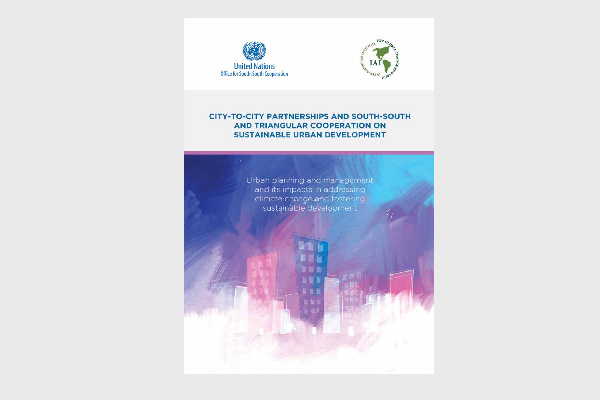
City-to-City Partnerships and South-South and Triangular Cooperation on Sustainable Urban Development


FOREWORD

This report is published at a time when South-South and triangular cooperation (SSTC) and sustainable urban development are increasingly recognized as important means for implementing the Paris Agreement (UNFCCC 2015) and the 2030 Agenda for Sustainable Development with its 17 SDGs (UN 2015). 

The adoption of the Paris Agreement and the 2030 Agenda in 2015 represent unprecedented multilateral commitments to tackling the global challenges of addressing climate change and achieving sustainable development. While urban development and climate action are emphasized as SDG 11 and SDG 13 respectively, these are also inter-connected with all the other SDGs.

This report focuses on the central theme of how cities are using innovative, collaborative and evidence-based processes to tackle the challenges of climate change and achieve sustainable development. In particular, it examines broad issues that are pertinent to sustainable development for cities, namely: how does the evolving context and challenges of climate change impact cities; and, what good practices and experiences emerge from management of the urban space through diverse, inclusive and sustainable strategies?

The report also examines how SSTC can help to further development outcomes, particularly those related to management and planning of the urban space in addressing climate change and fostering sustainable development. 

The outcome document of the second High-Level United Nations Conference on SouthSouth Cooperation, Buenos Aires (“BAPA+40 outcome document”), adopted in March 2019, (UN 2019) made significant contributions towards providing guidance for development partnerships in the context of SSTC in alignment with the economic and political transitions that have taken place since the adoption of the Buenos Aires Plan of Action (BAPA), in (UN 1978). 

The “BAPA+40 outcome document” welcomes, inter alia, the Paris Agreement − adopted in December (UNFCCC 2015) by the Conference of the Parties to the United Nations Framework Convention on Climate Change (UNFCCC) at its twenty-first session, designed to trigger greater levels of action and ambition among the Parties to combat climate change in a cooperative manner. It also recalls the New Urban Agenda,(UN 2016) adopted by the United Nations Conference on Housing and Sustainable Urban Development in October 2016, which sets a shared 20-year vision for sustainable development of cities and municipalities in an integrated manner, and refers to other relevant major United Nations conferences and summits in the economic, social and related fields.

The BAPA+40 outcome document states that “an important means to this end is sharing good practices in participatory urban planning and management”. This is the reference that has inspired this publication and highlighted the catalytic role of SSTC at the sub-national level in sharing experience in this regard.Moreover, the New Urban Agenda (NUA) features an explicit link to SSTC. It recognizes the need to “expand opportunities for North-South, SSTC and international cooperation, as well as subnational, decentralized and city-to-city cooperation, as appropriate, to contribute to sustainable urban development, developing capacities and fostering exchanges of urban solutions and mutual learning at all levels and by all relevant actors.”

This report highlights the importance of sharing knowledge, practices, experiences, on a voluntary basis, in the implementation of the 2030 Agenda and in the pursuit of sustainable development. It is intended as a knowledge resource to facilitate SSTC. By providing an insight into practical and effective development solutions adopted by Southern cities to combat climate change and foster sustainable development, it aims to enhance knowledge sharing and cooperation so that successes can be adapted, replicated and scaled up by other cities. 

Cities are at the frontier of transformation and could deliver sustained and inclusive growth and development outcomes for their inhabitants. An integrated approach to urban planning and management, backed by innovation and finance, are therefore critical to enabling cities to optimize the benefits of urbanization whilst securing a sustainable, climate-resilient and low emission future.
ABOUT

Terms of Service

Privacy Policy

Disclosures

RESOURCES

Terms of Service

Privacy Policy

Disclosures

ENGAGE

Terms of Service

Privacy Policy

Disclosures

Copyright © UNOSSC/UNDP

wpChatIcon
wpChatIcon

Alliance Application Form

Submit an Expression of Interest and/or Demand Signal. UNOSSC reviews submissions on a rolling basis.

1. Official name of organization / institution / government entity (exclusions to apply) *
2. Country *
3. Region *
4. SDG *
Secondary SDG *
5. Partner category *
6. Website *
7. Brief description of your institution (max. 150 words) *
Name for the Lead *
Title for the Lead *
Email address for the Lead *
Name for the co-lead
Title for the co-lead
Email address for the co-lead
Section 3. Expression of Interest in the Alliance *
Additional information on proposed areas of engagement may be requested through the platform following initial review by the Alliance Secretariat.
Section 4. Due Diligence and Integrity Declaration *

Submission Note:

  • Submission of this Expression of Interest form does not automatically confer participation in the Alliance.
  • All submissions will be reviewed by the Alliance Secretariat, including basic eligibility screening and proportionate due diligence, as appropriate.
  • Participation in Alliance activities is determined based on relevance to articulated cooperation needs, alignment with Alliance principles, and integrity considerations.
  • Engagement under the Alliance is voluntary, non-binding, and facilitative in nature, and does not constitute funding approval, contractual commitment, or institutional membership.
  • The Alliance Secretariat may contact submitting entities for additional information or clarification during the review process.

Submission of Demand Form

Description of Demand

Indicate the type of support or cooperation requested through the Alliance.
Please briefly describe the challenge, gap, or priority. (Max. 300 words)

Thematic and Geographic Focus

Please indicate the main focus areas of your demand:

A. Thematic Areas (select up to three)
B. Geographic Focus (select all that apply)

Proposed Engagement Modalities

Please indicate how you would like to engage through the Alliance (select all that apply):

Expected Outcomes

Please indicate the main results you seek to achieve through this engagement. (Max. 200 words)
Examples:
• Capacity strengthened
• Partnerships established
• Sectoral or regional strategies co-developed
• Solutions piloted
• Knowledge generated
• Policies informed

Timeline and Readiness (if applicable)

1. Expected timeframe for engagement:
2. Current stage:

Additional Information

Please provide any additional information, documents, or links relevant to this submission.
(Max. 200 words or upload link)

Submission of Offer Form

Description of Contribution

Indicate the type of contribution your institution can provide and describe the expertise, resources, or solutions you may offer.
Please briefly describe your proposed contribution. (Max. 300 words)

Thematic and Geographic Focus

Please indicate the main focus areas of your interest:

A. Thematic Areas (select up to three)
B. Geographic Focus (select all that apply)

Proposed Engagement Modalities

Please indicate how you would like to engage through the Alliance (select all that apply):

Expected Outcomes

Please indicate the main results you aim to achieve through this engagement. (Max. 200 words)
Examples:
• Capacity strengthened
• Partnerships established
• Sectoral or regional strategies co-developed
• Solutions piloted
• Knowledge generated
• Policies informed

Timeline and Readiness (if applicable)

1. Expected timeframe for engagement:
2. Current stage:

Additional Information

Please provide any additional information, documents, or links relevant to this submission.
(Max. 200 words or upload link)

Organization Registration

Authentication & Due Diligence This prototype simulates identity verification, due diligence confirmation, and an authentication step before submission. *

First Name *
Last Name *
Email address *
Password *
Confirm Password *
Name of institution / organization *
Country / Region *
Organization Type *
Organization other *
Function / role *
Organization logo *
Maximum file size: 1 GB

Login

Login / email *
Password *
Remember me

Forgot password?

Connect form

Your name *
Email *
Organization / institution *
Job title / role *
Reason for connecting:
Short message

Scroll to Top