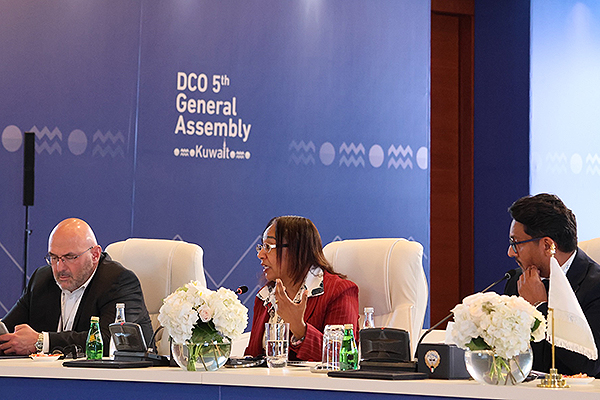
South-South and triangular cooperation featured prominently at the Fifth General Assembly of the Digital Cooperation Organization (DCO), where Member States adopted forward-looking decisions to advance responsible artificial intelligence (AI), trusted digital growth, and inclusive digital transformation.
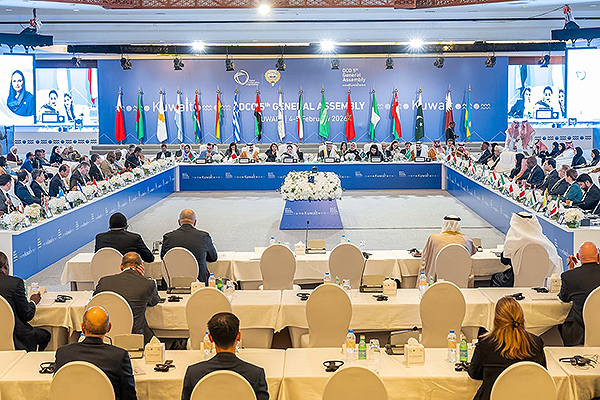
Convened under the Presidency of the State of Kuwait, the General Assembly brought together Ministers, senior officials, observers and partners to review progress under the DCO 4-Year Agenda (2025–2028) and to agree on practical steps to accelerate digital prosperity for all. Throughout the deliberations, cooperation among countries of the Global South – and strengthened partnerships across the United Nations system – were underscored as essential to delivering tangible results.
UNOSSC Calls for South-South Cooperation to Accelerate Digital Transformation
A message on behalf of Ms. Dima Al-Khatib, Director of the United Nations Office for South-South Cooperation (UNOSSC), was delivered by United Nations Resident Coordinator in Kuwait, Ms. Ghada Eltahir Mudawi.
The statement emphasized that the General Assembly was taking place at a defining moment for development, as digital transformation accelerates and AI reshapes economic and social systems. While DCO Member States are advancing ambitious national digital agendas, gaps persist across the Global South – in access, capacity, financing, and opportunity.
Against this backdrop, the statement underscored that South-South and triangular cooperation are essential delivery accelerators for digital transformation and Sustainable Development Goal (SDG) acceleration. UNOSSC reaffirmed its commitment to working with DCO to:
- Connect countries to proven and emerging digital solutions;
- Promote peer learning, innovation, and capacity-building;
- Facilitate new financing approaches for digital transformation; and
- Strengthen inclusive digital economy partnerships.
The statement highlighted country-led initiatives demonstrating the power of South-South knowledge exchange. Kuwait’s e-government modernization under the Central Agency for Information Technology (CAIT), Saudi Arabia’s leadership in AI governance and digital maturity, Morocco’s nationwide digital education programmes, and Rwanda’s continental coordination through Smart Africa were cited as examples of scalable solutions with cross-regional relevance.UNOSSC also noted its collaboration with the European Space Agency to support Member States in applying satellite Earth observation data and digital technologies to accelerate SDG achievement, including in climate resilience and food security.
Importantly, the statement pointed to UNOSSC’s tools – including the South-South Galaxy platform and the South-South and Triangular Cooperation Solutions Lab – as mechanisms to turn data into actionable partnerships and measurable results.
Adoption of the Kuwait Declaration on Responsible AI
A central outcome of the General Assembly was the adoption of the Kuwait Declaration on Responsible AI for Global Digital Prosperity. The Declaration recognizes AI’s transformative potential to drive productivity, competitiveness and public service delivery, while emphasizing the importance of ethical governance to address risks related to inequality, bias, privacy and security.Member States reaffirmed their shared commitment to inclusive, resilient and sustainable digital transformation. They endorsed policy and delivery frameworks to enable trusted cross-border data flows and advance digital trade, including the Model Digital Economy Agreement.
Progress was noted across flagship initiatives focused on digital economy measurement, data sovereignty, startup regulation, digital government solutions, AI readiness and ethical governance tools, women-led MSMEs, digital skills, online safety and e-waste cooperation.
Strengthening Multilateral and South-South Partnerships
The Assembly reaffirmed the importance of strengthened multilateral cooperation, including deeper engagement with the United Nations system and expanded South-South and triangular cooperation.
Member States endorsed coordinated action to strengthen trusted digital foundations, including initiatives to combat online misinformation, enhance startup ecosystems through the STRIDE framework, and advance investment facilitation through the Digital FDI initiative.
Commitments were also renewed in skills development and sustainability, including the next phase of the Skills Universe Initiative, strengthened protection for children and youth online, and expanded cooperation on e-waste management.
The General Assembly confirmed the transition of the DCO Council Presidency from the State of Kuwait to the Islamic Republic of Pakistan for 2026, with the Kingdom of Saudi Arabia to assume the Presidency in 2027. The next General Assembly will take place in Pakistan in 2027.
From Dialogue to Delivery
Parallel events held on the sidelines during the International Digital Cooperation Forum further reinforced a shared resolve to translate ambition into coordinated delivery.
As emphasized in the UNOSSC statement, digital transformation must be inclusive and results-driven. By anchoring responsible AI governance and digital economy advancement in South-South and triangular cooperation, DCO Member States demonstrated a collective commitment to cooperation over fragmentation and to shared prosperity over isolated progress.
Looking ahead, UNOSSC will continue to work closely with DCO and its Member States to scale Southern-led digital solutions, broker partnerships, and ensure that digital transformation contributes meaningfully to SDG acceleration across the Global South.