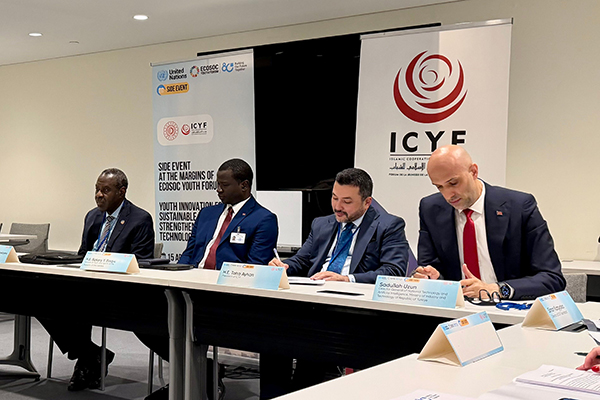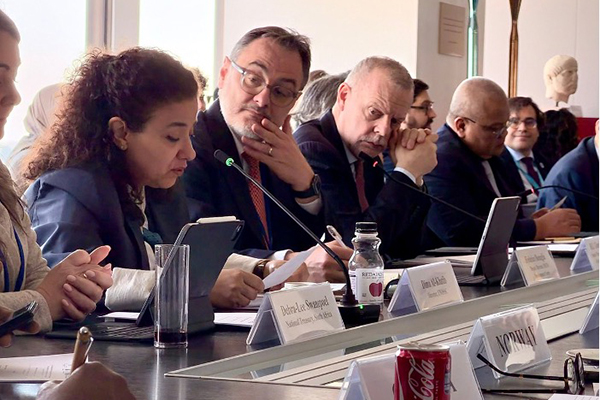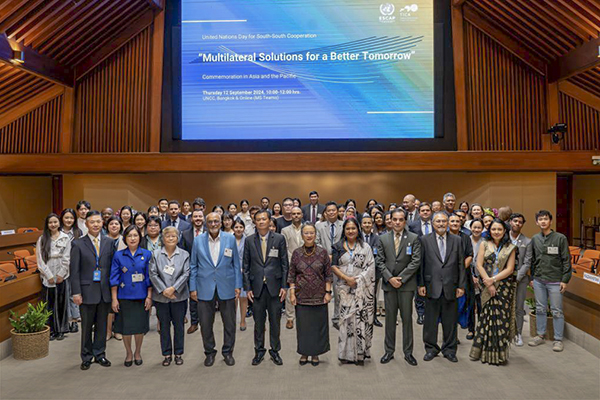
Over 100 participants (both in-person and virtual) from 15 member States in Asia-Pacific and beyond, along with representatives from development partners, academia, civil society and the private sector, converged at the United Nations Conference Center in Bangkok to commemorate the UN Day for South-South Cooperation in Asia-Pacific.
A multistakeholder panel discussion on the theme ‘Multilateral Solutions for a Better Tomorrow’, including member States representatives, civil society, academia, the private sector and development partners, discussed new developments in the South-South cooperation landscape and encouraging examples of cooperation in action across the region, to more effectively address common development challenges. South-South cooperation champions and practitioners aspired to shape a better tomorrow, with cooperation and solidarity serving as a catalyst for change.
“In 1955, the Asia-Africa Conference was held in my hometown of Bandung. That pioneering meeting laid the foundation for South-South cooperation… The “Spirit of Bandung” lives on in Asia-Pacific today, with inspiring examples showcasing the power and vital importance of multilateral and bilateral cooperation among countries of the South,” noted Ms. Armida Salsiah Alisjahbana, Under-Secretary-General of the United Nations and Executive Secretary of ESCAP in her welcome remarks. “With climate change, the advent of the digital revolution, unprecedented demographic transitions, unsustainable national debt levels and increasing cost of living, our region faces emerging and persistent, multi-dimensional crises and challenges. At the same time, Asia and the Pacific is witnessing an important transformation in the development assistance landscape, with the emergence of new development partners in the countries of the South”, the Executive Secretary stated. “As 2025 will mark 70 years since the Bandung Conference, renewing commitments and redoubling efforts for effective South-South and triangular cooperation are more relevant than ever”. Delivering his opening remarks, Mr. Wattanawit Gajaseni, Director-General, Thailand International Cooperation Agency, Ministry of Foreign Affairs of Thailand, stated: “Today the international community finds itself facing multiple challenges that hinder our progress towards sustainable development…. That is why South-South Cooperation is ever more instrumental to the successful implementation of the 2030 Agenda for Sustainable Development, in order to help the international community realize the Sustainable Development Goals”. “Countries of the Global South must partner up to learn from each other’s best practices, exchange knowledge and ideas, and find and adapt development solutions that will work for their specific local contexts,” he said. More information: https://www.unescap.org/events/2024/united-nations-day-south-south-cooperation-multilateral-solutions-better-tomorrow