• Home
  • /
  • Events
  • /
  • Global Town Hall 2025 Highlights South-South Cooperation and Citizen Leadership for “The Future We Need”

Global Town Hall 2025 Highlights South-South Cooperation and Citizen Leadership for “The Future We Need”


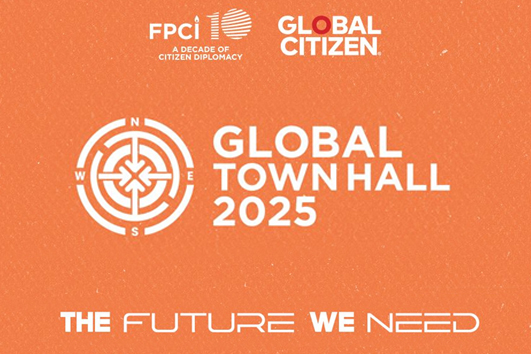
The Foreign Policy Community of Indonesia (FPCI), together with Global Citizen and an international consortium of think tanks, universities, civil-society networks, and multilateral institutions, convened the sixth Global Town Hall on Saturday 15 November under the theme “The Future We Need.” With a strong focus on South-South cooperation and citizen-led action, the forum brought together voices from across regions to confront the geopolitical, technological, and environmental crises shaping the future of global development. Held on the eve of the G20 Summit and in parallel with COP30 negotiations in Belém, Brazil, this year’s edition underscored the urgency of collective action. Global Town Hall 2025 brought together over 7,000 registered participants from 114 countries, reflecting the globally diverse and engaged community shaping this year’s discussions.   A Platform for Inclusive and Interregional Dialogue The Global Town Hall has become a leading venue for bridging East-West and North-South perspectives – and increasingly, for amplifying South-South collaboration as a driver of solutions. In his keynote address, Malaysia’s Prime Minister Anwar Ibrahim emphasized shared responsibility: “The future we need cannot be written by a select few, but must be written by everyone. This is why we believe in dialogue over division, cooperation over competition, and humanity over power.”   Multilateralism Rooted in Southern Leadership Joining the high-level discussions, UNOSSC Director Ms. Dima Al-Khatib underscored that the UN’s 80th anniversary and the UN80 Initiative mark a pivotal moment to rebuild trust in multilateralism. “This reform effort aims to make the UN fit for purpose in a world of complex crises, widening inequalities, and eroding trust,” she said. “A re-prioritized multilateral system must be inclusive by design, rooted in shared responsibility, and capable of turning solidarity into concrete results.” The Director stressed that South-South and triangular cooperation must sit at the heart of this renewal. “South-South and triangular cooperation embody the very principles that UN80 seeks to institutionalize: efficiency through collaboration, accountability through ownership, and effectiveness through innovation,” she noted. “They move us to a networked multilateralism, where developing countries exchange knowledge, design policies, and deliver solutions together.” Ms. Al-Khatib highlighted digital transformation as a central pillar, calling digital access a “global public good.” She pointed to the digital South-South Galaxy platform, hosted by UNOSSC, as a transformative example: “Galaxy connects over 150 countries, allowing policymakers to share and adapt solutions – from climate-smart agriculture in Asia to digital health systems in Africa. It shows how innovation can cross borders and empower communities.” She also emphasized the need for a fairer global financial architecture, citing UNOSSC-managed South-South Trust Funds as models of solidarity in action. “Financed by developing countries themselves, these funds channel resources directly to local priorities – supporting renewable energy, youth entrepreneurship, and climate resilience.”   Sustainable Development, Foundation of Stability Reflecting on the global security landscape, Ms. Al-Khatib stressed that development must never be sidelined. “Sustainable development must be the foundation of lasting peace and stability – not an afterthought,” she said. “Every investment in education, social protection, and climate resilience is also an investment in security.” She welcomed the Sevilla Commitment from the recent FFD4 Conference, describing its calls for debt relief, fairer financial governance, and closing the SDG financing gap as essential steps toward global stability. She also highlighted regional South-South platforms – including the Community of Latin American and Caribbean States (CELAC), Association of Southeast Asian Nations (ASEAN), African Union (AU), and Southern Common Market (Mercosur) – as “essential mechanisms for translating national priorities into coherent regional action.”   Safeguarding the SDGs Addressing whether development can remain a global priority amid cascading crises, Ms. Al-Khatib was unequivocal: “Development must remain the top global priority, even amid crises. Crises demonstrate why development must remain at the center of our collective agenda.” She noted three priorities:
  1. Diversifying SDG financing, including through Southern development banks such as the Asian Infrastructure Investment Bank (AIIB), New Development Bank (NDB), and Islamic Development Bank (IsDB);
  2. Accelerating knowledge exchange through platforms like South-South Galaxy and triangular cooperation;
  3. Leveraging the multilateral system’s presence on the ground to strengthen national capacities and ensure inclusive, context-specific support.
“Cooperation among equals – peer-to-peer sharing, collaborative knowledge exchange, and joint capacity-building – is not merely an aspiration; it is a necessity,” she said.   Shaping “The Future We Need” With sessions ranging from AI governance and multilateral reform to climate alliances and messages from civil societies to G20 leaders, Global Town Hall 2025 reaffirmed one central message: the world’s future depends on cooperation and solidarity. As Ms. Al-Khatib emphasized, “By placing South-South and triangular cooperation at the heart of multilateral renewal, we can rebuild trust, strengthen solidarity, and make development the shared currency of global action.” In an era defined by rapid change and rising uncertainty, Global Town Hall 2025 positioned dialogue as the pathway to shaping “the future we need.”   View the proceedings of the Global Town Hall 2025 here.  

Related Post


  • All Post
  • ATCT Featured Publications POM
  • BAPA+40
  • Blog
  • Capacity Development Initiatives
  • CICETE Featured Publications POM
  • CIKD
  • Cities Clusters - Agriculture
  • Cities Clusters - COVID-19
  • Cities Clusters - COVID-19 Knowledge Products
  • Cities Clusters - DRR
  • Cities Clusters - E-commerce
  • Cities Clusters - Tourism
  • Cities Clusters - Tourism Knowledge Products
  • Cities Clusters - Transport
  • Cities Clusters - Waste
  • Cities Project
  • Cities Project COVID-19 Newsletters
  • Cities Project COVID-19 Response
  • Cities Project Knowledge Products
  • Classic (untouched)
  • Climate Action
  • COMSATS Featured Publications POM
  • COMSATS Featured Solutions POM
  • Converted from Divi
  • Converted from Mixed
  • Converted from WPBakery
  • COVID-19
  • COVID-19 Page Featured Solutions
  • DRR Knowledge Products
  • DRR News
  • Empty Post
  • Events
  • Featured Event UN-Habitat POM
  • Financing for Development
  • Financing Mechanisms
  • g7+
  • Gender Events
  • Gender News
  • Good Practices in SSTrC Series
  • Good Practices Publications
  • Good Practices Thematic Series & Special Editions
  • Good Practices Vol. 2
  • Good Practices Vol. 3
  • GSSDC
  • Highlighted
  • Highlighted Publications
  • IAEA Featured Solutions POM
  • IBRAF Featured Publications POM
  • IBSA Fund
  • IBSA Fund Annual Reports
  • IBSA Fund News and Stories
  • IBSA Fund Publication
  • IBSA Fund Story
  • ICGEB Featured Events POM
  • ICGEB Featured Publications POM
  • ICGEB Featured Solutions POM
  • ILO Featured Events POM
  • ILO Featured Publications POM
  • ILO Featured Solutions POM
  • India-UN Development Partnership Fund
  • India-UN Fund Publication
  • India-UN Fund Story
  • IsDB
  • IsDB Featured Publications POM
  • IsDB SCC
  • News
  • Norec Featured Publications POM
  • Norec Featured Solutions POM
  • Peace and Development
  • PGTF Publications
  • PGTF Story
  • PICA Featured News POM
  • PICA Featured Publications POM
  • PICA Featured Solutions POM
  • PIDF Featured Publications POM
  • Publications
  • Regional Updates
  • Research
  • ROK-UNOSSC Facility
  • SGP Featured Publication POM
  • SGP Featured Solutions POM
  • Solution
  • South South in Action
  • South-South Global Thinkers
  • South-South Ideas
  • South-South Ideas Series
  • South-South in Action Series
  • Southern Response to COVID-19
  • SSN4PSI Featured Publications POM
  • SSN4PSI Featured Solutions POM
  • Training
  • UN Day for SSC 2020
  • UN Fund for SSC
  • UN SSC Day Publications
  • UN-Habitat Featured Publications POM
  • UN-HABITAT Featured Solutions POM
  • UNCCT
  • UNEP Featured Publications POM
  • UNFPA
  • UNFSSC Publication
  • UNFSSC Story
  • UNIDO Featured Publications POM
  • UNIDO Featured Solutions POM
  • UNIDO POM Events
  • UNOCT Featured Publications POM
  • UNV
  • UNV Featured Publications POM
  • WB Featured Publications POM
  • WB Featured Solutions POM
  • Webinars
  • WFP Featured Events POM
  • WFP Featured Publication POM
  • WFP Featured Solutions POM
  • WIPO
  • Workshops and Seminars
  • Youth4South
  • z Across the Globe 1
  • z Across the Globe 2
  • z Across the Globe 4
  • z Across the Globe 5
  • z Across the Globe 6
  • z Across the Globe 7
  • z Across the Globe 8
  • z ES BAPA+40
  • z ES Eventos
  • z ES Noticias
  • z ES Noticias Destacadas
  • z ES Publicaciones
  • z ES Publicaciones Destacadas
  • z ES Serie Buenas Prácticas en la CSSyT
  • z ES Serie El Sur-Sur en Acción
  • z FR Actualités
  • z FR BAPA+40
  • z FR Événements
  • z FR Publications
  • z FR Publications en vedette
  • z FR Série Bonnes pratiques en CSST
  • z FR Série Sud-Sud en action
  • z Highlighted News
  • z Photos
  • z Videos
  • z ZH BAPA+40
  • z ZH Events
  • z ZH News

ABOUT

Terms of Service

Privacy Policy

Disclosures

RESOURCES

Terms of Service

Privacy Policy

Disclosures

ENGAGE

Terms of Service

Privacy Policy

Disclosures

Copyright © UNOSSC/UNDP

wpChatIcon
wpChatIcon

Alliance Application Form

Submit an Expression of Interest and/or Demand Signal. UNOSSC reviews submissions on a rolling basis.

1. Official name of organization / institution / government entity (exclusions to apply) *
2. Country *
3. Region *
4. SDG *
Secondary SDG *
5. Partner category *
6. Website *
7. Brief description of your institution (max. 150 words) *
Name for the Lead *
Title for the Lead *
Email address for the Lead *
Name for the co-lead
Title for the co-lead
Email address for the co-lead
Section 3. Expression of Interest in the Alliance *
Additional information on proposed areas of engagement may be requested through the platform following initial review by the Alliance Secretariat.
Section 4. Due Diligence and Integrity Declaration *

Submission Note:

  • Submission of this Expression of Interest form does not automatically confer participation in the Alliance.
  • All submissions will be reviewed by the Alliance Secretariat, including basic eligibility screening and proportionate due diligence, as appropriate.
  • Participation in Alliance activities is determined based on relevance to articulated cooperation needs, alignment with Alliance principles, and integrity considerations.
  • Engagement under the Alliance is voluntary, non-binding, and facilitative in nature, and does not constitute funding approval, contractual commitment, or institutional membership.
  • The Alliance Secretariat may contact submitting entities for additional information or clarification during the review process.

Submission of Demand Form

Description of Demand

Indicate the type of support or cooperation requested through the Alliance.
Please briefly describe the challenge, gap, or priority. (Max. 300 words)

Thematic and Geographic Focus

Please indicate the main focus areas of your demand:

A. Thematic Areas (select up to three)
B. Geographic Focus (select all that apply)

Proposed Engagement Modalities

Please indicate how you would like to engage through the Alliance (select all that apply):

Expected Outcomes

Please indicate the main results you seek to achieve through this engagement. (Max. 200 words)
Examples:
• Capacity strengthened
• Partnerships established
• Sectoral or regional strategies co-developed
• Solutions piloted
• Knowledge generated
• Policies informed

Timeline and Readiness (if applicable)

1. Expected timeframe for engagement:
2. Current stage:

Additional Information

Please provide any additional information, documents, or links relevant to this submission.
(Max. 200 words or upload link)

Submission of Offer Form

Description of Contribution

Indicate the type of contribution your institution can provide and describe the expertise, resources, or solutions you may offer.
Please briefly describe your proposed contribution. (Max. 300 words)

Thematic and Geographic Focus

Please indicate the main focus areas of your interest:

A. Thematic Areas (select up to three)
B. Geographic Focus (select all that apply)

Proposed Engagement Modalities

Please indicate how you would like to engage through the Alliance (select all that apply):

Expected Outcomes

Please indicate the main results you aim to achieve through this engagement. (Max. 200 words)
Examples:
• Capacity strengthened
• Partnerships established
• Sectoral or regional strategies co-developed
• Solutions piloted
• Knowledge generated
• Policies informed

Timeline and Readiness (if applicable)

1. Expected timeframe for engagement:
2. Current stage:

Additional Information

Please provide any additional information, documents, or links relevant to this submission.
(Max. 200 words or upload link)

Organization Registration

Authentication & Due Diligence This prototype simulates identity verification, due diligence confirmation, and an authentication step before submission. *

First Name *
Last Name *
Email address *
Password *
Confirm Password *
Name of institution / organization *
Country / Region *
Organization Type *
Organization other *
Function / role *
Organization logo *
Maximum file size: 1 GB

Login

Login / email *
Password *
Remember me

Forgot password?

Connect form

Your name *
Email *
Organization / institution *
Job title / role *
Reason for connecting:
Short message

Scroll to Top