• Home
  • /
  • BAPA+40
  • /
  • HPLF: South-South Global Think Tanks Reflect on the BAPA+40 Outcome

HPLF: South-South Global Think Tanks Reflect on the BAPA+40 Outcome


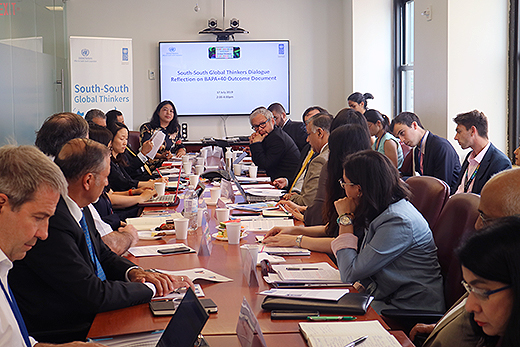
The newly endorsed Outcome Document of the BAPA+40 Conference recognized the contribution of think tanks and research institutions in the improvement of South-South and triangular cooperation (SSC & TrC) practices and called on United Nations entities to continue their engagement and support to these organizations to further strengthen the impact of SSC and TrC to successfully implement the 2030 Agenda for Sustainable Development. In this context, the United Nations Office for South-South Cooperation (UNOSSC) and United Nations Development Programme (UNDP) co-organized a High-Level Political Forum (HLFP) side-event titled South-South Global Thinker’s Dialogue: Reflections on BAPA+40 Outcome Document, bringing together think tank representatives who are members of the South-South Global Thinkers network to share their reflections on the BAPA+4O Outcome Document; share and propose research ideas and knowledge initiatives for the future that would be important for Southern countries and development partners.

The event was attended by representatives of all major think tank networks, namely Southern Voice; Network of Southern Think Tanks (NeST); Iniciativa Latinoamericana de Investigación para las Políticas Públicas (ILAIPP); the Global Research Consortium on Economic Structural Transformation (GReCEST); Middle East and North Africa Public Administration Research Think Tank Network (MENAPAR TTN); and Development Alternatives with Women for a New Era (DAWN).

UNOSSC Deputy Director, Ms. Xiaojun Grace Wang opened the session giving participants an overview of UNOSSC and UNDP’s engagement with think tanks in different streams of work ranging from research, knowledge-sharing, capacity-development and peer-to-peer learning. She commended the sincere efforts of the think tank network members in launching nine research papers during the BAPA+40 Conference, with topics ranging from impact assessment, monitoring and evaluation, multi-stakeholder engagement in South-South cooperation (SSC), economic structural transformation, renewable energy, trade and investment and SSC coherence, further informing policy dialogues and agenda-setting in SSC.

Special remarks, during the event, were provided by H.E. Dr. Shaikh Abdulla bin Ahmed Al Khalifa, Chairman of the Bahrain Centre for Strategic, International and Energy Studies (DERASAT) and Undersecretary for International Affairs at the Ministry of Foreign Affairs of the Kingdom of Bahrain.  He stressed the important role of Southern think tanks in advancing the Sustainable Development Goals (SDGs) through development of policy-oriented research that could be of great value to both policy makers and government entities.

Think tank network members also discussed the Outcome Document itself. First, there was broad consensus that the BAPA+40 Outcome Document encourages a broad level of ownership, institutionalization and multi-stakeholder partnerships to advance the SSC agenda towards the achievement of Agenda 2030. Dr. Bhattacharya, from the Center for Policy Dialogue (CPD) in Bangladesh, emphasized that the call for the incremental institutionalization of SSC is a common thread that should tie together all the research initiatives under the network. He also stressed the importance of going beyond the grassroots level to make substantial advancements in the methodological and empirical issues in SSC. Moreover, he pointed out that the South should consolidate their voice to give a Southern perspective on new and emerging issues such as migration, global financial structures and the global taxation system, noting their political sensitivities.

Other participants identified challenges, such as the definitional questions in SSC and TrC; and the methods of measurement, evaluation, impact assessment and reporting as areas that need immediate clarity moving forward. Network members stressed that think tanks have an active role to play here in moving the debate forward by investing in rigorous academic research.

Dr. Andre de Mello e Souza from the Institute for Applied Economic Research (IPEA)in Brazil stressed that “building on BAPA+40, developing countries should agree on a minimally shared conceptual and methodological framework of SSC, including its definition, distinctiveness, main principles and norms, impact assessment and responsibilities. Think tanks should contribute to this purpose by devising models for calculating concessionality and measuring and standardizing non-monetary flows, so as to capture the full diversity of SSC.”

SSC and TrC practices at national, regional and global levels should be given more attention to facilitate nuanced understanding of SSC and TrC from the “insider’s perspectives”. Dr. Xiuli Xu from the China Institute for South-South Cooperation in Agriculture (CISSCA) stressed the need to narrate more SSC and TrC experiences at national and regional levels for enhanced knowledge-sharing.

Ms. Andrea Villarreal Ojeda and Dr. Manuel Glave from ILAIPPemphasized the importance of evaluating the quality and impact of SSC and TrC programmes, and the incorporation of policy actions and recommendations from South-South evidence-based research. They also discussed the comprehensive vision needed for the implementation of the 2030 Agenda for Sustainable Development and the challenges of its implementation in the Global South.

Other areas of research that were identified are issues related to South-South trade. The newly endorsed African Continental Free Trade Agreement (AfCFTA) will benefit from research into the benefits and risks to parties of this agreement. Also, the importance of documenting best practices related to social protection policies, women’s participation in the labor market, gender-segregated data, and women’s financial inclusion in Southern countries were noted.

One of the speakers emphasized that the Outcome Document falls short of addressing the issue of “leave no one behind” but that it must remain the guiding principle of current and future work in the road to achieving the SDGs.

In conclusion, Mr. Jorge Chediek, UNOSSC Director and Envoy of the Secretary-General on South-South Cooperation called on the expertise, knowledge and networks of the think tanks in further advancing the SSC agenda, guided by the BAPA+40 Outcome Document.

For more information, contact Ms. Shams Banihani, Knowledge and Research Specialist, at shams.banihani@unossc.org.
Related Post


  • All Post
  • ATCT Featured Publications POM
  • BAPA+40
  • Blog
  • Capacity Development Initiatives
  • CICETE Featured Publications POM
  • CIKD
  • Cities Clusters - Agriculture
  • Cities Clusters - COVID-19
  • Cities Clusters - COVID-19 Knowledge Products
  • Cities Clusters - DRR
  • Cities Clusters - E-commerce
  • Cities Clusters - Tourism
  • Cities Clusters - Tourism Knowledge Products
  • Cities Clusters - Transport
  • Cities Clusters - Waste
  • Cities Project
  • Cities Project COVID-19 Newsletters
  • Cities Project COVID-19 Response
  • Cities Project Knowledge Products
  • Classic (untouched)
  • Climate Action
  • COMSATS Featured Publications POM
  • COMSATS Featured Solutions POM
  • Converted from Divi
  • Converted from Mixed
  • Converted from WPBakery
  • COVID-19
  • COVID-19 Page Featured Solutions
  • DRR Knowledge Products
  • DRR News
  • Empty Post
  • Events
  • Featured Event UN-Habitat POM
  • Financing for Development
  • Financing Mechanisms
  • g7+
  • Gender Events
  • Gender News
  • Good Practices in SSTrC Series
  • Good Practices Publications
  • Good Practices Thematic Series & Special Editions
  • Good Practices Vol. 2
  • Good Practices Vol. 3
  • GSSDC
  • Highlighted
  • Highlighted Publications
  • IAEA Featured Solutions POM
  • IBRAF Featured Publications POM
  • IBSA Fund
  • IBSA Fund Annual Reports
  • IBSA Fund News and Stories
  • IBSA Fund Publication
  • IBSA Fund Story
  • ICGEB Featured Events POM
  • ICGEB Featured Publications POM
  • ICGEB Featured Solutions POM
  • ILO Featured Events POM
  • ILO Featured Publications POM
  • ILO Featured Solutions POM
  • India-UN Development Partnership Fund
  • India-UN Fund Publication
  • India-UN Fund Story
  • IsDB
  • IsDB Featured Publications POM
  • IsDB SCC
  • News
  • Norec Featured Publications POM
  • Norec Featured Solutions POM
  • Peace and Development
  • PGTF Publications
  • PGTF Story
  • PICA Featured News POM
  • PICA Featured Publications POM
  • PICA Featured Solutions POM
  • PIDF Featured Publications POM
  • Publications
  • Regional Updates
  • Research
  • ROK-UNOSSC Facility
  • SGP Featured Publication POM
  • SGP Featured Solutions POM
  • Solution
  • South South in Action
  • South-South Global Thinkers
  • South-South Ideas
  • South-South Ideas Series
  • South-South in Action Series
  • Southern Response to COVID-19
  • SSN4PSI Featured Publications POM
  • SSN4PSI Featured Solutions POM
  • Training
  • UN Day for SSC 2020
  • UN Fund for SSC
  • UN SSC Day Publications
  • UN-Habitat Featured Publications POM
  • UN-HABITAT Featured Solutions POM
  • UNCCT
  • UNEP Featured Publications POM
  • UNFPA
  • UNFSSC Publication
  • UNFSSC Story
  • UNIDO Featured Publications POM
  • UNIDO Featured Solutions POM
  • UNIDO POM Events
  • UNOCT Featured Publications POM
  • UNV
  • UNV Featured Publications POM
  • WB Featured Publications POM
  • WB Featured Solutions POM
  • Webinars
  • WFP Featured Events POM
  • WFP Featured Publication POM
  • WFP Featured Solutions POM
  • WIPO
  • Workshops and Seminars
  • Youth4South
  • z Across the Globe 1
  • z Across the Globe 2
  • z Across the Globe 4
  • z Across the Globe 5
  • z Across the Globe 6
  • z Across the Globe 7
  • z Across the Globe 8
  • z ES BAPA+40
  • z ES Eventos
  • z ES Noticias
  • z ES Noticias Destacadas
  • z ES Publicaciones
  • z ES Publicaciones Destacadas
  • z ES Serie Buenas Prácticas en la CSSyT
  • z ES Serie El Sur-Sur en Acción
  • z FR Actualités
  • z FR BAPA+40
  • z FR Événements
  • z FR Publications
  • z FR Publications en vedette
  • z FR Série Bonnes pratiques en CSST
  • z FR Série Sud-Sud en action
  • z Highlighted News
  • z Photos
  • z Videos
  • z ZH BAPA+40
  • z ZH Events
  • z ZH News

ABOUT

Terms of Service

Privacy Policy

Disclosures

RESOURCES

Terms of Service

Privacy Policy

Disclosures

ENGAGE

Terms of Service

Privacy Policy

Disclosures

Copyright © UNOSSC/UNDP

wpChatIcon
wpChatIcon

Alliance Application Form

Submit an Expression of Interest and/or Demand Signal. UNOSSC reviews submissions on a rolling basis.

1. Official name of organization / institution / government entity (exclusions to apply) *
2. Country *
3. Region *
4. SDG *
Secondary SDG *
5. Partner category *
6. Website *
7. Brief description of your institution (max. 150 words) *
Name for the Lead *
Title for the Lead *
Email address for the Lead *
Name for the co-lead
Title for the co-lead
Email address for the co-lead
Section 3. Expression of Interest in the Alliance *
Additional information on proposed areas of engagement may be requested through the platform following initial review by the Alliance Secretariat.
Section 4. Due Diligence and Integrity Declaration *

Submission Note:

  • Submission of this Expression of Interest form does not automatically confer participation in the Alliance.
  • All submissions will be reviewed by the Alliance Secretariat, including basic eligibility screening and proportionate due diligence, as appropriate.
  • Participation in Alliance activities is determined based on relevance to articulated cooperation needs, alignment with Alliance principles, and integrity considerations.
  • Engagement under the Alliance is voluntary, non-binding, and facilitative in nature, and does not constitute funding approval, contractual commitment, or institutional membership.
  • The Alliance Secretariat may contact submitting entities for additional information or clarification during the review process.

Submission of Demand Form

Description of Demand

Indicate the type of support or cooperation requested through the Alliance.
Please briefly describe the challenge, gap, or priority. (Max. 300 words)

Thematic and Geographic Focus

Please indicate the main focus areas of your demand:

A. Thematic Areas (select up to three)
B. Geographic Focus (select all that apply)

Proposed Engagement Modalities

Please indicate how you would like to engage through the Alliance (select all that apply):

Expected Outcomes

Please indicate the main results you seek to achieve through this engagement. (Max. 200 words)
Examples:
• Capacity strengthened
• Partnerships established
• Sectoral or regional strategies co-developed
• Solutions piloted
• Knowledge generated
• Policies informed

Timeline and Readiness (if applicable)

1. Expected timeframe for engagement:
2. Current stage:

Additional Information

Please provide any additional information, documents, or links relevant to this submission.
(Max. 200 words or upload link)

Submission of Offer Form

Description of Contribution

Indicate the type of contribution your institution can provide and describe the expertise, resources, or solutions you may offer.
Please briefly describe your proposed contribution. (Max. 300 words)

Thematic and Geographic Focus

Please indicate the main focus areas of your interest:

A. Thematic Areas (select up to three)
B. Geographic Focus (select all that apply)

Proposed Engagement Modalities

Please indicate how you would like to engage through the Alliance (select all that apply):

Expected Outcomes

Please indicate the main results you aim to achieve through this engagement. (Max. 200 words)
Examples:
• Capacity strengthened
• Partnerships established
• Sectoral or regional strategies co-developed
• Solutions piloted
• Knowledge generated
• Policies informed

Timeline and Readiness (if applicable)

1. Expected timeframe for engagement:
2. Current stage:

Additional Information

Please provide any additional information, documents, or links relevant to this submission.
(Max. 200 words or upload link)

Organization Registration

Authentication & Due Diligence This prototype simulates identity verification, due diligence confirmation, and an authentication step before submission. *

First Name *
Last Name *
Email address *
Password *
Confirm Password *
Name of institution / organization *
Country / Region *
Organization Type *
Organization other *
Function / role *
Organization logo *
Maximum file size: 1 GB

Login

Login / email *
Password *
Remember me

Forgot password?

Connect form

Your name *
Email *
Organization / institution *
Job title / role *
Reason for connecting:
Short message

Scroll to Top