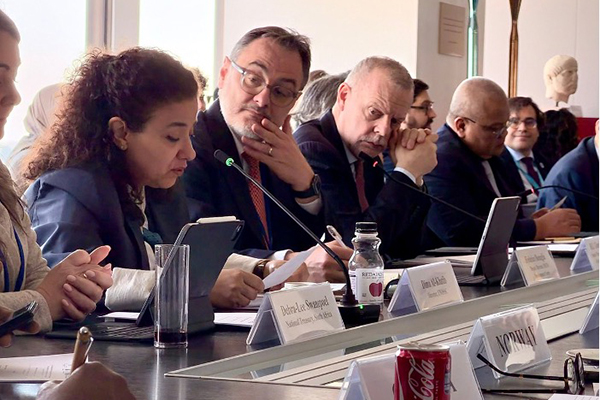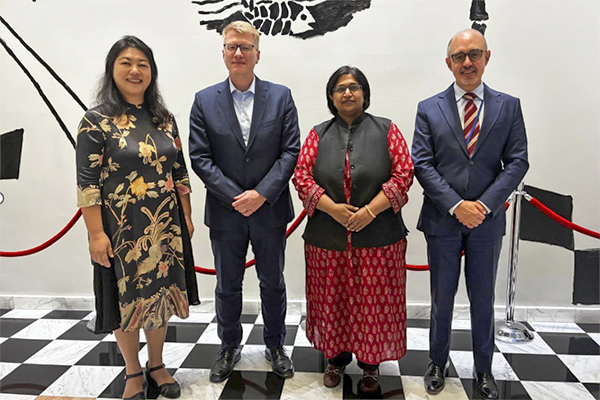
The Board of Directors of the India, Brazil and South Africa Facility for Poverty and Hunger Alleviation (IBSA Fund) has approved two new development cooperation projects aimed at advancing inclusive and sustainable development through South-South and triangular cooperation. The newly endorsed initiatives – one in Africa and one in the Arab States region – will support community sanitation infrastructure in Eswatini and women’s economic empowerment through floriculture in Jordan. These projects will be implemented respectively in partnership with UNICEF and UN Women.
The Eswatini WASH project will serve as a pilot initiative to improve sanitation in the peri-urban community of Kwaluseni Inkhundla. It will leverage Brazilian technical expertise and the support of UNICEF to build cost-effective sanitation infrastructure, including the design and construction of sewer networks, household toilets, and a wastewater treatment unit for the community. In addition, the project will strengthen urban sanitation management through community mobilization, hygiene promotion campaigns, and the provision of essential equipment – such as desludging trucks and sanitation monitoring kits – to local authorities.
Given its thematic and technological link to an ongoing IBSA-supported sanitation project in Angola, the Board took note of several lessons learned from the Angolan experience in planning the Eswatini initiative. Notably, experts from Brazil involved in the Angola project, as well as specialists from Angola, are already contributing to the formulation of the Eswatini project, exemplifying the spirit of trilateral South-South cooperation driving this initiative.
“We are pleased to see our countries coming together to share expertise on practical solutions for community sanitation,” said H.E. Mr. Norberto Moretti, Deputy Permanent Representative of Brazil to the United Nations. “Applying the lessons from Angola and leveraging Brazilian know-how in Eswatini shows how technical cooperation adds great value to the financial contributions we invest – it maximizes the impact of these projects for the benefit of fellow developing countries.”
Meanwhile, the Jordan floriculture project aims to boost rural livelihoods and women’s economic empowerment by developing a climate-smart floriculture industry that makes innovative use of treated wastewater. With a budget of USD 2 million over two years, the project will be led by Jordan’s Ministry of Agriculture in partnership with UN Women.
Jordan’s extreme water scarcity poses major challenges for sustainable agriculture and rural employment. To address this, the project will establish a reverse osmosis unit to reuse treated wastewater from the Tafileh plant, enabling floriculture production in 60 greenhouses and a 5-hectare nursery. It aims to create 65 jobs and 50 women-led microenterprises, while training 150 women in floriculture and business skills. With supporting infrastructure and a sustainability plan, the initiative promotes climate-smart agriculture and women’s economic empowerment.
“Integrating cutting-edge water recycling technology with women’s entrepreneurship in agriculture exemplifies the innovative spirit of South-South cooperation,” said H.E. Mr. Mr. Marthinus Christoffel Johannes Van Schalkwyk, Deputy Permanent Representative of South Africa to the United Nations. “By empowering women to lead new floriculture businesses, this project will not only improve livelihoods but also help build climate resilience in a water-scarce region. It is a holistic approach addressing economic and environmental challenges together.”
In addition to these new proposals, the Board reviewed the detailed project document for “Women Legislators in Liberia: Promoting Voice, Leadership and Gender-responsive Governance for Sustainable Development”, a USD 1 million initiative to be implemented by the Women’s Legislative Caucus of Liberia and UN Women. This project will strengthen the Caucus’s capacity for gender-responsive lawmaking, budgeting, and oversight, develop a reform action plan addressing discriminatory laws, and support women’s economic empowerment through targeted training and financial support.
“The strong focus of these newly approved projects on women’s empowerment, adding to an already rich portfolio of projects advancing gender equality speaks greatly of IBSA’s commitment to this central issue in development cooperation,” said H.E. Mrs. Yojna Patel, Deputy Permanent Representative of India to the United Nations and Chair of the IBSA Fund.
Beyond its role within the IBSA Fund Board of Directors, the United Nations Office for South-South Cooperation (UNOSSC) facilitates the project cycle, inter-agency coordination, and stakeholder engagement across the Fund’s portfolio. “We are delighted with our partnership with IBSA, as this Fund in delivering concrete, impactful results on the ground,” said Ms. Xiaojun Grace Wang, UNOSSC Trust Fund Director. “We look forward to the project’s approved today bringing very meaningful change to partners in Liberia, Eswatini and Jordan.”