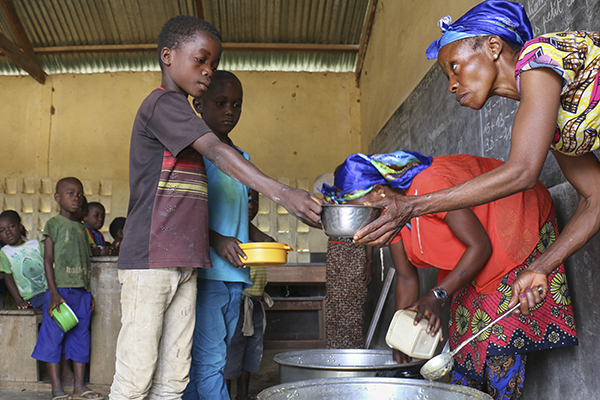
Smallholder farmers in the Republic of Congo face numerous challenges – from limited market access to insufficient support systems. These farmers, who cultivate cassava, bananas, and other staple crops, are the backbone of the nation’s food sector. However, they have often been marginalized, struggling to bring their produce to market and sustain their families.
To address local farmer’s needs, the IBSA Fund launched the project Enhancing Family Farmers’ Access to Local Markets in the Republic of Congo through South-South Cooperation in collaboration with the World Food Programme (WFP).
The project is set to advance the livelihoods of smallholder farmers by creating new avenues for them to thrive in local markets. At the core of this initiative lies a powerful component: integrating home-grown school feeding (HGSF) programmes to fuel both education and local agriculture, aiming to uplift these farmers by enhancing their market access and boosting their economic resilience.
The primary beneficiaries of this initiative are not just the farmers but also the key governmental bodies driving agricultural and educational policy. The Ministry of Agriculture, Livestock, and Fisheries, alongside the Ministry of Preschool, Primary, Secondary Education, and Literacy, are at the helm of this ambitious project. Their role is pivotal in coordinating local food procurement for the national HGSF programme and providing critical support to smallholder producers. By focusing on value chains of, for example cassava and banana, and emphasizing the empowerment of women and children, this project aims to support a sustainable and inclusive agricultural ecosystem.
A cornerstone of the project’s strategy is leveraging South-South and triangular cooperation, a dynamic model of collaboration between countries facilitated by WFP, together with other partners. This cooperation allows the Republic of Congo to tap into the wealth of knowledge and innovative practices from other countries in the Global South, particularly Brazil.
In a landmark visit in March 2024, representatives from the Congolese Government traveled to Brazil to immerse themselves in the country’s successful agricultural and school feeding initiatives. Brazil’s National School Feeding Program (PNAE) is globally recognized for its ability to seamlessly connect local producers with school feeding schemes, creating a win-win scenario for both farmers and students.
“We drafted a school feeding policy, requesting the Government to lead the implementation of the school feeding program. This challenge led us, along with WFP, to visit Brazil,“ said Mr. Aimé Blaise Nitoumbi, Director General of Development and Partnerships at the Ministry of Planning, Statistics, and Regional Integration. “In this process, we count on the support of our partners, Brazil and WFP. Currently, in the Republic of Congo, school feeding is not yet a consolidated programme but an initiative supported by WFP and endorsed by the Government. It is important to move forward to implement an effective program. In the next phase, we will work in collaboration with WFP to explore possible additional actions, including issues of child nutrition.”
By leveraging South-South and triangular cooperation, Mr. Nitoumbi and his team witnessed firsthand how Brazil’s school feeding program integrates local agricultural production, ensuring that children receive nutritious meals, while also supporting local farmers. This holistic approach not only nourishes young minds but also strengthens the local economy, creating a cycle of prosperity.
The next step for the Republic of Congo’s school feeding programme is to review the school feeding policy and elaborate a multisectoral strategy for implementing school feeding and integrating aspects observed in Brazil, such as enhancing the inclusion of indigenous people and making school menus more culturally appropriate.
“We will review our school feeding policy to incorporate the valuable lessons learned in Brazil, ensuring they are adapted to meet the needs of our local context. This will help us build a more effective and inclusive program that benefits our children and supports our local farmers,” Mr. Nitoumbi said.
With continued support and a commitment to inclusive growth, this initiative demonstrates the power of South-South cooperation and shows the potential of collaboration and innovation in creating a lasting change, improving school children’s access to nutritious meals and supporting farmers’ access to local and regional markets.