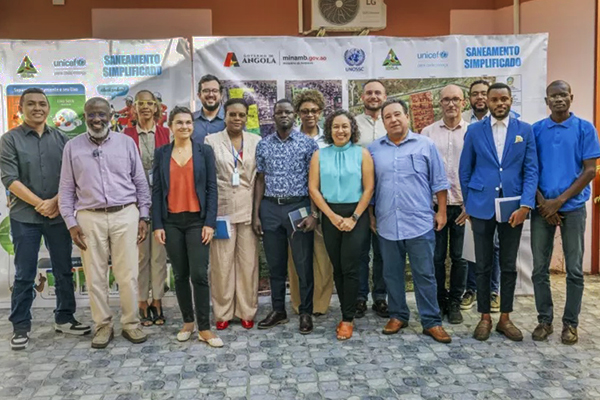
Between November 25 and 30, a technical mission from Brazil took place in the Municipality of Viana, Angola. The mission was implemented as part of the Trilateral South-South Cooperation project “Simplified Sanitation in the Municipality of Viana”.
Funded by the IBSA Fund, the initiative aims to share innovative practices in sanitation and solid waste management, focusing on local entrepreneurship and community empowerment.
The technical delegation was composed by representatives from the Brazilian Cooperation Agency of the Ministry of Foreign Affairs (ABC/MRE), the Water and Sewerage Company of the State of Ceará (CAGECE), the National Health Foundation (FUNASA), the Ceara State Secretariat of Cities (SCidades-CE), and UNICEF Brazil. The mission entailed field visits and as well as the III Annual Meeting of the Steering Committee, in which the 2025 work plan was approved.
The mission also entailed sharing of key lessons learned from implementation in 2024, focused on community engagement, which is one of the most curial elements of the initiative.
The ABC/MRE representative Hugo Leão highlighted the importance of cooperation and dialogue during this critical phase of the project: “The dedication and commitment of government authorities and UNICEF have been essential to the progress achieved so far. We are now at the most critical stage of implementation, which involves initiating the engineering design. This will require even more efforts from all Angolan entities involved.”
Representing the Angolan government, Hassana Lima, Director of the National Environmental Management Institute, highlighted the government’s commitment to promoting sanitation and called for collective action: “The simplified sanitation is not just a local project. The products we are developing are being used by other stakeholders. This means we must work to ensure success and make this technology part of the solution.”
During a field visit in the local community, local resident Dias Januário expressed the community’s enthusiasm: “This project is a blessing, but we must be patient. Often, we are skeptical because many things in Angola start but do not finish. However, we see this project moving forward, and we must believe in it.”
The Project
Launched in 2022, the project promotes affordable sanitation technologies and strengthens the resilience of the Mulenvos community to environmental challenges and climate change. Additionally, it seeks to reduce child mortality and build local capacity, uniting efforts from Angola, Brazil, and UNICEF for a more sustainable future.
Water, sanitation, and hygiene services are high-priority areas for the Angolan government to improve the population’s quality of life. Considering this context, the project has worked since 2022 to increase sustainable access to basic sanitation services. This includes implementing simplified wastewater treatment systems, coupled with a solid waste management program and initiatives to foster sustainable behavior change regarding hygiene and proper waste disposal.
The project also integrates innovative construction technologies with community, local, and provincial government support, alongside development policies. Simplified sanitation introduces a new approach by fostering local solutions to local problems through dialogue among sector stakeholders, including governments, service providers, users, and donors.
The project also aims to enhance technical skills and strengthen the institutional capacity of public and private entities involved in urban and peri-urban sanitation. Additionally, it seeks to empower grassroots civil society organizations in the area of the simplified sanitation, as well as solid waste management through recycling (5R—Rethink, Reuse, Refuse, Reduce, Recycle), within a circular economy framework. These efforts are grounded in knowledge-sharing with institutions participating in the initiative.
Source: https://www.unicef.org/angola/en/press-releases/south-south-cooperation-mission-angola-advances-innovative-practices-sanitation-and