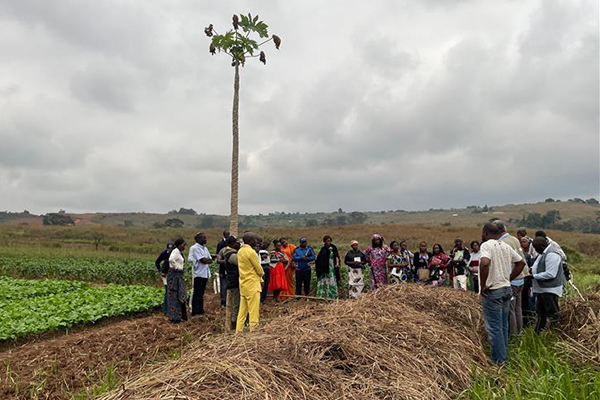
Brazzaville – A South-South and triangular cooperation initiative supported by the India-Brazil-South Africa Fund for the Alleviation of Poverty and Hunger is helping the Republic of the Congo turn school meals into a driver of rural transformation, linking family farmers to stable local markets while improving children’s nutrition and education outcomes.
The project, “Strengthening access to local markets for family farmers in the Republic of Congo through South-South Cooperation,” brings together the IBSA Fund, the Government of the Republic of the Congo, the Government of Brazil and the World Food Programme (WFP), with the United Nations Office for South-South Cooperation serving as the IBSA Fund’s manager and secretariat. Backed by nearly USD 1 million in IBSA financing, the two-year pilot – known locally as “Seeds for Tomorrow” – demonstrates how public procurement for school feeding can simultaneously strengthen national systems, empower farmers and build human capital.
At the heart of the initiative is a “home-grown school feeding” model: schools purchase food directly from local family farmers, creating predictable demand that enables smallholders to invest in production, storage and delivery. Technical support has been provided through WFP’s Centre of Excellence against Hunger in Brazil, drawing on lessons from Brazil’s nationally owned school feeding architecture.
Building national systems
Beyond service delivery, the project invested in institutional capacity to anchor local procurement within national policy frameworks. Sixty-five policymakers and technical staff from the Ministries of Agriculture and Education were trained through workshops, technical exchanges and study missions. Topics included agricultural market analysis, pricing and procurement protocols for family farming products, and monitoring and evaluation systems inspired by Brazil’s National School Feeding Programme (PNAE).
Four technical manuals were developed and validated, covering agricultural policy options, operational steps for purchasing from family farmers, monitoring and evaluation mechanisms, and “social control” systems to strengthen transparency and community participation. These tools provide a practical roadmap for scaling up the nationally owned programme.
The initiative has also generated important policy signals. In February 2025, the Republic of the Congo formalized its commitment to the Global School Meals Coalition, reinforcing high-level political support for expanding school feeding nationwide. Later that year, Decree No. 2025-450 established a national interministerial Task Force under the supervision of the Prime Minister to coordinate school feeding across sectors, embedding agriculture, education and nutrition within an integrated governance framework.
Empowering family farmers
At the community level, the project worked directly with more than 10 agricultural cooperatives across the departments of Bouenza, Pool and Plateaux, representing around 100 family farmers. Cooperatives received irrigation equipment, storage facilities and small-scale machinery, alongside training in production planning, savings management and market access.
For farmers, supplying local schools has meant more than new buyers – it has meant stability. With predictable contracts, cooperatives have expanded cultivated areas, improved yields and strengthened their ability to meet quality and delivery standards. Women-led groups in particular reported gains in income security and household food availability.
As one cooperative member in Bouenza noted, proximity to schools reduces transport costs and strengthens ties between producers and communities, keeping value circulating locally rather than flowing outward through imported food supply chains.
Improving education and nutrition
The pilot reached 10 schools and approximately 3,000 students, equipping facilities to safely store and prepare nutritious, locally sourced meals, including staples such as cassava. School staff received training in food handling and programme management to ensure quality and accountability.
The educational impact has been tangible. Schools in Mouyondzi and Gamboma reported increases in enrolment and attendance, with some recording significant improvements in examination pass rates. By reducing short-term hunger and improving diet quality, school meals are enhancing concentration and learning, while also acting as a social protection measure for vulnerable families.
A model for South-South cooperation
Partners describe the initiative’s most significant contribution as both technical and paradigmatic. Locally sourced school feeding has been positioned not simply as a feeding modality, but as a policy instrument that connects agriculture, nutrition, education and rural employment. In doing so, it reflects the core principles reaffirmed in the Nairobi Outcome Document: national ownership, equality, mutual benefit and non-conditionality.
A final evaluation published in late 2025 confirmed that planned targets were achieved and that the model is operationally viable in the Congolese context. A 2025-2030 transition plan is now under preparation to expand the approach to additional schools, while gradually shifting WFP’s role from direct implementation toward technical assistance as national systems assume greater responsibility.
For communities in Bouenza, Pool and Plateaux, the results are immediate: children eat better, family farmers gain reliable markets, and institutions are better equipped to deliver integrated services. In the broader South-South cooperation community, the initiative offers practical evidence that solidarity – translated into locally rooted systems – can generate measurable development impact.