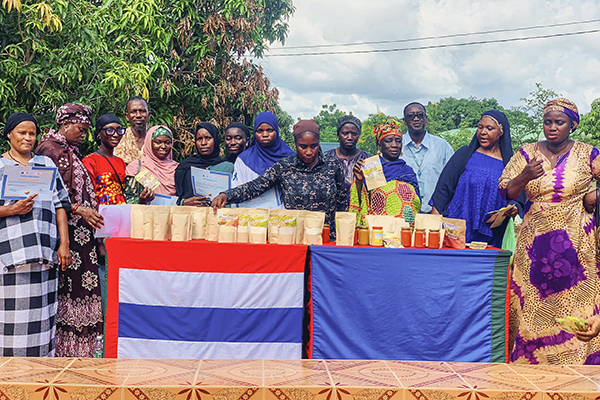
Fifteen young women and men from different parts of The Gambia recently completed a one-week training on vegetable processing and packaging in Jenoi, Lower River Region. The training was part of a project supported by the Food and Agriculture Organization (FAO) and funded by the India-Brazil-South Africa (IBSA) Fund. The IBSA support will assist rural youth and women to reduce post-harvest losses and start small agribusinesses.
The project, called “Enhanced Vegetable Production and Processing for Rural Women and Youth in The Gambia”, is led by the Ministry of Agriculture, Livestock and Food Security and the Ministry of Youth and Sports. It focuses on improving vegetable production, training farmers, promoting value addition, and linking them to markets. One of the main issues the project is tackling is post-harvest losses, where vegetables go bad before they can be sold. A recent survey showed that about 76% of farmers lose part of their harvest every year. The intervention supports FAO’s Better Production, Better Nutrition and a Better Life.
“We realized that without addressing post-harvest management, productivity gains would mean little. This training directly equips youth with practical solutions to preserve their harvests and increase income,” said Mustapha Ceesay, Assistant FAO Representative (Programmes), speaking on behalf of Moshibudi Rampedi, FAO Representative in The Gambia.
The training was led by Food Technology Services (FTS) from the Ministry of Agriculture, Livestock and Food Security. It combined class lessons and hands-on activities. Participants learned how to clean, cut, dry, treat, and package vegetables properly. They also got tips on phytosanitary measures, food safety, and how to make their products attractive and appealing for the market.
“We walked them through the entire production chain, from cleaning and cutting to drying and packaging. Cleanliness and food safety were emphasized throughout,” said Fatou Darboe, lead trainer from FTS. “The results exceeded our expectations. These young people were eager to learn and quick to adapt.”
During the training, participants made several types of processed goods like dry spices, pepper sauce, millet-based sweets, and baobab-cowpea mixes. These can be sold in local markets or stored for future use, helping reduce waste and increase income.
“We came here as farmers with little processing skills and we’re leaving as skilled processors,” said Jainaba Mbaye, a participant from Central River Region. “Now, instead of throwing away spoiled vegetables, we can turn them into products that earn money. This is a big step for our families and communities.”
The training is just one part of the IBSA-funded project. It also includes support for vegetable farming, irrigation, training in good farming practices, and helping young farmers organize themselves into groups or cooperatives to better access markets and funding.
“These interventions are creating lasting change,” said Lamin Sanyang, Regional Director of Agriculture for Lower River Region. “Some of the products we’ve seen here today could compete internationally with proper branding and consistency.”
Now that the training is done, the next step is to help the youth find places to sell their products and get support to grow their small businesses. The IBSA funded “Enhanced Vegetable Production and Processing for Rural Women and Youth in The Gambia”, Project supports the policy mandates Ministry of Agriculture, Livestock and Food Security as well as the Ministry of Youth and Sports; it will continue working with them to make sure the skills they learned are put to good use.
Source: https://www.fao.org/gambia/news/detail/young-gambian-food-processors-gain-new-skills-to-tackle-post-harvest-losses-and-unlock-agribusiness-potential/en