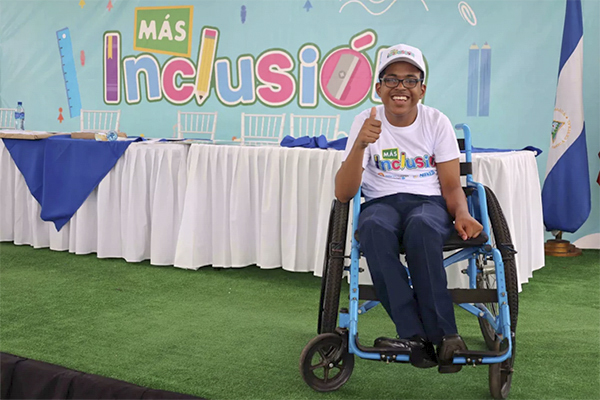
The Ministry of Education (MINED) in Nicaragua, with the support of UNICEF, has unveiled its latest initiative, the ‘More Inclusion’ Communication Strategy for Social and Behavioral Change to foster seamlessly integrating girls, boys, and adolescents with disabilities into the nation’s education system. With a focus on inclusivity, this effort marks a significant stride towards ensuring every child receives the opportunity to thrive academically.
At the heart of the announcement was the inspiring story of Josué, a determined student navigating the challenges of a motor physical disability. Josué, who attends the Experimental Public School Mexico, took the opportunity to share his uplifting journey.
“This beautiful experience,” Josué passionately expressed, “has been transformative, thanks to the exceptional educational inclusion strategies implemented by our dedicated teachers. These strategies have not only enabled me to excel but also to proudly represent my school. They’ve shown me, and indeed all of us, that disabilities do not define our capabilities. We all possess the warrior spirit within us, and with education as our most valuable inheritance, we’re equipped to face life’s challenges head-on.”
UNICEF has been instrumental in both the design and execution of the communication strategy, aimed at enhancing the educational system’s capacity to include students with disabilities. A notable achievement of this collaboration is the establishment of 15 prototype centers, epitomizing the very essence of inclusive education.
H.E. Lilliam Herrera, the Minister of Education, echoing the sentiment of collective responsibility and determination, said: “Our commitment extends beyond the confines of government institutions; it’s about ensuring that individuals with disabilities are provided with the support they need. Together, we have made great strides, and our resolve remains unwavering. We will continue our efforts until Nicaragua sets a new benchmark for inclusivity“.
Funded by UNICEF and the Government of India within the framework of the South-South cooperation of UNOSSC, this initiative is part of a broader project titled ‘Strengthening institutional capacities for the successful inclusion of boys and girls with disabilities in the education system’. With an investment of US$1,200,000, it’s a testament to the international commitment to fostering environments where children, irrespective of their abilities, can learn and grow together.
“We must work so that everyone, at all levels, from families to institutions, improve our knowledge and inclusive practices, so that children and adolescents, with and without disabilities, share spaces and develop, have fun, grow, and learn from each other, together, with more inclusion,” emphasized Eduardo Gallardo, Officer in Charge of UNICEF Nicaragua.
This story has been translated from the original version posted by UNICEF Nicaragua