Located in northeastern Honduras, the Gracias a Dios Department is perhaps the most remote and difficult-to-reach region in the country. Reachable only by air or local watercraft, its communities – home to the Miskito people – have faced generations of isolation from basic services. Only 18.5% of households in Gracias a Dios have access to basic Water, Sanitation and Hygiene (WASH) services, far below the national average of 67.4%. Diarrhea, a waterborne disease directly linked to unsafe water and poor sanitation, is the third leading cause of death among children under five years of age, according to the World Health Organization.
With support from the India-UN Development Partnership Fund, UNICEF Honduras and its partners are working to change this. The two-year programme for safe access to climate-resilient WASH services in Gracias a Dios targets eight communities in the area surrounding the Caratasca Lagoon – where deprivation is most acute – including Yahurabila, Pruhnitara, Puswaya, Krata, Uhi and Aurata. These communities lie along a narrow strip of land separating the freshwater lagoon from the Caribbean Sea, accessible only by boat or traditional kayuko. Attempts to construct groundwater wells often yield contaminated water due to proximity to the sea, and water treatment for drinking and household use is not yet common practice.
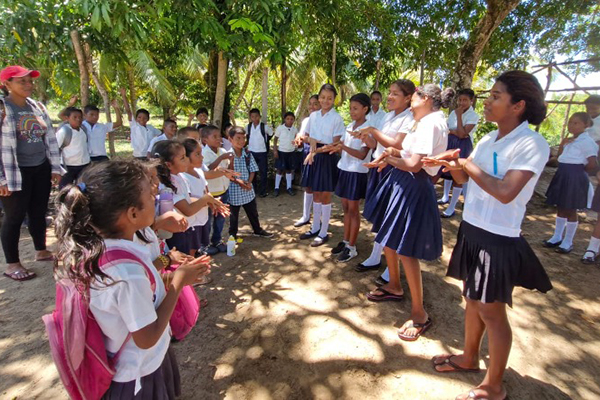
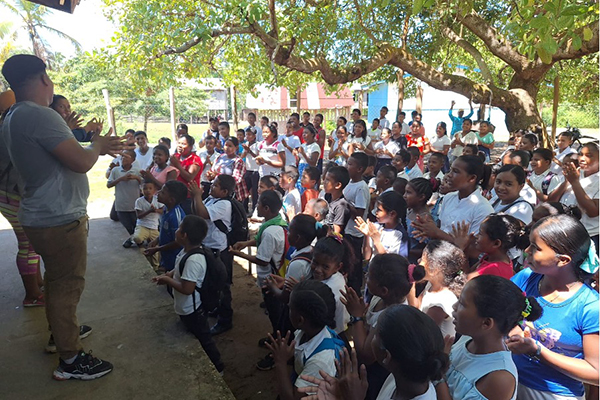
The programme reaches 15,000 people with awareness raising and promotion of healthy WASH habits, including menstrual hygiene, of whom 10,000 will also benefit from improvements to WASH facilities and support for local water quality monitoring. By September 2025, 3,000 people had already been reached with knowledge on safe WASH practices, with positive behavioural change documented through regular home visits by trained community volunteers.
A cornerstone of the initiative is community ownership and capacity transfer. To date, 185 community volunteers – mothers, fathers and caregivers – have been trained with practical tools they can apply at home: safe water treatment, personal hygiene, and the production of basic supplies. Artisanal soap-making was among the skills taught during the workshops. “In my life, I had never thought that I could make soap at home,” said an elderly participant from Krata.
The programme tackles menstrual hygiene – a subject still largely taboo in the region. Volunteers were trained to produce reusable sanitary pads from materials readily available at home, offering an affordable and dignified alternative in communities where commercial products are scarce and expensive. The cultural shift is already visible: in one workshop in Krata, a male community member chose to participate and was photographed with evident pride as he sewed a sanitary pad – a small but telling sign that community attitudes are beginning to change. Because the pads are made by girls and women themselves, they feel comfortable and safe to use them.
 WASH facilities across the targeted communities are being improved through low-cost, technically sound and sustainable solutions, designed jointly with a Local Technical Committee comprising the Ministries of Education and Health, the Municipality and Indigenous Territorial Councils. Health technicians have been trained in water treatment, disinfection and quality monitoring, guided by a participatory workplan developed from a shared analysis of sector challenges and local solutions.
South-South knowledge exchange between UNICEF India and UNICEF Honduras has played a significant role in identifying these locally appropriate solutions. India’s extensive experience in community-based WASH programming – including low-cost water treatment, volunteer-led behaviour change models and context-specific hygiene promotion – has been adapted to the realities of La Mosquitia, demonstrating the value of peer learning across the Global South.
Significant challenges remain. The operating conditions in Gracias a Dios are among the most difficult in Central America, and access constraints continue to affect the pace and cost of delivery. Through this initial phase, UNICEF is building a collaborative platform of strategic alliances, strengthened local capacities and improved logistics – the foundation for consolidation and scale-up of a programme designed to ensure a healthy and safe environment for the most disadvantaged children in Honduras.
The initiative is supported by the India-UN Development Partnership Fund, managed by the United Nations Office for South-South Cooperation (UNOSSC), and contributes to Sustainable Development Goals 3 (Good Health and Well-being), 5 (Gender Equality), 6 (Clean Water and Sanitation), 10 (Reduced Inequalities) and 17 (Partnerships for the Goals).
Source: UNICEF Honduras. Original human interest story by Fernando Herrera: www.unicef.org/honduras
WASH facilities across the targeted communities are being improved through low-cost, technically sound and sustainable solutions, designed jointly with a Local Technical Committee comprising the Ministries of Education and Health, the Municipality and Indigenous Territorial Councils. Health technicians have been trained in water treatment, disinfection and quality monitoring, guided by a participatory workplan developed from a shared analysis of sector challenges and local solutions.
South-South knowledge exchange between UNICEF India and UNICEF Honduras has played a significant role in identifying these locally appropriate solutions. India’s extensive experience in community-based WASH programming – including low-cost water treatment, volunteer-led behaviour change models and context-specific hygiene promotion – has been adapted to the realities of La Mosquitia, demonstrating the value of peer learning across the Global South.
Significant challenges remain. The operating conditions in Gracias a Dios are among the most difficult in Central America, and access constraints continue to affect the pace and cost of delivery. Through this initial phase, UNICEF is building a collaborative platform of strategic alliances, strengthened local capacities and improved logistics – the foundation for consolidation and scale-up of a programme designed to ensure a healthy and safe environment for the most disadvantaged children in Honduras.
The initiative is supported by the India-UN Development Partnership Fund, managed by the United Nations Office for South-South Cooperation (UNOSSC), and contributes to Sustainable Development Goals 3 (Good Health and Well-being), 5 (Gender Equality), 6 (Clean Water and Sanitation), 10 (Reduced Inequalities) and 17 (Partnerships for the Goals).
Source: UNICEF Honduras. Original human interest story by Fernando Herrera: www.unicef.org/honduras
WASH facilities across the targeted communities are being improved through low-cost, technically sound and sustainable solutions, designed jointly with a Local Technical Committee comprising the Ministries of Education and Health, the Municipality and Indigenous Territorial Councils. Health technicians have been trained in water treatment, disinfection and quality monitoring, guided by a participatory workplan developed from a shared analysis of sector challenges and local solutions.
South-South knowledge exchange between UNICEF India and UNICEF Honduras has played a significant role in identifying these locally appropriate solutions. India’s extensive experience in community-based WASH programming – including low-cost water treatment, volunteer-led behaviour change models and context-specific hygiene promotion – has been adapted to the realities of La Mosquitia, demonstrating the value of peer learning across the Global South.
Significant challenges remain. The operating conditions in Gracias a Dios are among the most difficult in Central America, and access constraints continue to affect the pace and cost of delivery. Through this initial phase, UNICEF is building a collaborative platform of strategic alliances, strengthened local capacities and improved logistics – the foundation for consolidation and scale-up of a programme designed to ensure a healthy and safe environment for the most disadvantaged children in Honduras.
The initiative is supported by the India-UN Development Partnership Fund, managed by the United Nations Office for South-South Cooperation (UNOSSC), and contributes to Sustainable Development Goals 3 (Good Health and Well-being), 5 (Gender Equality), 6 (Clean Water and Sanitation), 10 (Reduced Inequalities) and 17 (Partnerships for the Goals).
Source: UNICEF Honduras. Original human interest story by Fernando Herrera: www.unicef.org/honduras