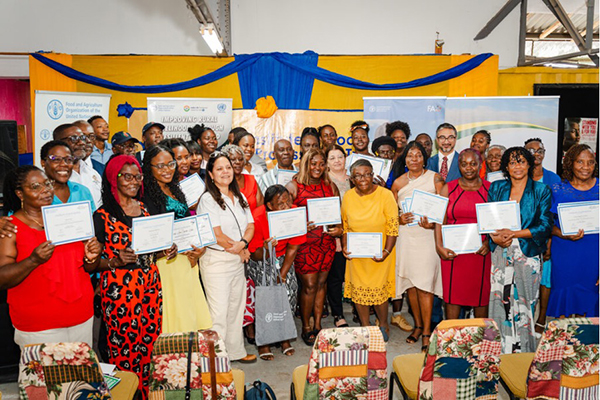
Over 200 participants completed a series of capacity-building trainings in Jamaica in February 2026, marking a significant milestone for the “Improving Rural Livelihoods Through Resilient Agrifood Systems” project. The training completion ceremony, held at the Institute of Vocational and Professional Training (IVTPA) in Spring Village, St. Catherine, brought together farmers, students, technical officers and partners who have engaged with the programme since its inception.
Funded through the India-UN Development Partnership Fund and implemented by the Food and Agriculture Organization (FAO) in collaboration with the Government of Jamaica, the project aims to strengthen rural development and build climate-resilient agrifood systems in St. Catherine – one of Jamaica’s key agricultural parishes. To date, 201 beneficiaries across the district have been equipped with practical skills spanning livestock management, entrepreneurship, protected agriculture, food safety, animal housing construction, photovoltaic installation and training delivery.
Speaking at the ceremony, FAO Representative in Jamaica Dr. Ana Touza commended participants for the visible impact of their learning within the Kitson Town community. “Your journey has shown that rural development thrives when knowledge becomes action. We at FAO are incredibly proud to witness how all participants have embraced the programme, retaining, transferring, and applying what they have learned to transform their farms, households and community,” she said.
Dr. Touza also highlighted the project’s significance in the context of the United Nations’ designation of 2026 as the International Year of the Woman Farmer. “Through this project, women not only participated – they expanded their livelihoods, upskilled across multiple disciplines, accessed technical assistance and became part of wider production, business and support networks. When women farmers are equipped with skills, resources and networks, local economies grow stronger, communities become more resilient, and development outcomes are more sustainable.”
Indian High Commissioner Mayank Joshi also commended the success of the programme, highlighting the diverse training components that have contributed to the sustainability and resilience of the Kitson Town community.
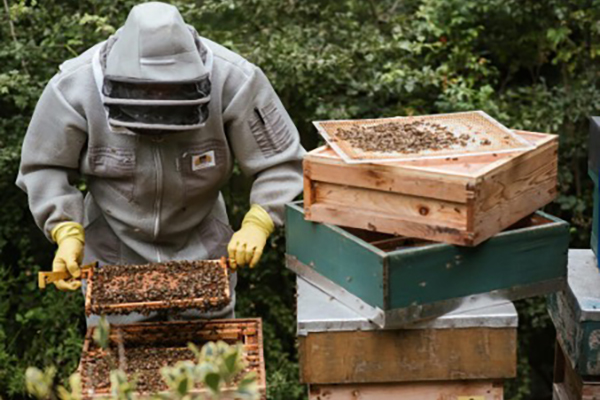
The project’s training delivery drew on the expertise of a coalition of national partners. The Spring Village Development Foundation led livestock production training, covering poultry, small ruminants, pigs and beekeeping. The Jamaica Business Development Corporation (JBDC) and Junior Achievement Jamaica (JAJ) delivered entrepreneurship and business development modules, supporting participants in financial literacy, business planning and agri-entrepreneurship. The Agro-Invest Corporation led the protected agriculture component, while the Ministry of Agriculture’s Bodles Research Station led beekeeping training. Students from St. Catherine High School and Tacius Golding High School also benefited from entrepreneurship training with JAJ, and 12 students from Tacius Golding received specialised training in greenhouse installation and crop management following the renovation of a greenhouse facility.
Participant Nadia McKenzie, a pig farmer, described the tangible difference the programme has made. “I was in the pig area before, but I didn’t know how to care for them. I have lost a lot. Being in the pig programme has helped me move forward – to know what to do when it comes to caring for pigs, how to prepare the sow for birth. I didn’t know I was supposed to use gloves, scissors and other tools.”
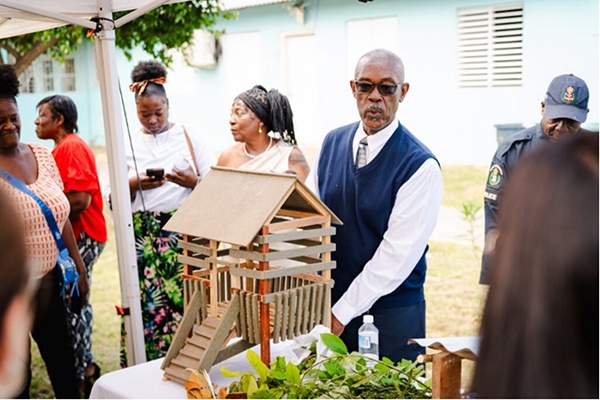
Beyond training, the project has delivered concrete infrastructure and inputs to support participants engaged in livestock. Three poultry demonstration sites and one goat house have been constructed; one goat house and one pig house have been renovated; and 2,450 broiler chicks, goats and piglets have been distributed along with over 300 bags of feed and beekeeping equipment. Current activities include the installation of 14 greenhouse models – incorporating plant nurseries, hydroponic units and small-scale irrigation systems – for select beneficiaries.
The completion of this training cycle builds on earlier phases, including poultry management training, which have progressively strengthened the capacity of small farmers and encouraged the inclusive participation of women and youth. The project represents a practical demonstration of South-South cooperation in action: drawing on FAO’s expertise across both India and Jamaica to develop locally appropriate, cost-effective and sustainable solutions for rural communities.