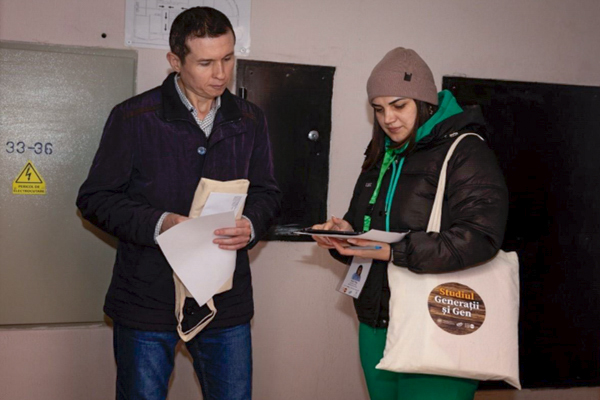
In Moldova, policymakers today can rely on integrated, real-time national statistics to inform planning across public health, education, and social protection – especially for women and girls. This transformation stems from a project supported by the India-UN Development Partnership Fund, managed by the United Nations Office for South-South Cooperation (UNOSSC) and implemented by UNFPA Moldova in close partnership with the National Bureau of Statistics and national institutions.
The initiative has modernized Moldova’s data management infrastructure and made the country’s statistical system more resilient to crises – enabling evidence-based decisions that directly improve people’s lives.
For many years, Moldova’s statistical ecosystem operated through separate systems and traditional methodologies. Census and survey data were managed independently, which made it more challenging to generate timely and comprehensive information. The need for more integrated and agile data systems became especially clear during emergencies such as the COVID-19 pandemic, when rapid and accurate information was vital to guide decisions and protect vulnerable populations.
With support from the India-UN Development Partnership Fund, Moldova embarked on an ambitious effort to modernize its statistical systems. The project integrated 24 national databases into a unified framework capable of supporting register-based censuses and surveys. This innovation has dramatically reduced the costs and time required for large-scale data collection, while improving coverage and reliability.
To sustain these advances, more than 50 statisticians, demographers, and IT professionals received specialized training, equipping them to manage and expand the new systems. South-South knowledge exchange played a vital role: Moldovan experts drew on experiences from peer countries that had already adopted register-based systems, adapting proven methods to the national context.
Beyond technical improvements, the project has transformed how evidence is used for policymaking. Moldova can now generate comprehensive, disaggregated data to inform more inclusive social and economic policies – ranging from maternal health and youth employment to care for aging populations.
The National Bureau of Statistics has institutionalized these practices, embedding them in its long-term strategy for sustainable development.
By strengthening data-driven governance, the initiative advances Sustainable Development Goal (SDG) 16 on effective, accountable institutions and SDG 17 on global partnerships. It demonstrates how South-South cooperation can drive innovation, build institutional resilience, and enable countries like Moldova to plan confidently for a more inclusive and sustainable future.